Skittles, ninepins, & other 18th century bowling games
© The Trustees of the British Museum. Shared under a Creative Commons Attribution-NonCommercial-ShareAlike 4.0 International (CC BY-NC-SA 4.0) licence.
Le Jeu de quilles tapestry woven by Willem Werniers, c. 1691-1710
A dancing couple in an outdoor musical party by Joseph François Nollekens
Apes playing skittles by Leonard Schenk, c. 1720
A game of skittles by Pieter Angellis, 1727
Playing skittles in front of an inn by Franz Josef Textor, c. 1727-1741
Bowling at an inn by Jan Josef Horemans, c. 1729-1760
The Enraged Vixen of a Wife, or The Play of Skittles by Francis Hayman, c. 1735-1745
Lustig und frölich inß gemein from the album of Johann Franz Hörmannsperger, 1736
Gentlemen Playing Skittles by Balthasar Nebot, 1740
Children at play in a garden, Augsburg, c. 1751-1800
Saint Monday in the Afternoon, or All Nine and Swallow the Bowl, 1770s
Four Corners, Played at the Swan, Chelſea, 1771
Sir William Pepperrell and his family by John Singleton Copley, 1778
Miss Tipapin Going for All Nine, 1779
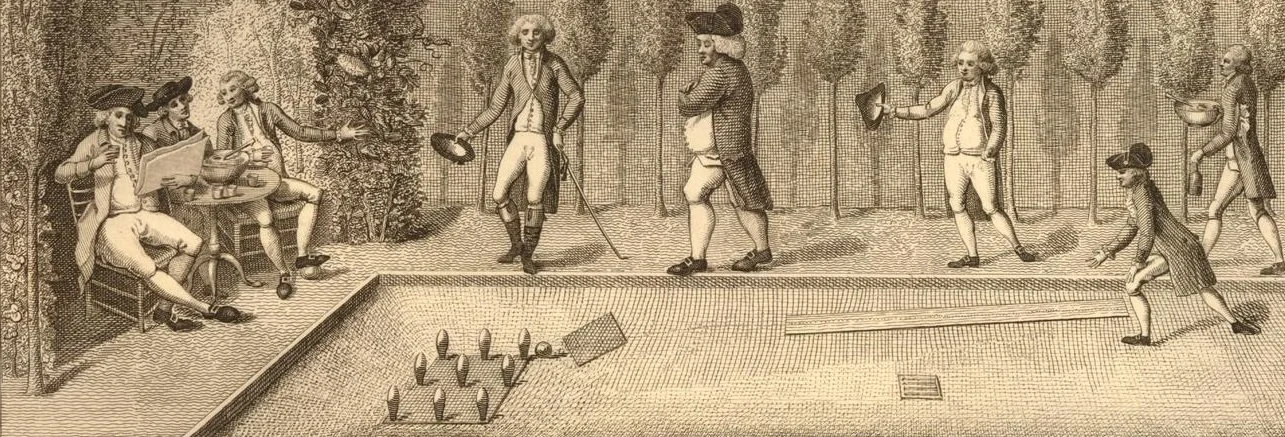
The Laws of the Game of Dutch-Pins, 1787
Rules and Instructions for Playing at Skittles By a Society of Gentlemen, 1786
Reformation, or Their Worships Grubbing Up a Skittle Ground, 1787
A game of skittles at the Adam and Eve Tea Gardens at St. Pancras, north London by Thomas Rowlandson, 1790
Additional Resources
This site contains affiliate links for which I may be compensated
The art of playing at skittles: or, the laws of nine-pins displayed (1773)
Skittles – History and Useful Information
A Recreation to Great Persons: Bowling in Colonial Boston
History of Early American Landscape Design: Bowling green
Marble Hill Revived Archaeology: Nine Pin Bowling Alley
History of Bowling and Billiards
More Than 'Just a Game': Bowling's "Role" Throughout History