Chaussons: 18th Century Slipper Socks
This is a collection of notes on chaussons, a style of 18th century slipper-socks produced in France. I’m still looking for more examples, illustrations, and references. I’d like to understand who was wearing chaussons, how & when they were worn, etc.
Until I can find additional sources & references, I’m saving my notes here.
Defining Chaussons
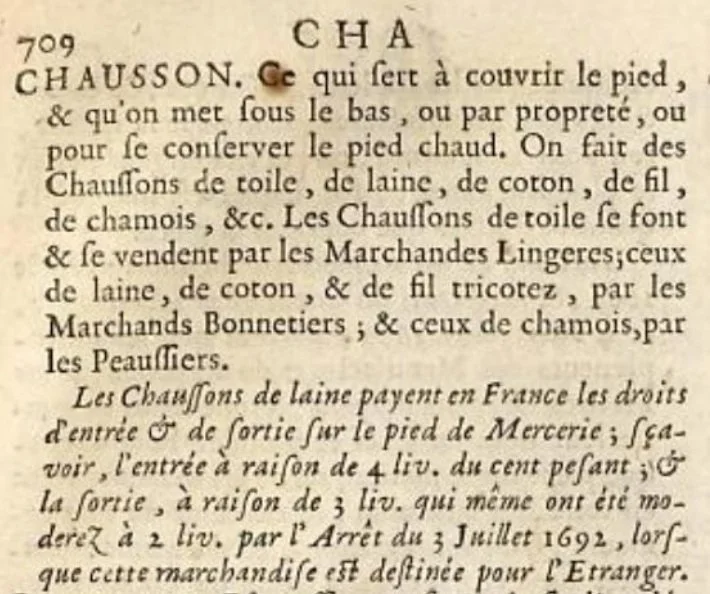
This definition comes from the Dictionnaire universel de commerce (1723):
This is something used to cover the foot, and which is worn under the stocking, either for cleanliness or to keep the feet warm. Chaussons are made of linen, wool, cotton, thread, chamois leather, etc. Linen chaussons are made and sold by Marchandes Lingeres; those of wool, cotton, and knitted thread by Marchandes Bonnetiers (hosiers); and those of chamois leather by Peaussiers (leatherworkers).
Woolen slippers are subject to import and export duties in France, classified under the category of mercery; namely, an import duty of 4 livres per hundredweight, and an export duty of 3 livres, which was even reduced to 2 livres by the Decree of July 3, 1692, when this merchandise is destined for export.
Chaussons are also referenced in the Encyclopédie ou Dictionnaire raisonné des sciences, des arts et des métiers (1752) s.n. bonneterie (translation: hosiery).
Garsault’s Chaussons
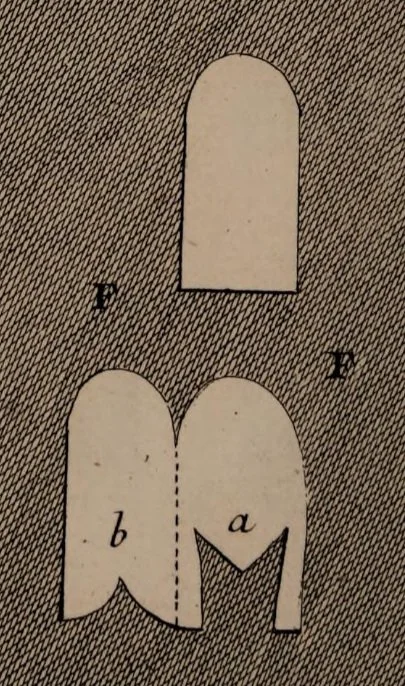
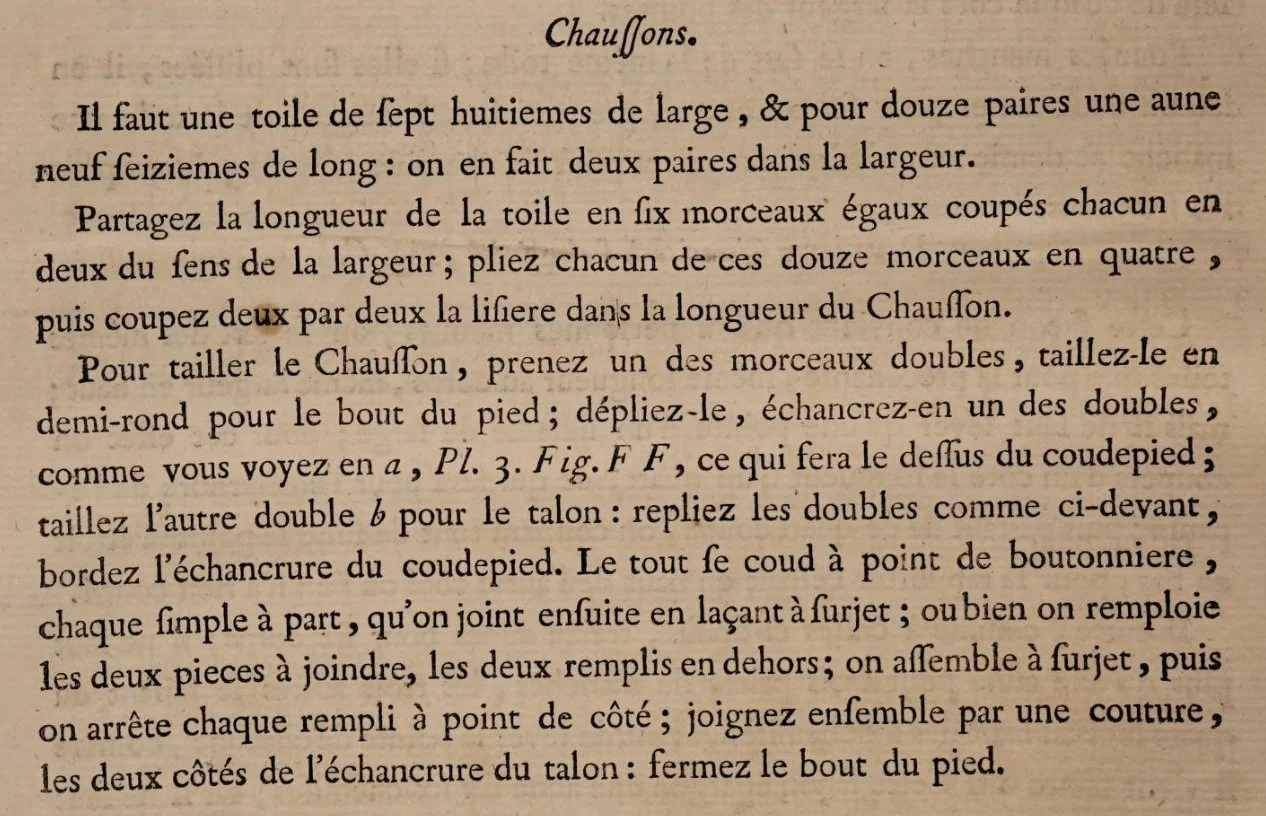
Garsault wrote about how to make chaussons in L'art de la lingere (1771).
You need a piece of fabric seven-eighths of an aune wide for twelve pairs, and one and nine-sixteenths yards long: two pairs are made from the width. Divide the length of the fabric into six equal pieces, each cut in half lengthwise; fold each of these twelve pieces into four, then cut the selvage two by two along the length of the chausson.
To cut the chausson, take one of the double pieces, cut it in a semicircle for the toe; unfold it, notch one of the double layers, as you see in a, Pl. 3, Fig. F F, which will form the instep; cut the other double layer b for the heel: refold the double layers as before, and edge the instep notch. The whole thing is sewn with buttonhole stitch, each single piece separately, which are then joined by lacing with overcast stitch; or you can fold the two pieces to be joined, with both folds on the outside; assemble with overcast stitch, then secure each fold with a side stitch; join the two sides of the heel notch together with a seam; close the toe.
(As a side note: the pointed vamp reminds me of V&A T.502 to A-1913, a later pair of embroidered woolen slippers, though they have a square toe.)
Thomas Jefferson’s Slipper-Socks
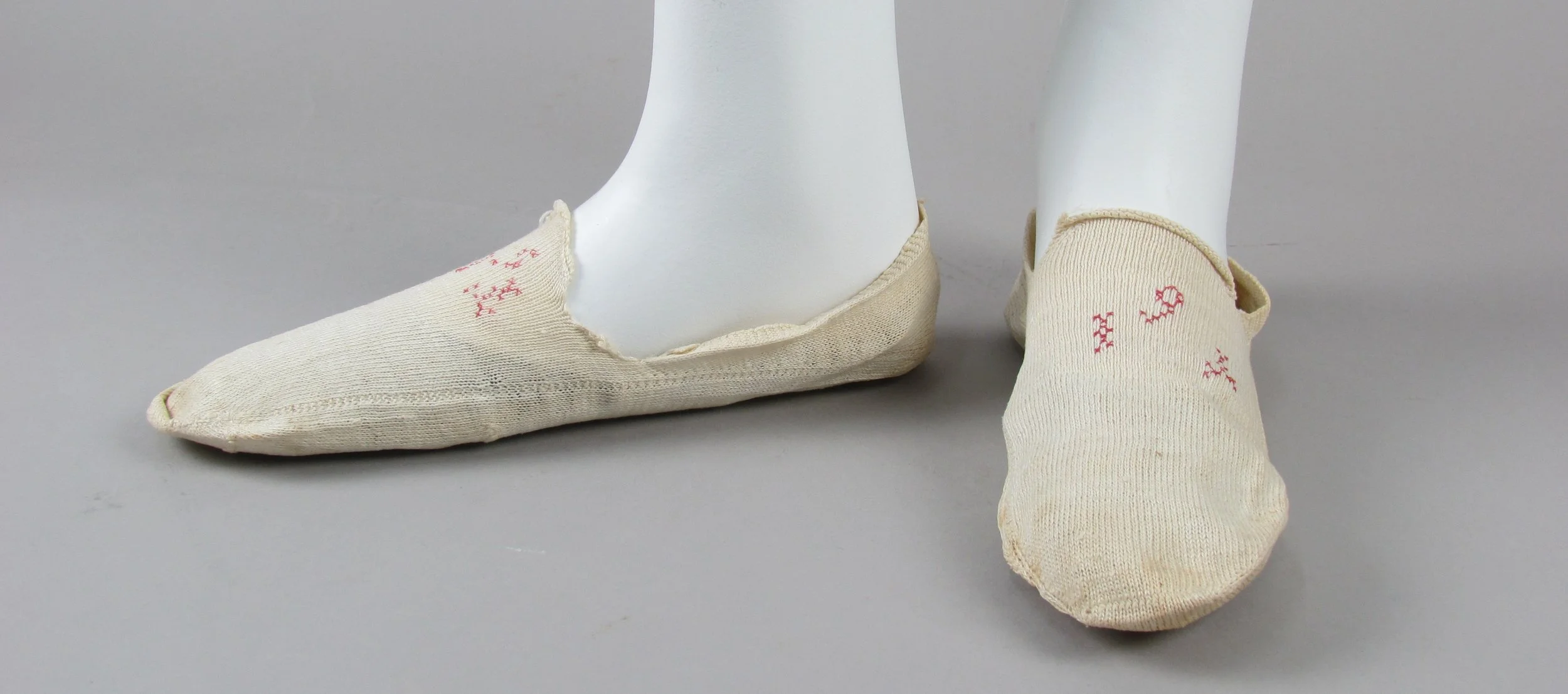
The DAR Museum has a pair of slipper-socks — 77.20.A & 77.20.B — that belonged to Thomas Jefferson in the first quarter of the 19th century. They’re knit in white cotton, and marked “T J / 6” in red red silk cross stitches.
I’m not sure whether we can consider these to be typical American footwear of the early 19th century; there are certainly many examples of slippers for men and women in this era, but these seem to be the closest examples to the French descriptions above. Perhaps Jefferson had found chaussons comfortable during his time in France in the 1780s, and returned to this style in his later years.
With thanks to Carrie Blough & Alden O’Brien of the DAR Museum.
Slipper Patterns in The Workwoman’s Guide (1838)
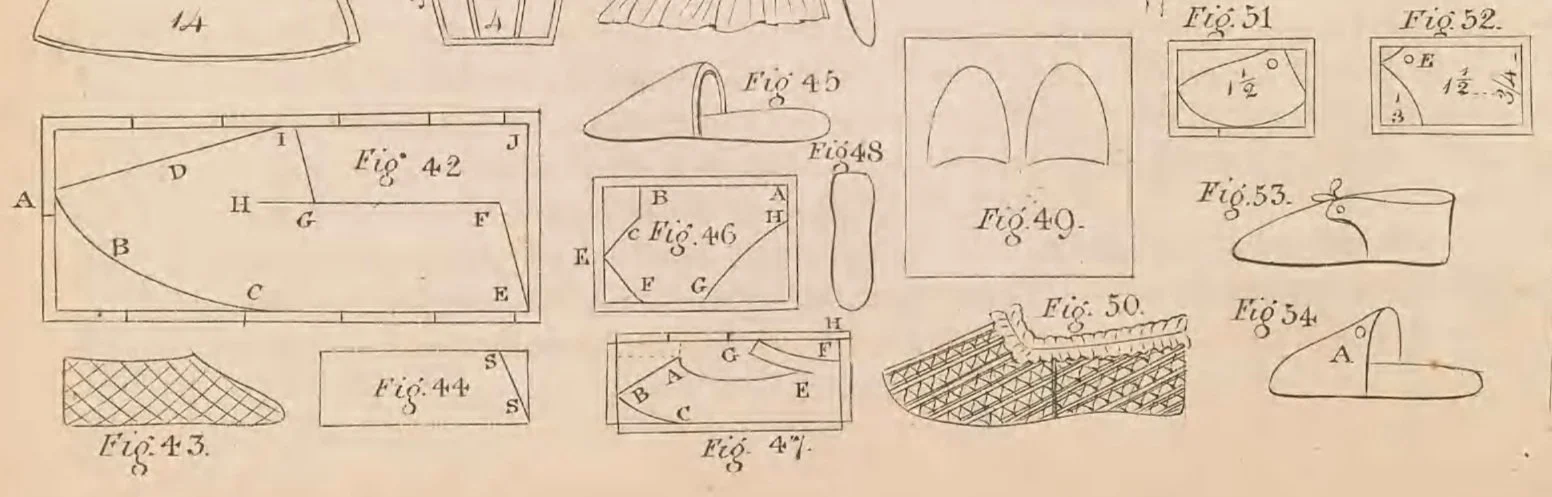
Just as an extension (and to show contemporary English styles to Jefferson’s slipper-socks above): The Workwoman’s Guide has a variety of slipper patterns, though none are knit.
The lady or gentleman’s half slipper — figure 45 above — is little changed from 18th century men’s slippers.