18th Century Chocolate
While we tend to think of 18th century chocolate consumption to be limited to drinking hot chocolate, there are also recipes for chocolate-flavored sweets. This page includes illustrations of people drinking chocolate as well as links to 18th century chocolate recipes.
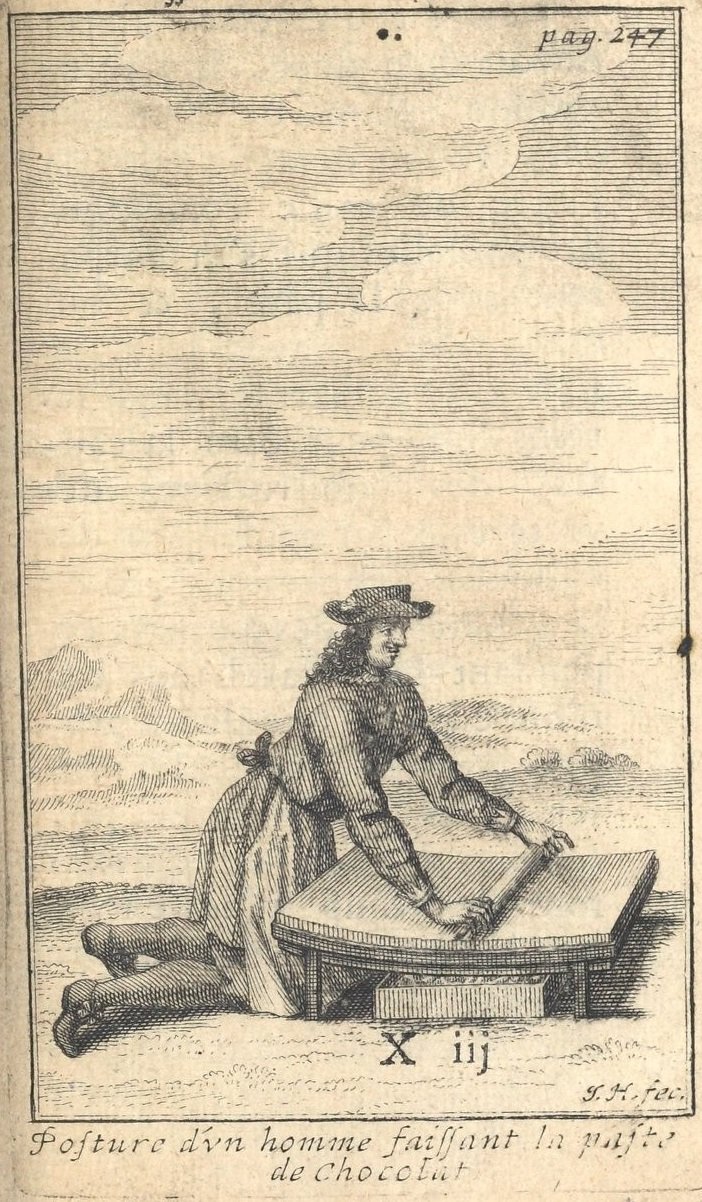
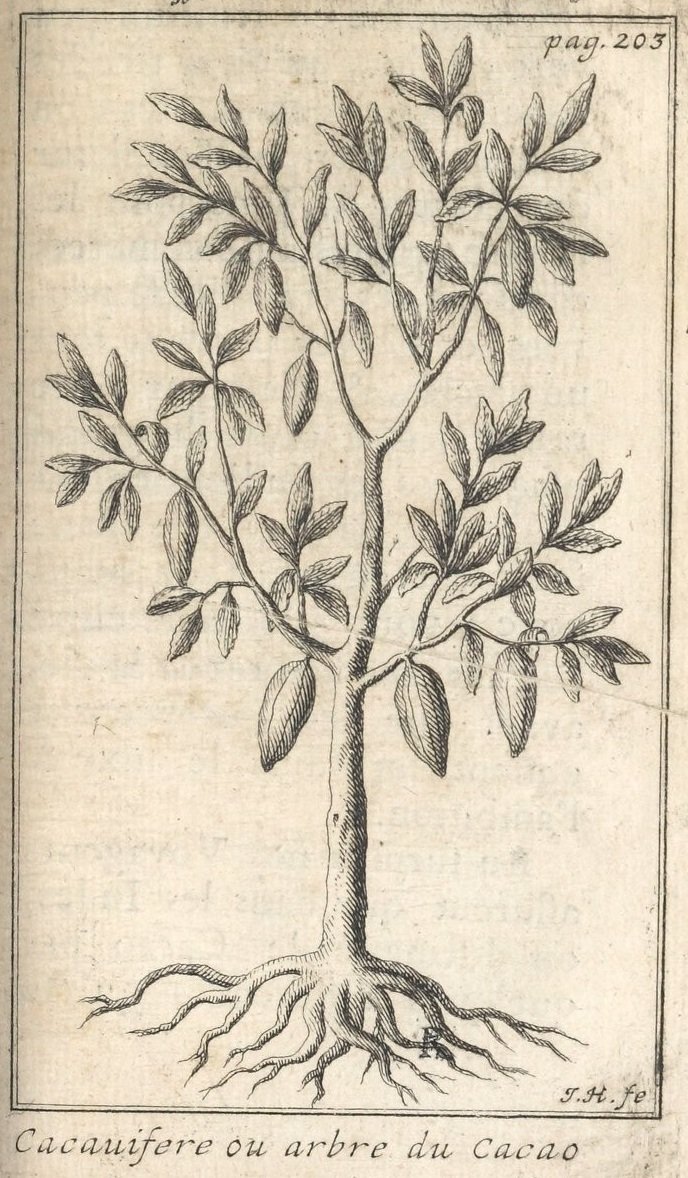
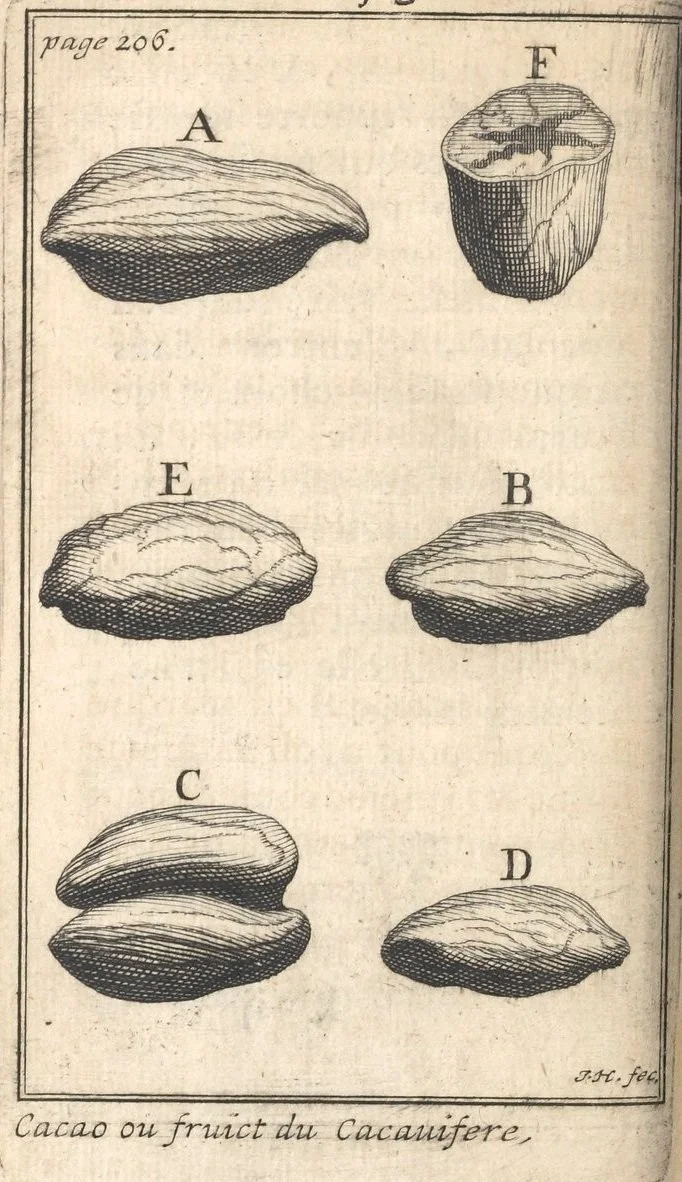
Source gallica.bnf.fr / Bibliothèque nationale de France
Chocolate is made of a fruit called Cacoa produced in the Weſt-Indies and other parts of the world. This is a kind of nut about the ſize of a wallnut, which being ſtripped of its thin ſhell is worked upon a ſtone, till it is equally mellow, and then put into tin moulds in which it hardens, and from them receives the form of cakes.
— Of the Chocolate-Maker, The parent's and guardian's directory, 1761
Source gallica.bnf.fr / Bibliothèque nationale de France
This illustration shows a woman milling the chocolate so it will be frothy when it is poured and served.
Elizabeth Raffald’s recipe calls for chocolate to be milled three times: once after it is mixed with boiling water, again after it has been boiled and allowed to stand all night, and then once again after it has been boiled for two minutes.
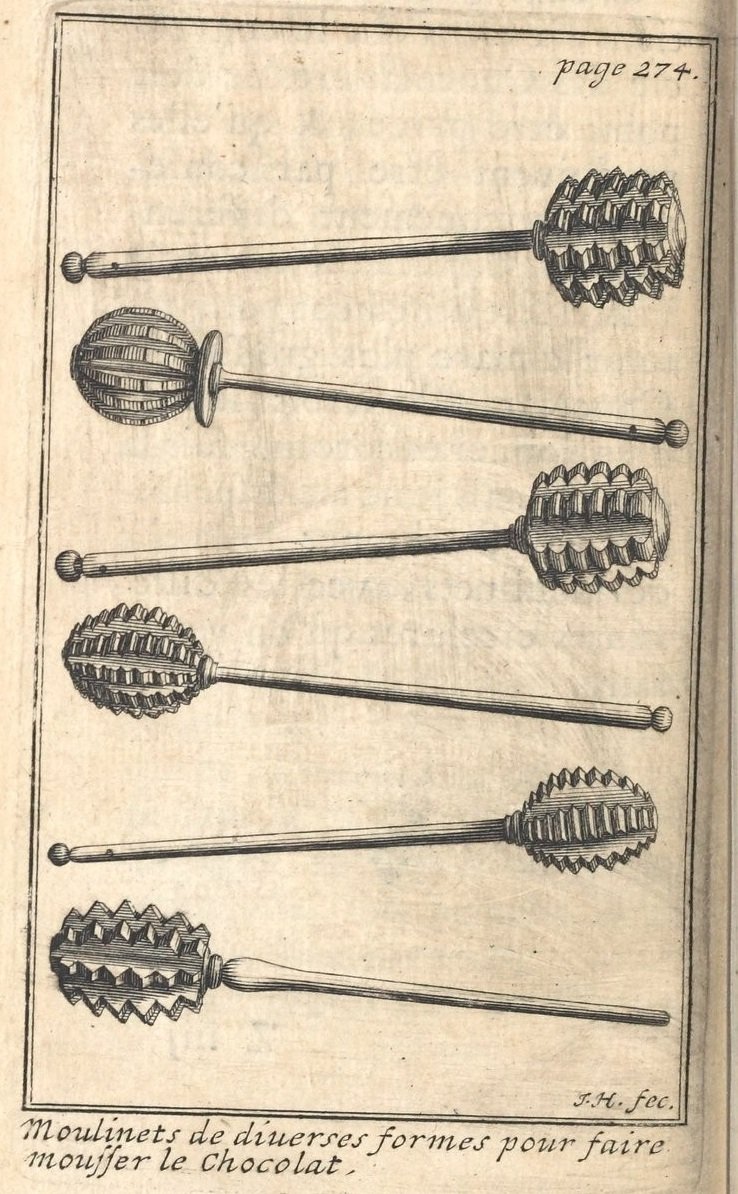
The mill is a rod-shaped tool — like Colonial Williamsburg 2003-5 and those depicted in this 17th century diagram — that goes through the lid of the chocolate pot.
It is this process that Despina complains about in Che vita maledetta in Cosi fan tutte.
Artwork & illustrations depicting drinking chocolate
Most of these illustrations show chocolate served as a morning beverage – often served upon waking up in the morning.
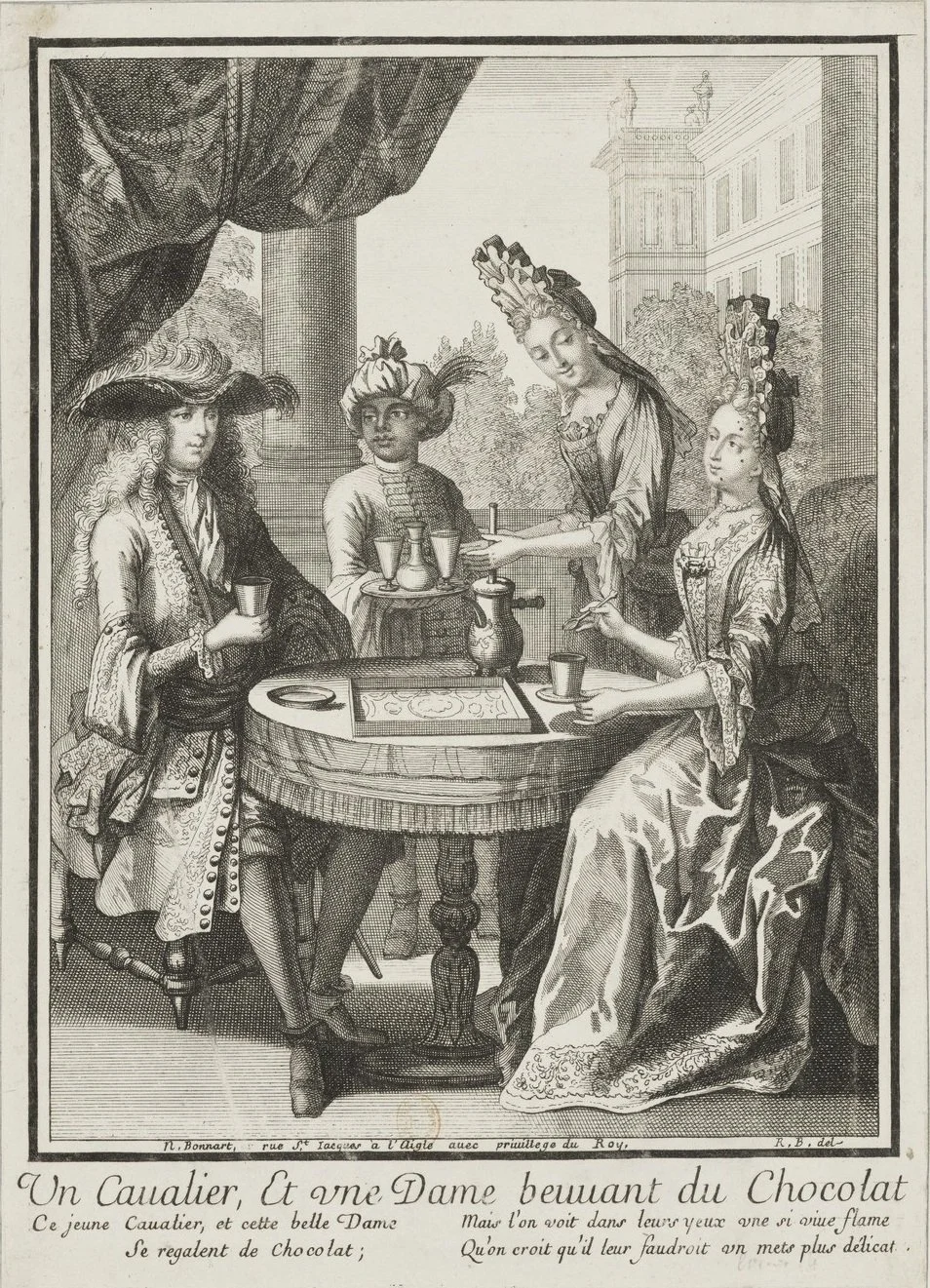
Un cavallier, et une dame beuvant du chocolat, 1690-1710
Smaak/Le Goust, c. 1695-1724
Young woman drinking chocolate by Jean-François de Troy, 1723
Marriage a-la-Mode: The Toilette by William Hogarth, c. 1743
The Morning Rose, What Shall Poor Harpax Do!, 1744
The Chocolate Girl by Jean-Étienne Liotard, c. 1744-1745
The Breakfast by Jean-Étienne Liotard, c. 1752
Saint Nicholas Day in the Imperial Family of Austria, 1762
Kitty Fleecing the Old Jew, 1764
The Family of the Duc de Penthièvre in 1768 by Jean-Baptiste Charpentier the Elder
Fear (La Crainte) by Jean-Baptiste Le Prince, 1769
Still Life with Chocolate Service by Luis Egidio Meléndez, 1770
Le Bain, 1774
The morning chocolate by Pietro Longhi
A kitchen interior with two women, attributed to Johan Rodin
Le Lever, 1781
The Sultana by Charles-Amédée-Philipppe van Loo
La Jolie Visiteuse (The Pretty Visitor) by Jean Baptiste Mallet
Chocolate pots
Several features distinguish chocolate pots tfrom contemporary coffee pots or teapots; for example, the spout tends to emerge at a 90-degree angle from the handle (the better to tilt and pour), and the handle itself is often more like a long stick than a looped handle. A lid or removable finial at the top lets the you insert the mill, or molinet (a stirring stick, like Colonial Williamsburg 2003-5) to stir the chocolate before pouring it. A Monument for Tom K—g (1737) illustrates the difference between similar-looking coffee and chocolate pots.
National Trust 852070, a silver chocolate pot with heraldic engravings, 1708
V&A 848:1 to 3-1892, a miniature chocolate pot made by David Clayton in London c. 1710
V&A M.1819-1944, a silver chocolate pot made by John Fawdery in London, 1714-1715
National Trust 413487, a Chinese ceramic chocolate pot, c. 1720
Christie’s 9587, Lot 93, a silver toy chocolate pot and molinet made by David Clayton, London, c. 1720
V&A M.379-1927, a silver chocolate pot engraved with the arms of Willis, 1722-1723
National Trust 1245591, a chocolate pot from a set of Meissen ceramics, c. 1735
V&A M.242:1, 2-1976, a miniature silver chocolate pot made by John Hugh Le Sage, c. 1740
V&A 414:101/&A-1885, a Meissen porcelain chocolate pot c. 1740 with enamel decorations probably painted in Holland c. 1750
V&A C.335&A-1918, a Meissen porcelain chocolate pot, c. 1745
National Trust 591600.1/591600.2, a copper chocolate pot
V&A LOAN:GILBERT.677:1, 2-2008, a silver chocolate pot made by Samuel Courtauld in London, 1750-1751
Louvre OAP 899, a three-footed silver chocolate pot engraved with the heraldry of Claude-François Baulard d’Angirey, made in 1756
Louvre OAP 904, a silver chocolate pot with three feet formed as deer hooves, made by Pierre-François Grandguillaume
V&A C.114&A-1911, a Meissen porcelain chocolate pot, c. 1760-1775
V&A C.1579&A-1919, a Ludwigsburg porcelain chocolate pot, c. 1765
V&A C.1586&A-1919, a Ludwigsburg porcelain chocolate pot, c. 1765
V&A C.61A-1929, a Höchst porcelain chocolate pot, c. 1765-1775
National Trust 581992, large Ludwigsburg porcelain chocolate pot on three scrolled feet, 1770
National Trust 581993, Ansbach porcelain chocolate pot, 1770-1775
V&A C.1633&A-1919, a porcelain chocolate pot made at Tournai and decorated at the Hague, c. 1775
V&A 460-1875, silver chocolate pot made in London, 1777-1778
V&A 527&A-1875, a Royal Copenhagen porcelain chocolate pot, c. 1780-1785
National Trust 1296730, a Chinese willow pattern porcelain chocolate pot, 1790-1800
Additional Resources
A Brief History of the Chocolate Pot
Chocolate Preparation and Serving Vessels in Early North America
The Silver Chocolate Pots of Colonial Boston
Chocolate Pots Brewed Ingenuity
Thé, café ou chocolat? L’essor des boissons exotiques au XVIIIe siècle (and press packet)
Find 18th century chocolate pots and chocolate cups on eBay
This site contains affiliate links for which I may be compensated
18th century chocolate recipes
From The Complete Confectioner by Hannah Glasse (1765): chocolate almonds, chocolate cream, and chocolate puffs
From The Art of Cookery, Made Plain and Easy (1774): How to make chocolate; Another way to make chocolate
From The Experienced English Housekeeper (1786): Solomon’s temple in flummery, chocolate cream, chocolate puffs, chocolate
Additional Resources
The Recipes Project: Chocolate
A Cup of Hot Chocolate, S’good for What Ails Ya
The “American Nectar”: William Hughes’s hot chocolate, and Rebeckah Winche’s Chacolet
Chocolate Cream: How to make George Washington’s favored breakfast drink