18th Century Butter Churns
For detailed thoughts on churns and butter production, read the section on the Butter and Cheeſe Dairy (“The beſt Method of making Butter and Cheeſe, with ſeveral curious Particulars containing the whole Management of the Dairy”) in The Country Housewife’s Family Companion (1750). Pehr Kalm has additional observations on butter production in his Account of His Visit to England (1748).
A new Method of ſhortening the Operation of Churning, deſcribed and recommended (1788) proposes adding a small amount of vinegar before churning the cream. This method was published in several newspapers around 1790. A modern variation on this theme, cultured butter, is typically produced by adding buttermilk, yogurt, sour cream, or crème fraîche before churning the cream.
A page on churns from the 13th-16th centuries can be found on my other website.
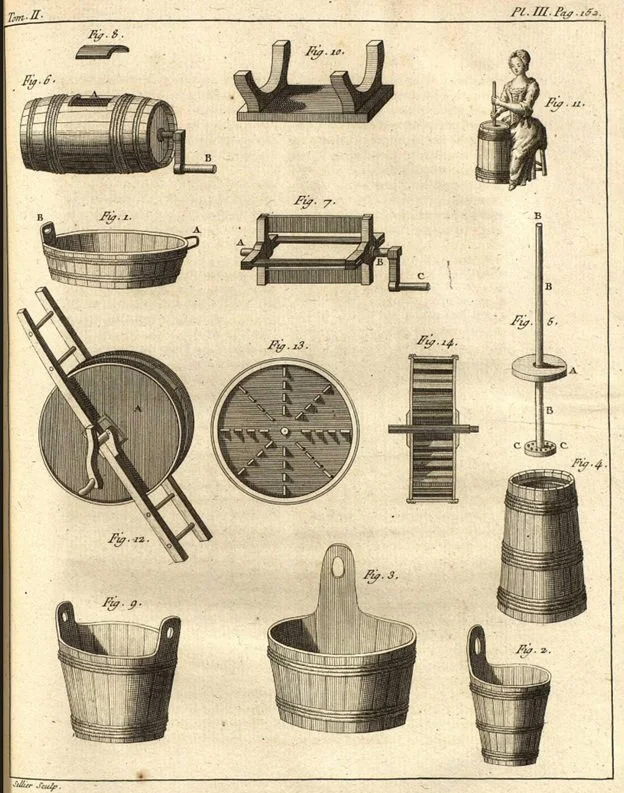
CHURN (or butter churn): A type of tall wooden vessel made of staves, narrower at the top than at the bottom, used for churning the cream from which butter is made. (Pl. 3, Fig. 4.)
This vessel is usually fitted with two, three, or four hoops at its two ends and in its middle. The semi-circular hoops, similar to those used for barrels, are defective; not only does the wicker wear out quickly, but also the cream that sometimes splashes out gets trapped in the cavity formed by the joining of the two hoops; there it quickly sours, as does the whey that separates during butter making; and if this soured matter mixes with the cream through the leakage, the butter soon takes on a strong, acrid taste; moreover, since all milk preparations require the utmost cleanliness, these hoops hinder the cleanliness required by these vessels. Two flat, wide hoops are preferable to the former type; the reason for this is obvious.
The second component of the churn is its lid A, Fig. 5; it is removable and lifts off along with the staff B that passes through it and is attached to the actual beater CC, which is pierced with several holes. We see Fig 11, the position of the person churning the butter. It is by raising and lowering the churn-staff for a considerable time that the whey separates from the cream and the cream forms butter; the more it is churned, the better it keeps and the less likely it is to turn rancid. In the dairies of the nobility, the churns are made of earthenware.
Whenever the churn is used, it and all its accessories must be thoroughly washed and scrubbed, inside and out, then set out to drain and dry; in short, they must never be used unless they are impeccably clean. Some meticulous butter-makers begin by washing the churns with warm whey, followed by fresh water.
This implement suffices for a dairy supplied by only a few cows; however, the process would be too slow and laborious for large dairies, such as those found in Flanders, Holland, Franche-Comté, Switzerland, etc. These require more efficient implements, tools well worth adopting in regions where they are currently unknown, as they save time and labor, accomplishing in a single hour what ordinary churns fail to achieve in ten.
Figure 6 shows a Flemish churn; it is a barrel capable of holding between sixty and two hundred pintes of milk (the pinte being a Paris measure, that is, it holds two pounds of water, poids de marc).
This barrel is secured onto a sturdy stand, Fig. 10, so that neither the stand nor the barrel can move while the operator turns the crank B, Fig. 6. A large opening A is made in the top of the barrel; this is closed with its lid Fig. 8, and fastened securely in place.
The interior of the barrel, Fig. 6, is fitted with a four-vaned paddle, Fig. 7, the vanes of which come within a pouce of the barrel staves; its axis A rests against the central stave of the head and fits into a socket made for this purpose, ensuring it does not shift during the operation; at the other end of the axis B is attached the crank C, by means of which the man turns the churn, and transmits motion to the entire mass of milk contained in the barrel.
The Swiss, the people of Franche-Comté, and the inhabitants of the Vosges, at least in certain districts, construct their churns based on the same principle as the Flemish and the Dutch. The churn’s support is a type of frame resembling a ladder, Fig. 12, much like the one that holds a knife-grinder's wheel. Churn A is approximately two to two and a half feet high, with a diameter of ten to twelve pouces from one end to the other. Figure 13 shows a front view of the internal agitator, and Fig. 14 the agitator or butter-beater viewed perpendicularly. As this agitator has more vanes than the Flemish type, the butter forms and separates from the buttermilk more quickly; however, the former is preferable, there is less waste, and less cream and butter adhere to the surfaces of the vanes; finally, it is more difficult to keep the latter in a proper state of cleanliness.
— From François Rozier’s Dictionnaire universel d’agriculture (1782)
Concord Museum H2033, an 18th century churn made of maple and ash wood, stave construction
Met 17.190.1777, a French faience butter churn, 1730
Roman peasant woman with a butter churn on her head by Jean-Étienne Liotard, c. 1737
Butter (1752) and The Dairy (1765) in the Encyclopédie ou Dictionnaire raisonné des sciences, des arts et des métiers
The Butter Churner, 1754
Rural Life: The Housewife’s Employment
La petite beurrière by François Boucher (also here)
The London Beau in the Country, or the Dairyhouse Gallant, 1773
Man churning butter, c. 1777-1779
Illustration of a woman in a courtyard from A Pretty Book of Pictures, 1779
Cours complet d’Agriculture by Jean-François Rozier, 1781
Lovelace flirts with the daughters of the widow Sorlings (an illustration from Clarissa) by Daniel Nikolaus Chodowiecki, 1784
Colonial Williamsburg 1973-345,A&B, a creamware butter churn, Staffordshire, c. 1785
Tall butter churn from 18th century New England
Edinburgh Milkmaid with Butter Churn by David Allan, c. 1785-1795
Morning, c. 1790
A woman churning by James Ward
The Milkmaid and the Snail, c. 1790
Women churning butter by Johann Karl Müllener, c. 1790-1795
John Bull’s Progress, 1793
The Butter Churner by Henry Robert Morland
Morning by Francis Wheatley, 1799
Willis Henry Nov 16, 2013, Lot 7, a tall New England butter churn, 18th century
Old hunchbacked woman with a butter churn by Daniel Nikolaus Chodowiecki