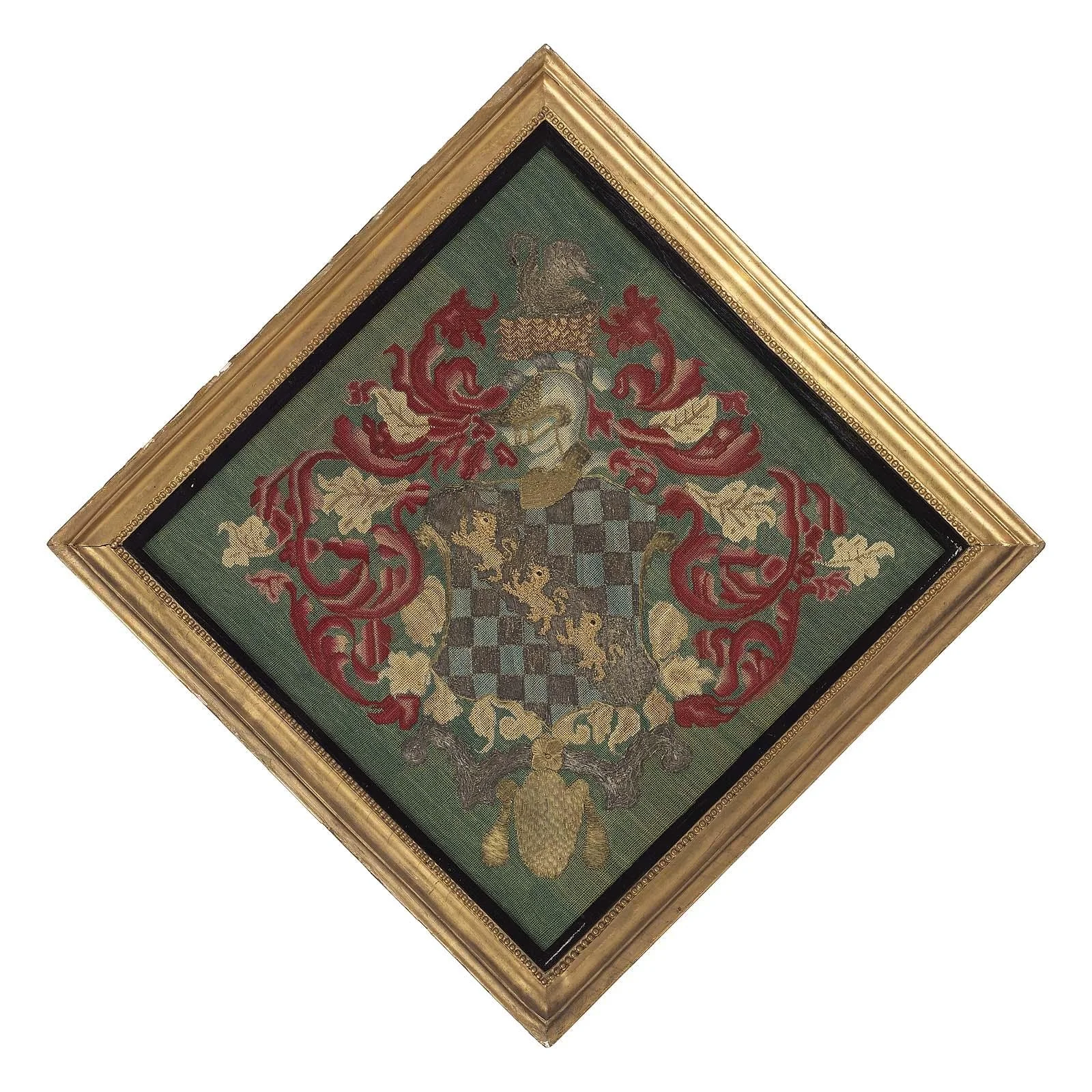
Embroidered
Coats of Arms
Not as well-known as the stereotypical schoolgirl embroideries of colonial America (such as embroidered samplers and canvaswork pictures), schoolgirls in New England embroidered heraldic panels that displayed their skill with a needle and the family's heraldry – or at least their families’ heraldic pretensions.
There’s a particularly good discussion of these embroideries in With Needle and Brush:
The most lustrous and elaborate of all the embroideries worked in the eighteenth century by schoolgirls were coats of arms. The lozenge-shaped coats of arms, unique to New England, were created in Boston, first as canvaswork in the 1740s and then in silk and metallic thread on a black silk background by the early 1750s. They were sophisticated accomplishments intended as decoration to demonstrate a family’s prestige in society. Though visually similar to funereal hatchments, which were painted on wood and hung over the door of the deceased, the social functions of the two objects were very different.
The Needle’s Eye has more on these embroideries:
One project that was particularly popular among young women of wealthy New England families finishing their education was the embroidering of a family coat of arms. These heraldic needleworks, generally worked in gold, silver, and colored silk threads on a black, diamond-shaped ground, are among the most impressive examples of needle art. Expensively framed and displayed in a home’s most public spaces, they signaled the owner’s wealth, education, leisure, and privilege, communicating a family’s ability to do without a daughter’s labor while she attended school and to select and enroll her in a school filled with well-heeled students. The working of the piece conveyed a family’s membership among the leaders of society, while the heraldic imagery signaled the supposed duration of that membership. At the same time, the products of these young women’s labor allowed select citizens of the colony and then early republic to assert their English heritage. As Betty Ring has observed, “undeterred by either republicanism or nationalism,” these objects represented a desire, among New England’s elite, “for purely English emblems of family pride and prestige.”
Historic Deerfield provides additional context:
By the mid 18th century, the rising merchant class wanted to display status symbols, and coats of arms became a popular subject for needlework pictures wrought in Boston. Embroideries depicting true or pseudo-coats of arms (few New England families were entitled to bear them) done in girls’ embroidery schools were probably some of the most costly done. The city was home to at least six school mistresses who taught this kind of embroidery, advertising in local papers during the 1750s, 1760s, and 1770s. By 1730, Boston heraldic painters had access to a number of publications that illustrated coats of arms from which to copy or combine elements. The schools were provided with patterns and stencils from shops operated by these heraldic painters, such as John Gore, the largest provider in Boston. Based on a 2010 article by Angela Duckwall, these kinds of embroidered coats of arms from Boston were marked on the fabric before being embroidered with color instructions. The threads were probably imported from England, and the girls’ choices were governed by what their families could afford. Heraldic embroidery provided the perfect forum for displaying needlework, education, leisure, status, elite heritage, and family allegiance. Nearly all the Boston coats of arms appear to be in basically the same form, but the earlier ones seem to be more lavishly embroidered in metallic material.
Following is a roughly chronological outline of these embroidered coats of arms. (A page on heraldic embroidery of the 13th-17th centuries appears on the old website.)
Additional Resources
This site contains affiliate links for which I may be compensated
X-Radiography Examination of an Embroidered Coat of Arms
Needlework of the Rural Gentry: The World of Elizabeth Porter Phelps
Stitching it Together: Schoolgirl Embroidery From the Connecticut River Valley
Stitching a Lineage: Embroidered Coats of Arms in Eighteenth-Century Boston
With Needle and Brush: Schoolgirl Embroidery from the Connecticut River Valley, 1740-1840
Women’s Work: Embroidery in Colonial Boston
Girlhood Embroidery: American Samplers & Pictorial Needlework, 1650-1850
Winterthur 1958.1524 A, Hall coat of arms, possibly made by Hannah Hall, 1730-1740
Addison Gallery of American Art 1962.6, the arms of Foxcroft and Coney embroidered by Elizabeth or Mehetable Foxcroft, c. 1740-1750
Winterthur 1953.0171.001 A, Penhallow/Kneeland family coat of arms, embroidered by Prudence Kneeland Penhallow, 1740-1760
Winterthur 1957.1395, coat of arms labelled “Simpkins And Symmes,” 1740-1760
MFA 39.243, Rufus Greene family coat of arms, embroidered by Katherine Greene Armory, 1745
Winterthur 1994.0003 A, B, Cushing family coat of arms, 1750
MFA 64.2045, Wendell and Oliver coat of arms, probably worked by a daughter of Jacob Wendell and Sarah Oliver, c. 1750
MFA 39.244, Chandler coat of arms, embroidered by Catharine Chandler, c. 1750
Northeast Auctions Aug 17-18 2013, Lot 254, coat of arms for the Peirce family
Connecticut Historical Society 1935.10.1, unfinished Pitkin family coat of arms, attributed to Jerusha Pitkin, c. 1750-1755
Winterthur 1959.2851 A, arms of Browne of Weald Hall, possibly embroidered by Jane Brown, 1758
Historic Northampton 71.119, coat of arms of the Stoddard family, probably embroidered by Esther Stoddard or Prudence Stoddard, c. 1760
Concord Museum T900, arms of Jones of Monmouthshire, assumed by Col. Jones of Weston, embroidered by Mary Jones, c. 1760-1770
Historic Deerfield 56.358.2, 1760-1775
Coat of arms, erroneous heraldry of the Porter family, stitched by Elizabeth Porter Phelps starting when she was a young woman (around 1760) and continued in “the twilight of her life” (c. 1817)
Winterthur 1958.2226 A, embroidered by Ann Flower of Philadelphia, 1763
Christie’s Sale 1745, Lot 652, embroidered by Elizabeth Flower of Philadelphia, 1765
Historic Deerfield 58.234, coat of arms of the Ross family, attributed to Elizabeth Ross, c. 1768
Historic Deerfield 1391, Grant coat of arms, worked by Ann Grant, 1769
Historic Deerfield 63.154, Lloyd coat of arms, c. 1770
Bayou Bend collection, coat of arms with the names Howe and Babcock, embroidered by Hannah Babcock, 1785
Met 36.28, embroidered by Mary Ann Thomas, c. 1786
Met 2003.581, embroidered by Sarah Duncan, c. 1790
Winterthur 1967.1393 A, King/Hodges coat of arms, embroidered by Hannah Hodges, 1790-1791
Connecticut Historical Society 1992.68.1, Patten, Davenport and Wheelock coat of arms, embroidered by Ruth Patten of Hartford, c. 1790-1810
Winterthur 1955.0083.003 A, made by Betsy Putnam, c. 1790-1810
Winterthur 1964.0617 A, c. 1790-1820
Dietrich American Foundation 4.5.1248, needlework hatchment of the Boyd and Brewster families of Portsmouth, New Hampshire, embroidered by Submit Boyd (daughter of Colonel George Boyd and Jane Brewster) c. 1795
Met 1993.496, embroidered by H. Goodwin of Hartford, 1800-1810
Connecticut Historical Soceity 1985.41.0, Frye family coat of arms, 1800-1820
Connecticut Historical Society 1963.61.15, unfinished coat of arms, 1800-1820
Historic Deerfield 2002.64, Moseley coat of arms, attributed to Mary Moseley, c. 1804
Connecticut Historical Society 1939.8.1, Ripley family coat of arms, embroidered by Lucy Ripley, 1804-1805
Connecticut Historical Society 1949.5.0, Perkins family coat of arms, attributed to Charlotte Perkins, 1810-1815