18th Century Coffeehouses
In 1703, Ned Ward colorfully described a particularly loathsome coffeehouse in The London Spy:
“Come,” says my Friend, “let us step into this Coffee-House here, as you are a Stranger in the Town, it will afford you some Diversion.” Accordingly in we went, where a parcel of Muddling Muck-Worms were as busie as so many Rats in an old Cheese-Loft; some Going, some Coming, some Scribbling, some Talking, some Drinking, some Smoaking, others Jangling; and the whole Room stinking of Tobacco, like a Dutch-Scoot, or a Boatswains-Cabbin.
Despite Ward’s scabrous description, coffeehouses were spaces where men could do business, exchange news, and engage in conversations and debates, though the quality of such discussions could vary significantly. Regarding Will’s Coffee House, Samuel Pepys writes, “It will be good coming thither, for there, I perceive, is very witty and pleasant discourse.”
Fifty years later, Jonathan Swift complained:
Indeed, the worſt converſation I ever remember to have heard in my life, was that at Will’s coffee-houſe, where the wits (as they were called) uſed formerly to aſſemble; that is to ſay, five or ſix men, who had writ plays, or at leaſt prologues, or had ſhare in a miſcellany, came hither, and entertained one another with their trifling compoſures, in ſo important an air, as if they had been the nobleſt efforts of human nature, or that the fate of kingdoms depended on them; and they were uſually attended with an humble audience of young ſtudents from the inns of courts, or the univerſities, who, at due diſtance, liſtened to theſe oracles, and returned home with great contempt for their law and philoſophy, their heads filled with traſh, under the name of politeneſs, criticiſm, and belles lettres. By theſe means the poets, for many years paſt, were all over-run by pedantry.
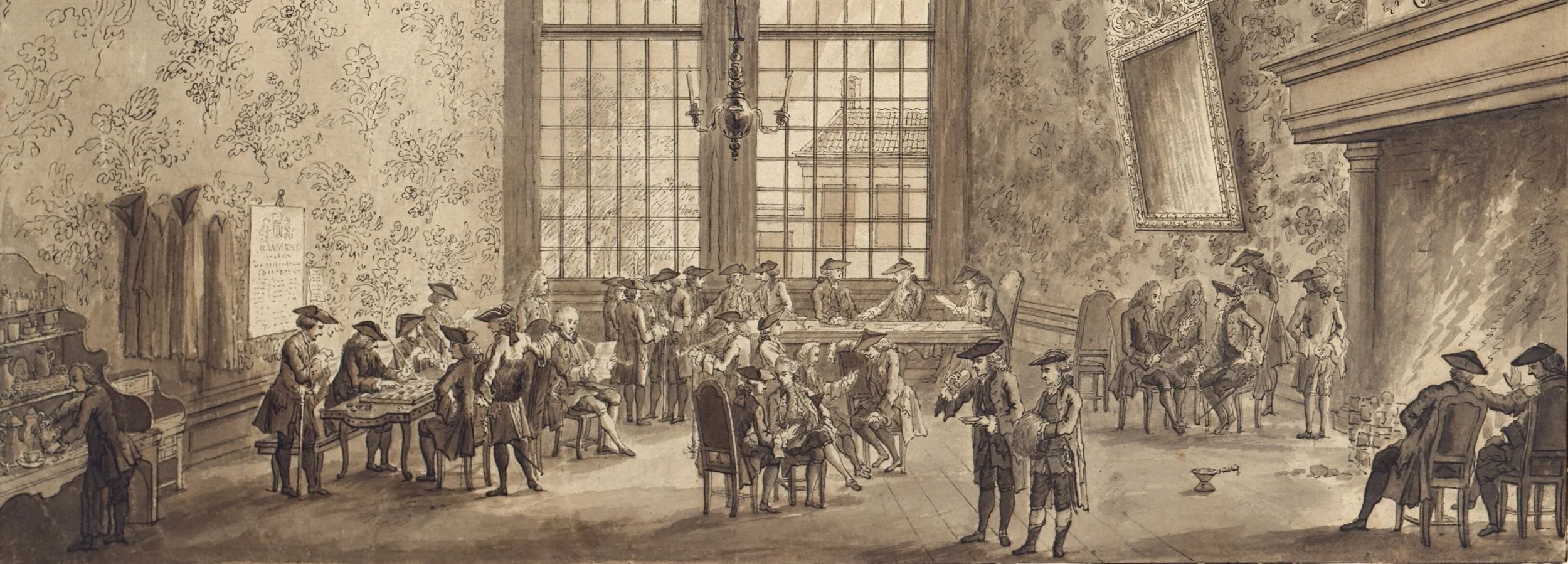
The illustrations below provide further depictions of the interiors of 18th century coffeehouses; see the Additional Resources for further discussion of their role in society. (Additional notes on 18th century coffee are on a separate page.)
Additional Resources
This site contains affiliate links for which I may be compensated
The Lost World of the London Coffeehouse
Coffeehouse Civility, 1660-1714: An Aspect of Post-Courtly Culture in England
Newspapers, gossip, and coffee-house culture
‘To Clapham’s I go’: a mid to late 18th-century Cambridge coffeehouse assemblage
Coffeehouses: Free, yes, from debauchery and vice, but hotbeds of sedition
The Encyclopedia of Greater Philadelphia: Coffeehouses
Society at Auction: Coffee-House Culture in Occupied New York
The rise and fall of the English coffee-house
English Coffeehouses, Penny Universities
Coffeehouses in the Digital Encyclopedia of British Sociability in the Long Eighteenth Century
Conflict and the Coffeehouse: Three Stories from Eighteenth-Century Amsterdam
The Early History of Coffee Houses in London
The Coffee House: A Cultural History
The Social Life of Coffee: The Emergence of the British Coffeehouse
The RULES and ORDERS of the COFFEE-HOUSE, in A BRIEF DESCRIPTION OF THE EXCELLENT VERTUES OF THAT Sober and wholesome Drink, CALLED COFFEE, AND ITS INCOMPARABLE EFFECTS IN PREVENTING or CURING MOST DISEASES INCIDENT TO HUMANE BODIES, 1674
Interior of a London Coffee-house, c. 1690-1700
A trade card for Will's Beſt Coffee Powder at Manwarings Coffee House in Falcon Court over against St. Dunstans Church in Fleet Street, c. 1700
The Coffehous Mob, frontispiece to The Fourth Part of Vulgus Britannicus: or the British Hudibras, 1710
Das Coffe-Haus, 1711
The Coffee House Politicians, c. 1733
Tom King’s Coffee House in Covent Garden on the left side of Four Times of the Day: Morning by William Hogarth, 1736 (easier to see in this engraving, on the right)
Miſs Salley King, keeper of a coffee-house, c. 1740-1750
Card-players in a coffeehouse by Pieter Muilman, c. 1740-1760
John’s Coffee House, 1745
A street coffee house, Edinburgh by Paul Sandby, c. 1747-1752
Interior of an Italian Coffee House by Thomas Patch, 1747-1755
John Balfours Coffee house at Edinburgh 1752, attributed to Paul Sandby
Of the Coffee-House-Man, The parent’s and guardian’s directory, 1761
Franse Koffiehuis, Kalverstraat, 1761
The Grumblers of Great Britain, 1762
Jonathan's Coffee House or An analysis of change alley with a group of characters from the Life, c. 1763
The Duellists, c. 1770
The London Gazette by Henry William Bunbury, 1780
The Discomfited Duellists, 1784
Ruige Keet, 1784
Lloyd’s Coffee House, 1789
The coffee-house in Bath, 1793
The New Blenheim Drop or Patent Pegs for Impertinent Puppies, 1800
Little Will at the Turks Head Coffee House, c. 1800
Caricature Ornaments for Screens by George Cruikshank, 1800
A café in Venice by Domenico Tiepolo, c. 1800
A Mad Dog in a Coffee House by Thomas Rowlandson, 1809
The interior of a coffee house by James Miller