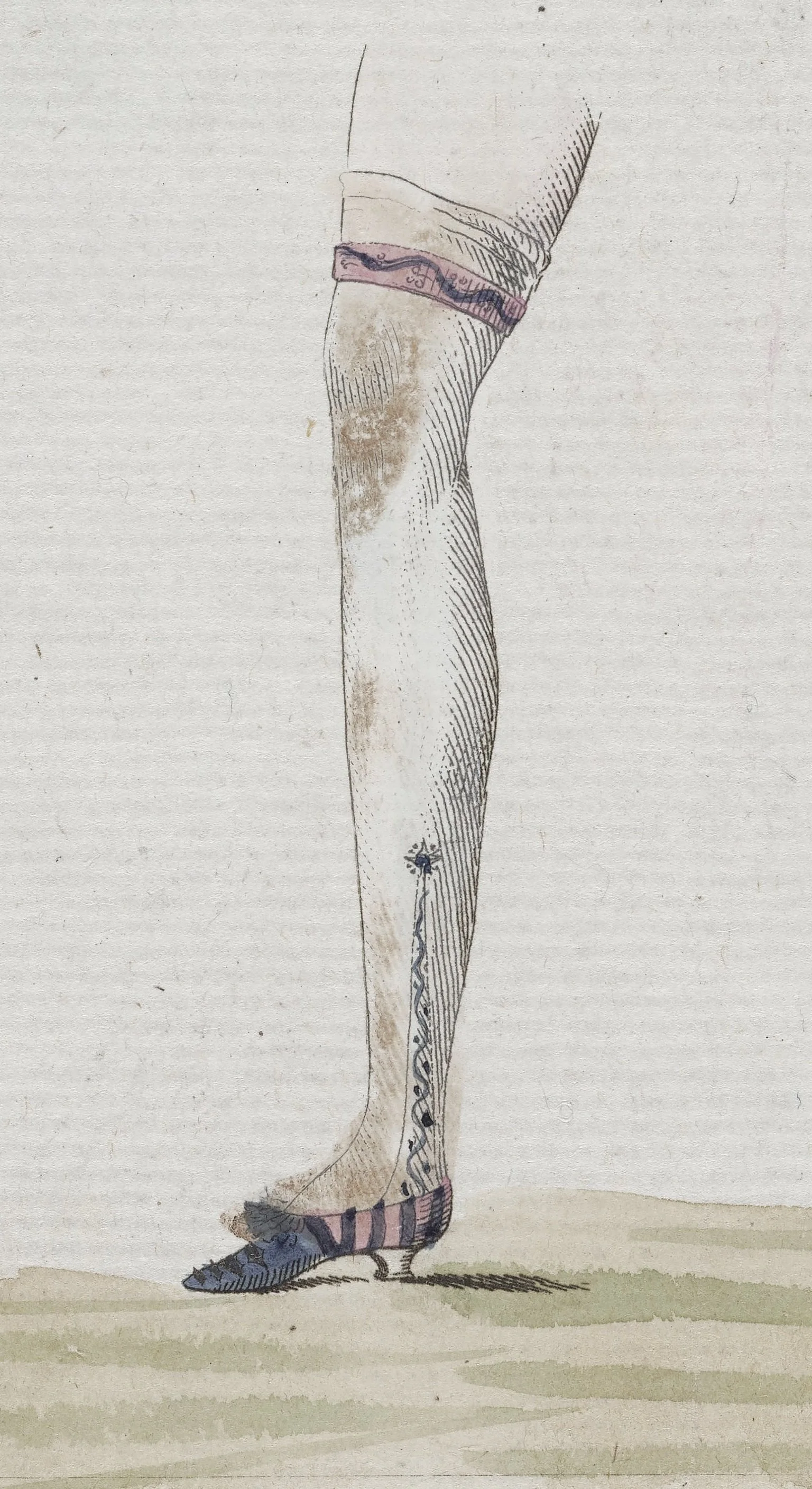
© Victoria and Albert Museum, London
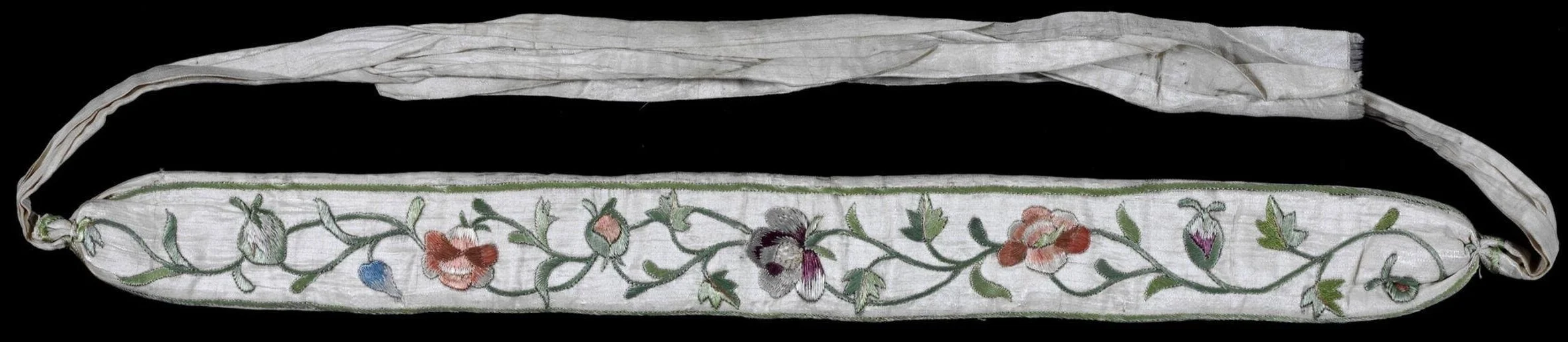
18th Century Garters
Garters also appear for sale in 18th century advertisements (e.g. Symonds and Bayard of Philadelphia, Pennsylvania Journal, July 5, 1759; Benjamin Villepontoux and William Waring, Charleston, The South-Carolina Gazette, March 16, 1765; Robert Adam and Company, Alexandria, Virginia Gazette, August 20, 1772; etc.), often as imported goods from England.
They appear less frequently in runaway advertisements; one of the few examples is “a Convict Servant named JOHN WOOD, an Engliſman; by Trade a Bricklayer” who ran way from Urbana, Virginia, and had “a fine Hat Half worn, with a Knee Garter buckled round the Crown, and a Piece of Knee Garter ſewed on for a Loop to the Button” (Virginia Gazette, March 4, 1773).
Some additional items relating to the Order of the Garter: a portrait of the Prince of Wales wearing a garter ribbon, and a garter ribbon of the Noble Order of the Garter.
Additional Resources
Costume in Detail: Women’s Dress 1730-1930
An Essay on the GARTER, The Gentleman’s Magazine, 1748
Return Engagement: Garters at Work
Tutorials by LBCC Historical, The Pragmatic Costumer, and The Sartorial Sleuth
Garters made by The Pragmatic Costumer, The Sewprano (completed), Penelope, Red Shoes Red Wine, and Rococo Atelier
Extant 18th century garters
MFA 38.1227, macramé in silk and silver-gilt threads, France, 17th or 18th century; “Worked with gold thread (gilded silver wound on yellow silk) and several shades of green silk. The design consists of connected pointed ovals. The ends are trimmed with strings of small gold tassels.”
Rijksmuseum BK-NM-8624-A and BK-NM-8624-B, a pair of 18th century garters made from lancé-effect silk with a hook on one side and a tassel on the other
MFA 38.1217a,b, France, silk brocade with steel buckles
MFA 38.1218a,b, France, silk satin with silk embroidery and silk plain-weave ribbon
MFA 38.1228, France; “One garter of pink silk with scrolling conventional flowers couched in silver thread (silver wound on white silk) and flat silver wire. Silver somewhat tarnished, pink silk worn and faded. Lined with linen (two pieces).”
MFA 38.1390a,b, France; silk plain weave with silk tambour work and embroidery on silk ribbon; one has the motto 'MA • DEVISE • EST • DE VOUS • AIME' (My motto is to love you) and the other has the motto 'ES • DE • NE • JAMAIS CHANGER' (It will never change)
TC1454, a pair of linen tape garters embroidered with colored silk thread, with knotted fringes; one has the motto 'MEMENTO VIVERE' (remember that you will live) and the other has the motto 'NUL BIEN SANS PEINE' (no success without trouble)
MFA 38.1391a,b, France; “Silk and silver and spangle embroidery and pigments on silk mounted on paper board and silk ribbon”
MFA 38.1392a,b, France; silk satin with silk tambour-work and silk fringe; both feature a motto
MFA 38.1393a,b, France; painted silk taffeta, with silk taffeta ribbon
MFA 43.1863, gold and silver knit band with gold tassels
MFA 43.2333a,b, sablé glass bead work in a floral serpentine design, on silk ribbon with silver lace edging, France
MFA 55.601a,b, America; “linen worked solidly with polychrome silks in rococo stitch in zig-zag pattern, colors, green, blue, and brown between points of pink and yellow, blue ribbon lines embroidery and forms ties.”
Met 1986.73.1, a garter in polychrome rococo stitch with a heart-shaped pattern
Rijksmuseum BK-KOG-85 ('IK GEVE JOU DESE KOUSEBANT MDCCXXII') and Rijksmuseum BK-KOG-86 ('DIT IS OP TROW HIER IS MYN HANT'), North Holland, 1722
Colonial Williamsburg 1956-17, England, tablet woven silk garter with the inscription 'WOVE WITHOUT SIGHT' and the date 1725
Silk garters, 1727: Rijksmuseum BK-NM-8410-A ('JAN ANNEE DOET DESE VEREERING AAN SYN MOEDER GEESIE DE VRIES ANNO MDCCXXVII') and Rijksmuseum BK-NM-8410-B ('JAN ANNE DOET DESE VEREERING AAN SYN MOEDER GEESIE DE VRIES ANNO MDCCXXVII')
National Trust 1140219, a wedding garter, 1730; “Wedding garter of ivory satin and grosgrain ribbon embroidered with threads of silver, gold and coloured silks in a design of ovall medallions with flower motifs in silver and gold linked horizontally by small flowering vines in shades of pink, green and blue.”
Jacobite garters:
V&A T.107-1938, woven silk Jacobite garters inscribed 'God Bless the Prince and Save the King'; and the other 'While Whiggs and Rumps in Halters Swing', made in England c. 1745
V&A T.121-1931, Jacobite garter of woven silk inscribed 'OUR PRINCE IS BRAVE OUR CAUSE IS JUST', made in England c. 1745
Garters at the Culloden Visitor Centre, inscribed 'COME LET US WITH ONE HEART UNITE TO BLESS THE PRINCE FOR WHOM WE’LL FIGHT'
Bonhams 24-26 August 2005, Lot 800 Bonhams 15 May 2019, Lot 275, garters incribed 'GOD BLESS P.C. AND DOWN WITH THE RUMP'
Lyon & Turnbull 13 May 2015, Lot 112, garters woven with tartan detail and inscription 'GOD BLESS P.C AND DOWN WITH RUMP,' both still joined as one ribbon
British Museum 1893,0205.58, garters inscribed 'GOD BLESS PC AND DOWN WITH RUMP' (with extensive notes on their manufacture and related examples)
A writer in The Gentleman’s Magazine remarks, “After having ſo laviſhly ſpoken in praiſe of the garter, I cannot but diſapprove of it, when it is made the diſtinguiſhing badge of a party. It ought to be like the cæſtus of Venus, ſo beautifully deſcribed in my motto, and not to be daubed with plaid, and crammed with treaſon. I am credibly informed, that garters of this ſort were firſt introduced in the late rebellion, by ſome female aid de camps; and whether or not ſuch ladies are to be imitated, is worth the ſerious conſideration of the virtuous part of the fair ſex.”
(See also “'Daubed with Plaid and Crammed with Treason': The Visual and Material Culture of Embodied Insurrection” in Art and Identity in Scotland.)
V&A CIRC.217-1920, ivory silk taffeta with floral embroidery, British, c. 1750-1770
Silk garters of Hannah Callender of Philadelphia, marked with her name and the date 1762
Christie’s Lot 241 / Sale 5422, a pair of silk garters, c. 1770-1790; “padded white silk ground delicately printed with pairs of lovers in barges pulled by swans and dolphins, constructed with fine metal springs woven through silk, and with the mottos 'La Amour les Conduit' and 'L'Amitie les Ramene'”
V&A CIRC.218-1920, ivory silk satin garters with silk tambour embroidery, c. 1770-1790
National Trust 1350074.1/1350074.2, a pair of garters said to have belonged to Marie Antoinette. “Made from cream silk satin and lined with cream silk tabby. Originally they fastened with ribbons atttached to brass springs encased in silk. They are padded and embroidered with chenille in a design of flowers and leaves either side of a printed box containing the following verse: 'Je peins une beauté fidèle; Je forme un emsemble parfait; Et quand je trace ce portrait, Vous seule en êtes le modèle.'”
Monogrammed and embroidered garters once owned by Marie Antoinette
V&A T.106&A-1969, embroidered silk with silver thread and ribbon, France, c. 1780-1800; one says 'UNIS A JAMAIS' (united forever) and the other says 'JE MEURS OU JE M'ATTACHE' (I die where I cling) tamboured in silver filé
V&A T.208-1911, padded silk taffeta with vining floral tambour embroidery, France (?), c. 1780-1800
MFA 43.2010a,b, England; “Cross-stitch embroidered silk with blue, yellow, green, white quatrefoils and salmon diamonds flanking gold silk inscription 'JEH, 1784' on green ground. Salmon silk back and binding; blue silk ribbons to sides.”
MFA 43.2015, France, c. 1790; “Blue silk rep embroidered with silver yarns and wire over parchment with design of two chained salmon silk hearts between inscription 'RIEN/NE/PEUT/E/GA/LER' ('Nothing can be equal'). White silk binding and ribbons to sides.”
MFA 43.2013, England, c. 1790; a blue garter of the Order of the Garter, with the motto ('HONI SOIT QUI MAL Y PENSE') in silver yarns, wire, and spangles
Met 1976.235.1a, b, French silk garters, c. 1790; one inscribed 'PLUS SINCERE QUE JE LE SUIS' and the other 'VOUS NAUREZ MAIS DAMIS'
Kerry Taylor Auctions 25 Feb 2014, Lot 193, “Two embroidered silk garters, French, late 18th century, one of purple satin embroidered in white chain stitch 'Souvenir d'Amite', the other of ivory silk couched with silver thread and sequins”
Colonial Williamsburg 1985-263, a spring garter, probably made in France c. 1790-1835
Meg Andrews 8007, painted bride’s garters, late 18th century; “the beige velvet hand painted with an oval containing two doves, surrounded by full blown roses, leaves and forget-me-knots, all in pink, two shades of blue, green, with grey silk ruched elastic to the right hand sides, with base metal clasp and catches engraved with leaves to both ends, edged and lined with rich golden yellow silk”
V&A T.196&A-1964, knit cotton garters (in alternating bands of plain and openwork) bound in silk satin, each inscribed "V E / C '98'"
MFA 38.1394a,b, probably France, 18th-19th century; “Silver on silk plain-weave with silk embroidery and silk lining and silver buckles”
Pair of ladies embroidered garters, France, c. 1800; “Concealed under full-length gowns and petticoats, garters secured the stockings just above or below the knee. In the latter part of the eighteenth century, short garters incorporating fine metal springs and buckles replaced long ribbons or bands that tied around the leg. On a lightly padded ivory satin ground, a trailing vine with diminutive, stylized buds is worked in gradated pink-to-burgundy and light-to-dark green chenille threads, accented with tiny false pearls; along the sides, ivory chenille threads form a shallow, scalloped edging. This type of chenille needlework on garters, particularly fashionable around the turn of the nineteenth century, was in keeping with the restrained ornament of neoclassical dress.”
LACMA M.61.9.5a-b, early 19th century spring garters made in England or France
Rijksmuseum BK-NM-14278-C, a pink silk garter chain-stitched with a motto ('IL + NE + REVIEN // DRA + PAS + SOUVENT +')
Visible garters in 18th century artwork and illustrations
Woman removing her stockings by Jan Havicksz. Steen, c. 1655-1660
Trade card for Thomas Garratt, Hosier, at the Leg & Garter in Cheapside, near St. Paul’s, London
The Garter by Jean-François de Troy, 1724
After by William Hogarth, 1731
A Rake’s Progress: The Brothel by William Hogarth, 1732-1733
Strolling Actresses Dressing in a Barn by William Hogarth, 1738
An Essay on Woman, by the Author of the Essay on Man, 1742
Detail from The Toilette by François Boucher, 1742
Pamela in the bedroom with Mrs. Jewkes and Mr. B. by Joseph Highmore, c. 1743-1744
A young woman pulling on her stocking by Philippe Mercier, c. 1745-1750
London Cries: Any Kitchen Stuff by Paul Sandby, c. 1759
The Swing by Jean-Honoré Fragonard, 1767
The Battle Royal, or Who wears the Breeches?, 1774
Femme en Robe à la Polonoise, de tafetas rayé, garnie de gaze, remettant la jarrietiere, et laiffant voir la belle jambe (also MRA 44.1296), from the Gallerie des Modes et Costumes Français, 1778
The Husband’s Holyday; Or Right Road to the Horns, 1778
The Whore’s Last Shift, 1779
Young woman at her toilette by Niklas Lafrensen, c. 1780
A young lady arranging her garter by Jean-Honoré Fragonard, c. 1780-1789
Officers recruiting in an inn by Léonard Defrance
Women fighting by Léonard Defrance
A March to the Bank, 1787
Detail from Journal de la Mode et du Goût, August 5, 1790
An Old Maid in search of a Flea by Thomas Rowlandson, 1794
Indecency by Isaac Cruikshank, 1799