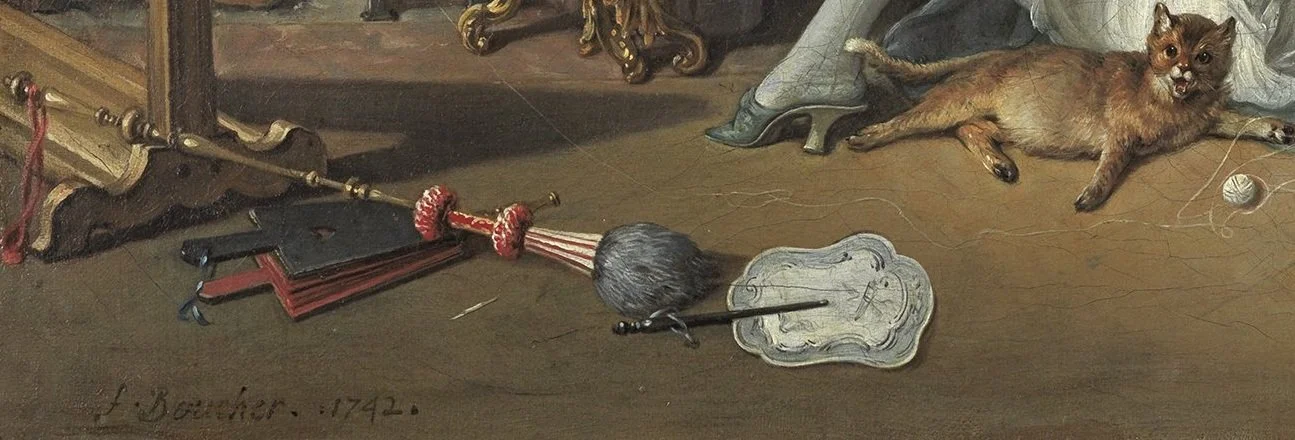
18th Century Hand Screens
Detail from La Toilette by François Boucher, 1742
Image courtesy of Museo Nacional Thyssen-Bornemisza, Madrid
The V&A provides a good description of hand screens and their function:
Handscreens were designed to screen a woman’s face from the heat of a domestic fire. They would usually be kept in pairs, at the ready, by the mantelpiece. Handscreens are typical of the type of small furnishing or dress accessory that might be decorated with silk embroidery by a woman at home, either for her own domestic use or to give as a present. Handles could be bought separately, on which the embroidery would be mounted.
(I am still looking for images of interiors with handscreens displayed at the mantelpiece.)
Du plus petit au grand, chacun me fait la cour,
Et jusqu’au petit maître, on me voit à son tour
Lui servir de rempart, et mettre sa figure
À l’ombre d’un objet dont il craint la nature.
A riddle from 1729 describing a hand screen. For more, see “On embellit mon corps pour l’exposer aux flammes, / et souvent on le peint de diverse couleur” in Dix-huitième siècle 2019.
Printed hand screen with a scene from The Barber of Seville.
On the back of the screen is a dialogue between Bartholo and Rosine corresponding to (but not a direct translation of) this scene in Rossini’s opera.
Source gallica.bnf.fr / Bibliothèque nationale de France
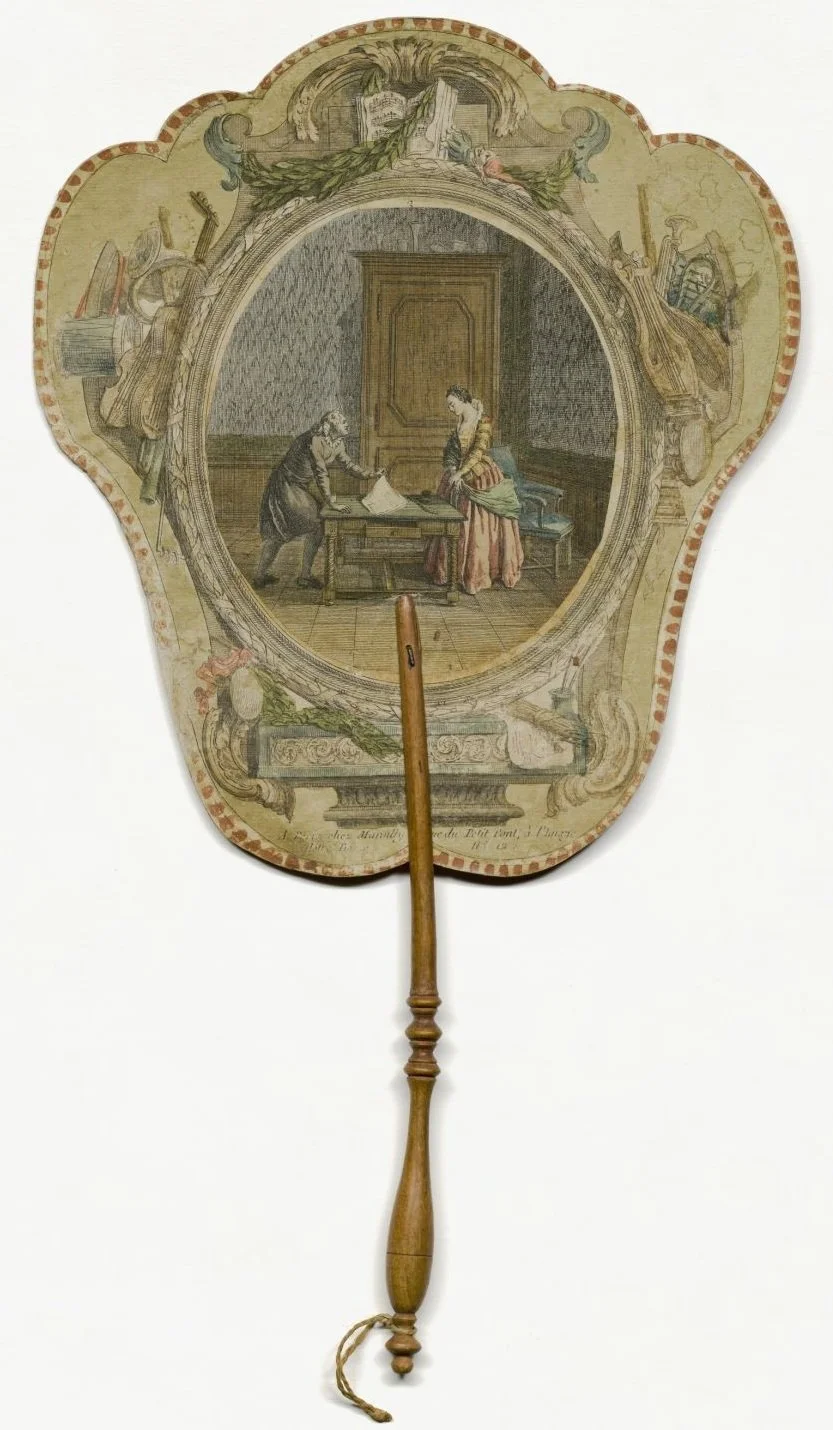
Printed handscreens
Several of the French handscreens in this section depict scenes from comic operas, often with lyrics from the operas printed on the back. Where possible, I’m grouping them together by opera. (See On embellit mon corps pour l’exposer aux flammes for more information about this type of handscreen and its use.)
Cooper Hewitt 1925-1-62, Italy, early 18th century
British Museum 1891,0713.159, France, 1729; “Hand-screen with seven stanzas of verse in the centre with four lines of music (the the first of the seven stanzas) above, titled 'Vaudeville sur la Naissance du Dauphin'”
Cooper Hewitt 1925-1-67, design for a screen fan, printed in Germany c. 1730-1750
Handscreen designs from Différentes Pensées d’Ornements Arabesques a divers usages, c. 1734-1737: V&A E.842-1905, E.843-1905, E.844-1905, E.845-1905, E.846-1905, E.847-1905, E.852-1905, E.853-1905, E.854-1905, E.855-1905, E.856-1905, E.857-1905,
Cooper Hewitt 1925-1-60, handscreen with a shepherdess, mid-18th century
Cooper Hewitt 1927-17-4, mid-18th century
Cooper Hewitt 1921-6-8, mid-18th century
Cooper Hewitt 1927-17-6 & 1927-17-7, mid-18th century
Cooper Hewitt 1921-6-23-a (peasant girl on the front and a map of Europe on the back and 1921-6-23-b (peasant girl on the front and a map of South America on the back), France, c. 1750
Scenes from “Les Moissonneurs,” c. 1768-1799: nº 1 (BNF 4-O ICO-248), nº 4 (BNF 4-O ICO-178)
Scene from “Lucile,” c. 1769: nº 6 (BNF 4-O ICO-283)
Scenes from Pierre-Alexandre Monsigny’s “Le Déserteur,” c. 1769-1789: nº 3 (BNF 4-O ICO-171), nº 5 (BNF 4-O ICO-172), nº 6 (BNF 4-O ICO-177)
BNF 4-O ICO-180, handscreen with “Le voyage à Saint-Cloud,” Paris, c. 1769-1790
Cooper Hewitt 1925-1-64, handscreen with a Chinese scene on one side and a map of Britain and a description of the British Isles on the other, c. 1769-1800
Cooper Hewitt 1927-17-5, “Le lion s’en allant en Guerre”
Cooper Hewitt 1921-6-24-a and 1921-6-24-b, France, c. 1770
Scenes from “Les Deux Avares,” 1770: Cooper Hewitt 1927-17-8, nº 6 (BNF 4-O ICO-295)
Late 18th century handscreens with images relating to Louis XV, Cooper Hewitt 1927-17-18, 1927-17-19, 1927-17-20
Scene from “Les Vendangeurs,” 1780: nº 5 (BNF 4-O ICO-260)
Scene from “Les voyages de Rosine,” c. 1783: nº 2 (BNF 4-O ICO-276)
Scene from “Blaise et Babet,” c. 1783-1793: nº 5 (BNF 4-O ICO-262)
Scene from “Fanfan et Colas,” c. 1784: Cooper Hewitt 1927-17-17
Scenes from “Les Solitaires de Normandie,” c. 1788: Cooper Hewitt 1927-17-9, 1927-17-10, 1927-17-11, 1927-17-12, 1927-17-13, 1927-17-14
Kyoto Costume Institute AC4347 82-21-10, France, late 18th century; “Copper print and hand-paint on paper with a picture of male and female figures and a text surrounded by flowers, ribbons, and agricultural tools on the one side; texts excerpted from a play script on the other side” (This is number 6 in a comic opera series.)
Cooper Hewitt 1925-2-413, late 18th century
Scene from “Le barbier de Séville,” c. 1791-1799: nº 3 (BNF 4-O ICO-265)
British Museum 1892,0817.29, “Handscreen in the shape of a spade with hand-painted peacock feathers and in the centre a medallion with a young man embracing a young woman, who holds up her apron full of flowers in her left hand and with her right hand holds a rose in the air; on the reverse classical-inspired ornament on a yellow ground,” France, c. 1790-1840
Painted paper handscreens
Cooper Hewitt 1925-1-57-a, mid-18th century
Cooper Hewitt 1911-28-138, handscreen with a picture of children on one side and a nosegay of flowers on the other, mid-18th century
Cooper Hewitt 1925-1-58, mid-18th century handscreen with an Oriental-inspired design
Cooper Hewitt 1931-25-3, mid-18th century French handscreen with Oriental-inspired design
Cooper Hewitt 1925-1-57-b, mid-18th century
Cooper Hewitt 1925-1-59, handscreen painted with a bouquet of flowers, mid-18th century
Cooper Hewitt 1925-1-65, round handscreen with a Chinese scene, mid-18th century
Cooper Hewitt 1925-1-55, handscreen with floral design, mid-18th century
Cooper Hewitt 1925-1-54, handscreen with floral designs, late 18th century
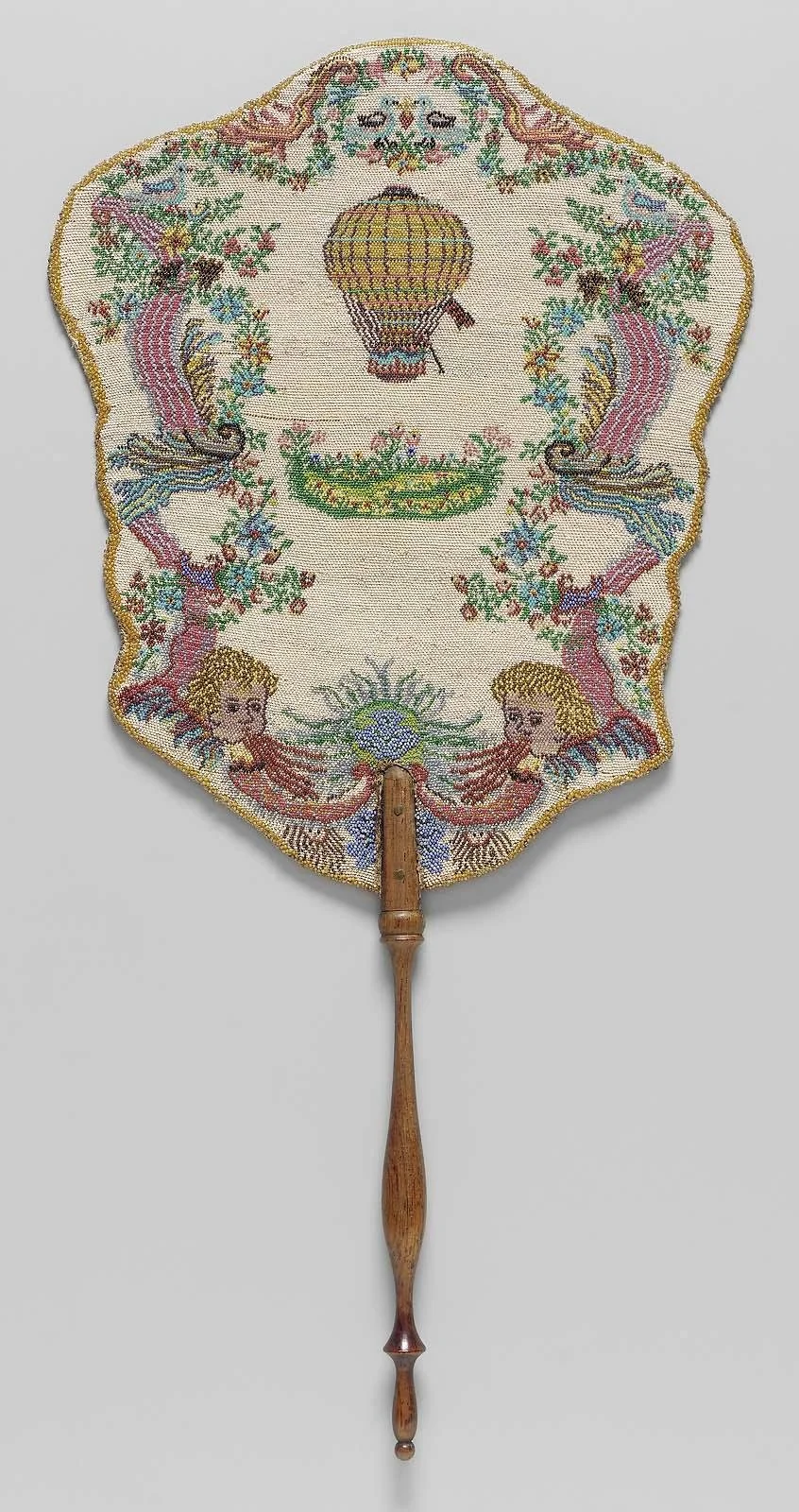
MFA 43.2426, a handscreen in sablé beadwork depicting a hot-air balloon floating on the wind, made in France c. 1785-1800
Handscreens in other media
Colonial Williamsburg 1971-1649, a hand screen or fan with floral-embroidered silk on one side and green satin on the back, Italy, c. 1680-1700
British Museum 1891,0713.286, “A handscreen (fan) showing a copse of trees and, from left to right: a woman dancing, a man playing the guitar (?), a man dancing and holding out a goblet; behind them a bust of Priapus, three small animals and a Pierrot. On the reverse some couplets pasted on to the screen and a woman carrying vegetables.”
Cooper Hewitt 1915-7-1, an embroidered silk handscreen
V&A T.93-1934 and T.94-1934, a pair of flamestitched handscreens made by Dorcas Haines in England in 1718
Met 64.101.1342, .1343, a pair of canvaswork embroidered hand screens, one with a shepherd and one with a shepherdess, first quarter of the 18th century
A pair of British canvaswork embroidered panels for hand screens from the first half of the 18th century: Met 10.126.14a depicts a shepherd, Met 10.126.14b depicts a shepherdess
Danvers Historical Society 1893.49.1, a hand screen with silk patchwork on one side and marbled paper on the other, made by Deborah Hobart Clark in Danvers, Massachusetts, c. 1730s-1750s; see also Massachusetts Quilts: Our Common Wealth
Colonial Williamsburg 1954-4, a hand screen with flamestitch in a floral design on one side and handpainted Chinese paper on the other side, possibly made in America c. 1750-1790
MFA 41.778, flamestitched on the front and plain green fabric on the back, made in New England in the second half of the 18th century
Winterthur 1958.1526, flamestitch, America, c. 1750-1800
Old Sturbridge Village 26.11.2, Massachusetts, 18th century; “It is worked in flamestitch on canvas in silk threads in shades of blue, green, rose, red, gold, tan, light brown, and black and white. The reverse is covered with an unusual embossed paper tinted in shades of green and orange.“
Concord Museum T816, a handscreen with flamestitch embroidery on one side and A View of the Salfatara (c. 1779) on the other
“Am elegant Pattern for a Hand-Screen” in The Lady’s Magazine in March 1783
“Pattern for a Hand Screen” in Walker’s Hibernian Magazine in May 1786
“A new and elegant PATTERN for a HAND-SCREEN” appeared in The New Lady’s Magazine in April 1786
Cooper Hewitt 1924-15-43-a, handpainted silk, late 18th century
MFA 43.2426, a hot-air balloon floating on the wind in sablé beadwork, France, c. 1785-1800
Depictions of handscreens
Dama Francese Vestita da Sultana con la Ventarola, 1689
A hand screen on the floor in La Toilette by François Boucher, 1742