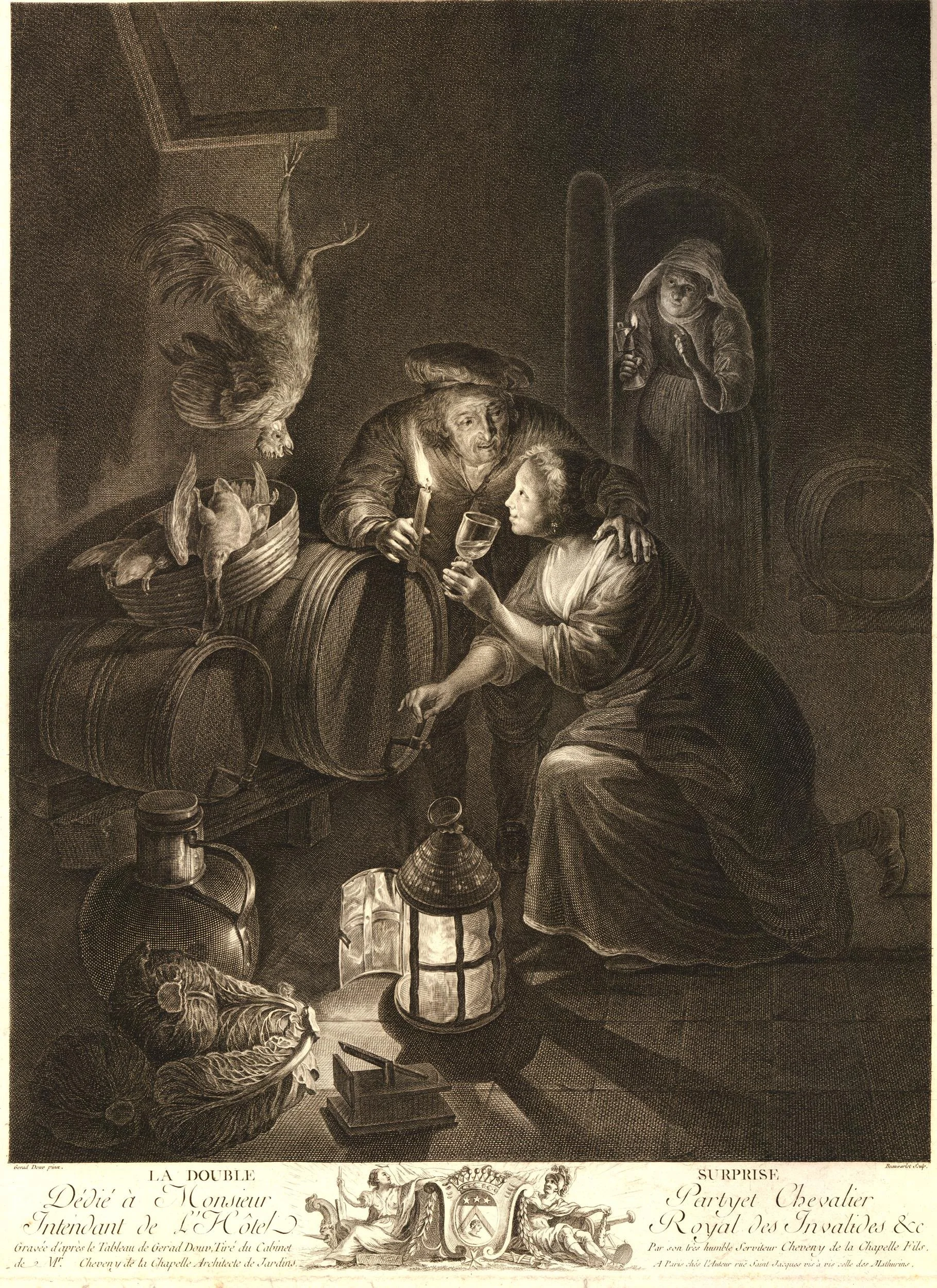
Detail from
The Double Surprise, c. 1746
© The Trustees of the British Museum. Shared under a Creative Commons Attribution-NonCommercial-ShareAlike 4.0 International (CC BY-NC-SA 4.0) licence.
18th Century
Lanterns
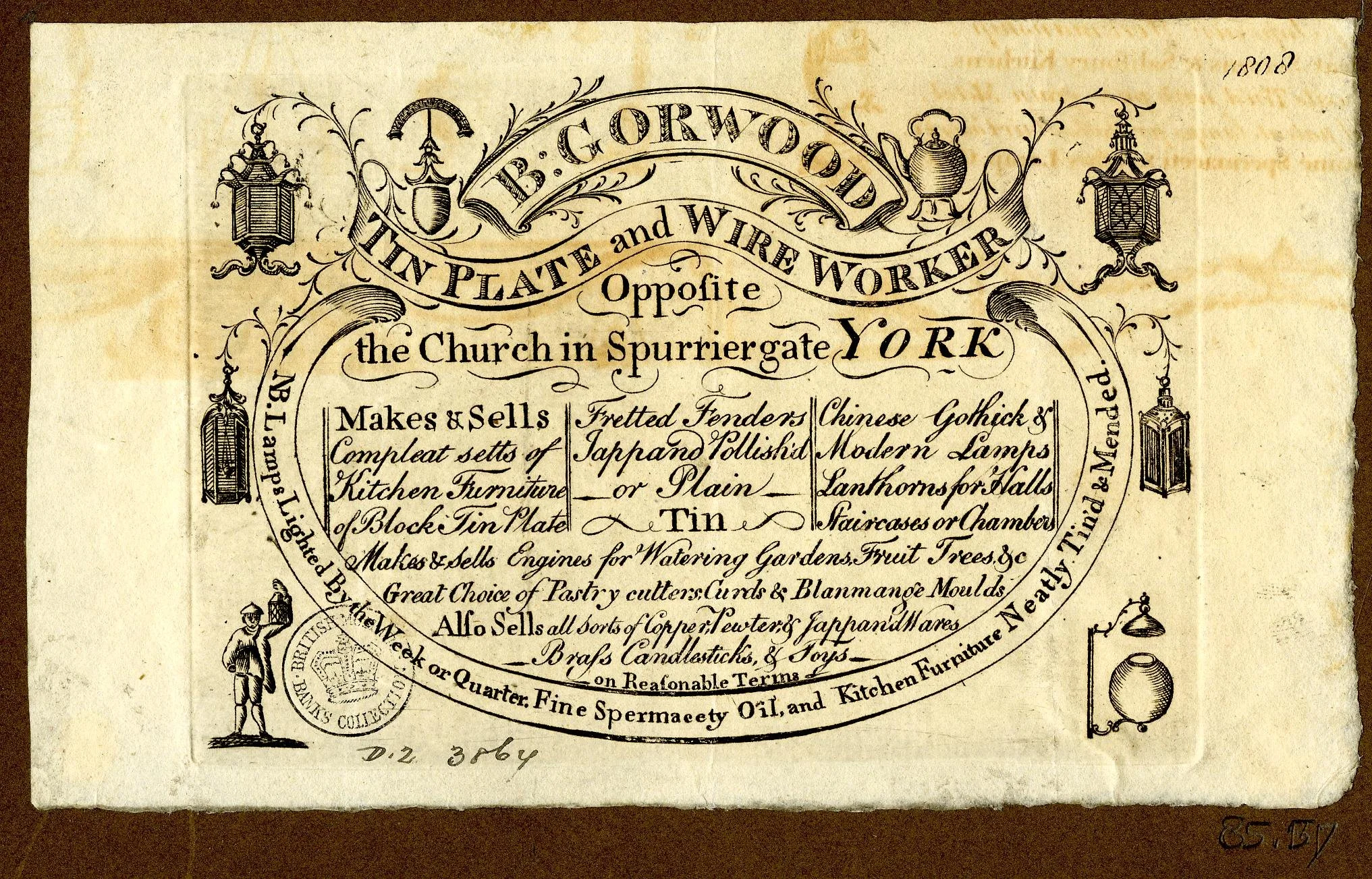
© The Trustees of the British Museum. Shared under a Creative Commons Attribution-NonCommercial-ShareAlike 4.0 International (CC BY-NC-SA 4.0) licence.
Extant lanterns from the 18th century
18th century tin lanterns at the MFA: 28.28, 28.36, 28.37, 28.38, 28.311
National Museums Scotland H.MGK 7, “Three-cornered lantern with a wooden frame and base and tin candle holder, carried by Lady Grizell Baillie when visiting her Covenanter father, Sir Patrick Hume, during his concealment in the vault beneath Polwarth Church in 1684”
V&A 1959-65, a metal lantern with a leather handle
National Museums Scotland H.MGK 5, a wooden lantern from Aberdeenshire; “The rectangular lantern has a sloping top and horn windows on three sides, with a door on the fourth side. It is bound all round with leather and a tab of leather, fixed to the door with studs, serves as a handle. There is a handle of twisted cord.”
National Museum of American History 2002.0160, a tin lantern with horn panes
Bonhams 30 September 2015, Lot 152, a 17th/18th century iron, brass and horn black-out lantern, possibly French, circa 1700; “With fluted cap topped by a knopped brass finial, the body formed from two sheet iron cylinders, the innermost sleeve swivelling to either be open, glass-lined or completely closed, fitted to the interior with a fluted sheet metal candle socket with shield, the iron strap handle bound in wicker and leather for a grip”
National Museums Scotland H.MGK 9, a brass and horn lantern dated 1750, associated with the Fairbairns of Cockburnspath, East Lothain; “It may have been used to warn vessels from the rocks at Cove in East Lothian. The lantern has horn windows and is engraved 'P FAIRBAIRN COVE 1750'. There is a lighthouse and a sailing galley incised on each of the four partitions of the frame and a design of scallops and stars on the horizontal bands.”
Isabella Stewart Gardner M19w12, an 18th century lantern from Germany; “This lantern has a double-high brass dome on top, ornate brass edges, and a flat brass bottom. Each of its four glass sides is etched with scrollwork and one side includes an etched crown and coat of arms”
V&A 155-1891, a brass and glass hand lantern, Dutch, 18th century
Concord Museum H1667, pierced tin lantern, made in America in the 18th century, and later wired for electricity
Hanes and Ruskin Y143; “This amazing lantern consists of an engraved glass inserted into a tin frame. Made on the Continent (20 years ago we bought a similar example, or maybe even this very one, in France) in the mid to late 18th century. It is in completely original condition, including the insert to hold a candle with its crimped bobeche and long handle so your fingers don't get burnt.”
Colonial Williamsburg 1958-75, America, c. 1750-1850; “Tinned sheet iron lantern composed of a cylindrical body with a conical top, surmounted by a wire-mounted carrying ring”
Colonial Williamsburg 2016-164, America, c. 1750-1850; “Tinned sheet iron lantern of unusually small size”
Colonial Williamsburg 1963-10, England or America, 1760-1800; painted iron “Lantern with circular strap suspension ring or carrying handle with moulded face and wire swivel attachment to center of top”
Concord Museum M400a1 (one of the two Paul Revere lanterns), made in Boston c. 1765-1770; “Tinned iron, glass. Rectangular shaped lantern, with four glass panels and a ring on the top. Metal has incised line design … Lantern has been identified as one of the lanterns hung as a signal in the belfry of Christ Church (Old North Church) in Boston on the night of April 18, 1775.”
Met 34.100.188, a tin lantern with horn panes, made in Pennsylvania c. 1770
Met 39.184.48a-d, a wall lantern in bronze with glass panes, made in England c. 1770
A tin lantern from Orkney, late 18th or early 19th century; “The cylindrical candle lantern has been painted green. It has a hinged door on one side, a conical top and scalloped cap with a handle linked through it. The windows are made of sheet mica, and form three rows of panes. The top row is ornamented.”
Colonial Williamsburg 2015-180, probably England, c. 1780; “Circular lantern with flat base, rectangular box-shaped hinged door with glass window; squared handle opposite door; and conical top with circular hanging ring above a square-shaped deflector/shield. Pierced with various shapes (circles, crescents, leaves, etc.) on conical top and with garland patterns on sides”
Historic New England 1991.985, possibly c. 1780-1820; “Wood frame with chamfered and notched uprights and square chamfered edge on the top and bottom; holds four rectangular panes of glass; the top has a shaped opening and is fitted with a pierced tin panel and a wire handle; the upright post projects through the top and bottom; one side has cotter-pin hinges and a loop wire.”
Manchester 1922.774, c. 1800; “Lantern made with iron fittings with ridged glass cylinder. The iron lid is pierced in two monotype patterns. Small round, fluted candle-holder lifts out by means of a long handle and hook.”
The Met has a few American punched-tin lanterns dated to the 18th or 19th centuries; see 10.125.599a, 10.125.599c, and 10.125.600
Sheet iron and horn lanterns, late 18th/early 19th centuries: Brunk Auctions Aug 1 2020, Lots 1000, 1001, and 1002
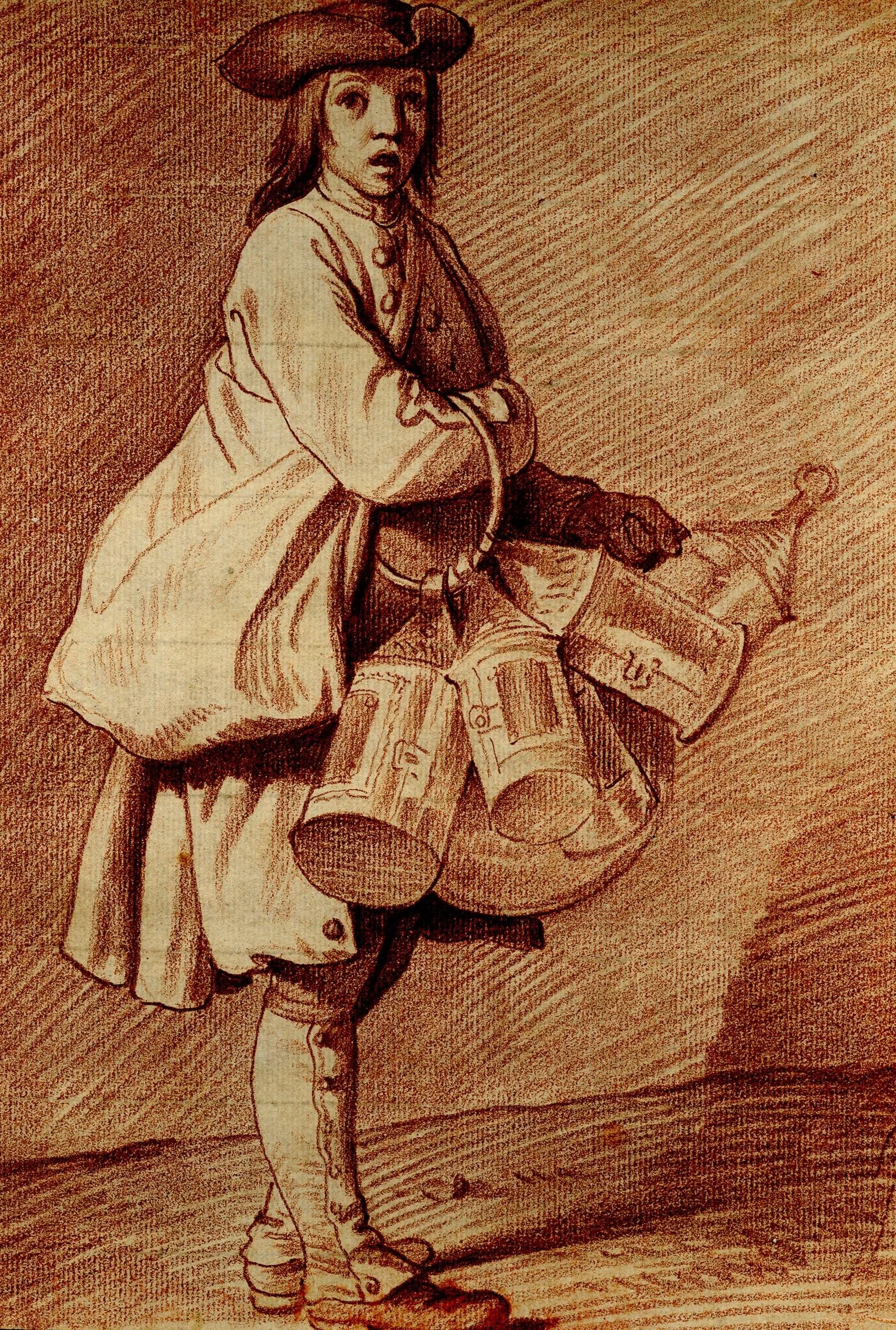
© The Trustees of the British Museum. Shared under a Creative Commons Attribution-NonCommercial-ShareAlike 4.0 International (CC BY-NC-SA 4.0) licence.
18th century illustrations and artwork featuring lanterns
An old woman counting coins, Thomas van der Wilt
A girl places a candle in a lantern, attributed to Godfried Schalcken, c. 1690-1706
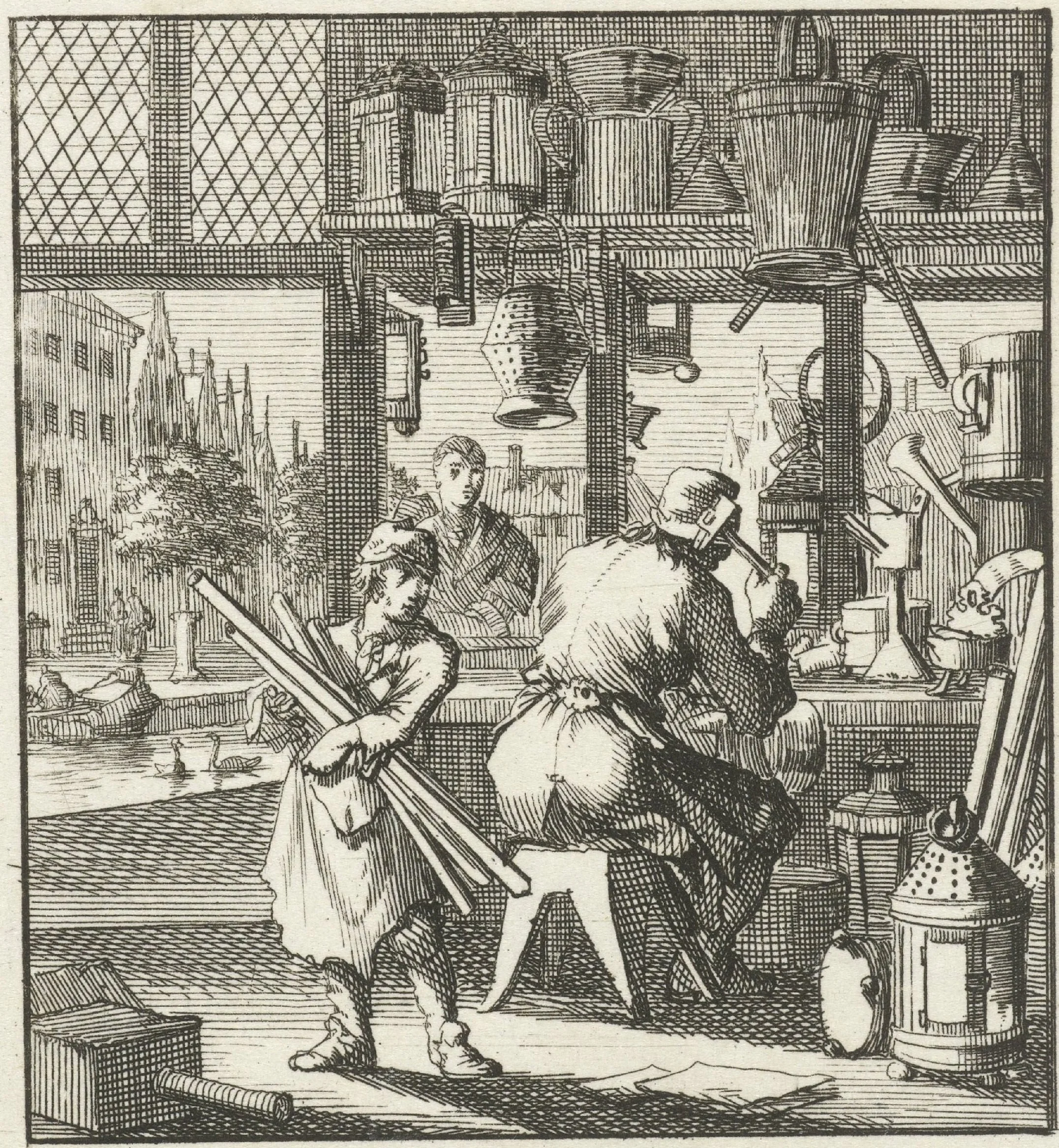
Het Menselyk Bedryf: The Lantern Maker by Jan & Caspar Luyken, 1694
Oublieur de la ville de Paris, 1708
A lantern seller by Edme Bouchardon, c. 1730s
Illustration from “Love in a Nunnery,” 1735
The Four Times of Day: Night by William Hogarth, 1736
Satire on the Act of Parliament for the suppression of gin, c. 1736
Fishmonger’s stall by Balthazar Nebot, 1737
Mr Turbutt in the Character of Sosia in “Amphitryon,” c. 1740
Illustration from Romeo and Juliet, c. 1741-1765
La double surprise (also The Double Surprize, c. 1768-1772)
Hob carrying Mr Friendly’s Letter to Mrs Flora and Hob’s petition to Sr Thomas to be saved from the well, c. 1745
Industry and Idleness: The Idle Prentice Betrayed by William Hogarth, 1747
The Four Stages of Cruelty: Cruelty in Perfection by William Hogarth, 1751
A lantern lighter and a lantern bearer illuminates the way for two figures dressed for a masquerade, Le Arti che vanno per via nella Città di Venezia, 1753
Count Matteo Alberti escorted by a servant holding a lantern by Antonio Maria Zanetti, before 1757
Mount Vernon W-15, made in England c. 1760-1761; “Square japanned lantern; four sided frame composed of tinned sheet iron enclosing shaped panes of glass on each side”
The Kitchen by Willem Joseph Laquy, c. 1760-1771
Young musicians, c. 1760-1780
The Schoolmaster, c. 1760-1780
Illustration from a story from the Heptameron by Sigmund Freudenberger, c. 1760-1781
David Garrick and Mary Bradshaw in “The Farmers Return” by David Garrick, c. 1762
High Life Below Stairs by John Collet, 1763
David Garrick as Sir John Brute in Vanbrugh’s “The Provoked Wife” by Johann Zoffany, 1763-1765
A Girl Singing Ballads by a Paper Lanthorn by Henry Morland, c. 1765-1782; The Pretty Ballad Singer by Henry Morland, c. 1768-1775
The Fond Parents, 1766
Arthur Wentworth of Bulmer, near Castle Howard, Yorkshire, 1767
The Oyster Woman by Henry Morland, 1769; shows a lamp within a lantern (see also Oyster Girl and Oyster Seller)
The letter woman, c. 1769
Search-Night, or the Ladies in Limbo, 1771
Girl bundling asparagus by John Atkinson, 1771
Still life by Jean Georges Wille, 1772
The Anatomist Overtaken by the Watch, 1773
The Guards of the Night Defeated, 1774
Old Haman the Northampton-lamp-lighter, 1774
A boy receives money from a woman by Jacob Hoolaart
Adoration of the Shepherds, c. 1774-1789
The Fond Parents, 1776
The Talle-Ho Parson Going in to Cover, 1778
Paternal Love by Étienne Aubry
Watchman, or the Night Guard of London, 1782
Dark Lanthern Business, or Mrs Hob and Nob on a Night Canvass with a Bosom Friend, 1784
The Westminster Canvass, 1784
The Sad Discovery of the Graceless Apprentice, 1785
“De note ora ai teatri, ora al Redutto / Son quell che col feral serve de lume; / E pur che i paga mi so andar per tutto,” Le arti che vanno per via nella citta di Venezia, 1785
Diogenes in Search of an Honest Man, 1787
Inn interior with a woman and baby, 1788
House-Breaking, before Sun-Set, 1789
The Social Pinch, 1789
The Earth Stopper, 1790
An Apparition, 1790
Caricature of a lamp-lighter, before 1791
The Vicar and Moses, 1790s
Fairies (Od dang it what have we got here?), 1792
Affrightened Travellers; or, the Illuminated Turnip!, 1792
A Night Mare, 1794
A Salt Water Salute, 1794
A Will'O th'Wisp, 1794
Diogenes alias A.B. in ton looking for an Honest Lawyer!!!, c. 1794-1806
Returning From a Rout on a Rainy Night, 1797
Characters in a Village Alehouse, 1797
Search-Night, or, State-Watchmen, Mistaking Honest-Men for Conspirators, 1789
The Effect of Imagination: A Gown metamorphose’d into a GHOST!! by Isaac Cruikshank, 1797
Provincial Wit / Provincial Politeness by Isaac Cruikshank, 1797
Diligence and Dissipation: The Wanton Revelling with her Companions, 1797
John Bull’s Watchman Neglecting his Duty!!!, 1800
Two children reading by lanternlight by Abraham van Strij
Coming out of a Country Theatre, 1802
A night watchman sees a seller of caller oſts in the Cries of Edinburgh, 1803
A watchman making his rounds by Thomas Rowlandson
The Miseries of the Country by Thomas Rowlandson
Night Watchman by Thomas Rowlandson
Attacking the night watchman by Thomas Rowlandson
Science Museum 1934-440, horn lantern made in England c. 1790-1850
Concord Museum H400, perforated tin lantern made in America, late 18th-early 19th century
Concord Museum H2252.0001, Japanned rectangular lantern, probably made in New England in the late 18th or early 19th century
Sotheby’s July 5 2000, Lot 19, a painted tin and horn lantern from the gun decks of HMS Victory, English, c. 1800
An Easy Reply, 1804
The Cauldron-Scrubber by Abraham van Strij, c. 1808-1810