18th Century Women’s Mitts
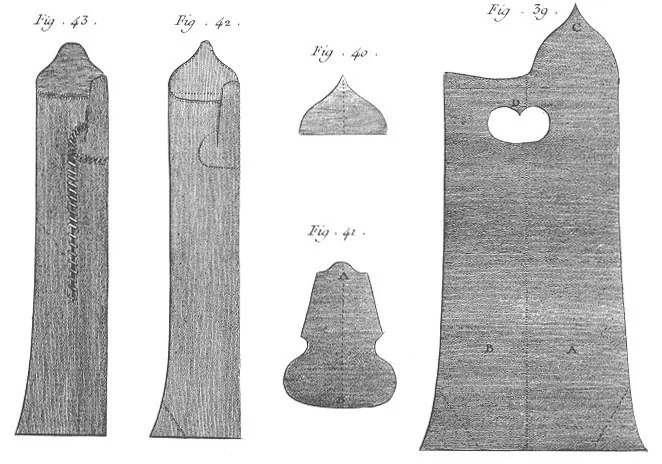
Diagrams relating to the construction of women’s leather mitts from the Encyclopédie ou Dictionnaire raisonné des sciences, des arts et des métiers (1765).
39. The trank (main piece) of the mitt. A. the outside of the hand; B the inside; C the point; D the opening [for the thumb].
40. The lining of the point of the mitt.
41. The thumb. A the top; B the side near the opening.
42. Finished mitt.
43. Finished embroidered mitt.
Additional Resources
This site contains affiliate links for which I may be compensated
Tutorials and mitts made by Burnley & Trowbridge (Part 1 & Part 2), SewLoud, A Fractured Fairytale, A Sartorial Statement, Augustintytär, CFGriffith,Costume Diva, Mr Spinalzo
Costume Close Up: Clothing Construction and Pattern, 1750-1790
What Clothes Reveal: The Language of Clothing in Colonial and Federal America
The American Duchess Guide to 18th Century Dressmaking
Kannik’s Korner Stockings, Pockets & Mitts pattern
At the Sign of the Golden Scissors 18th Century Mitts Pattern
Embroidery patterns for mitts & gloves
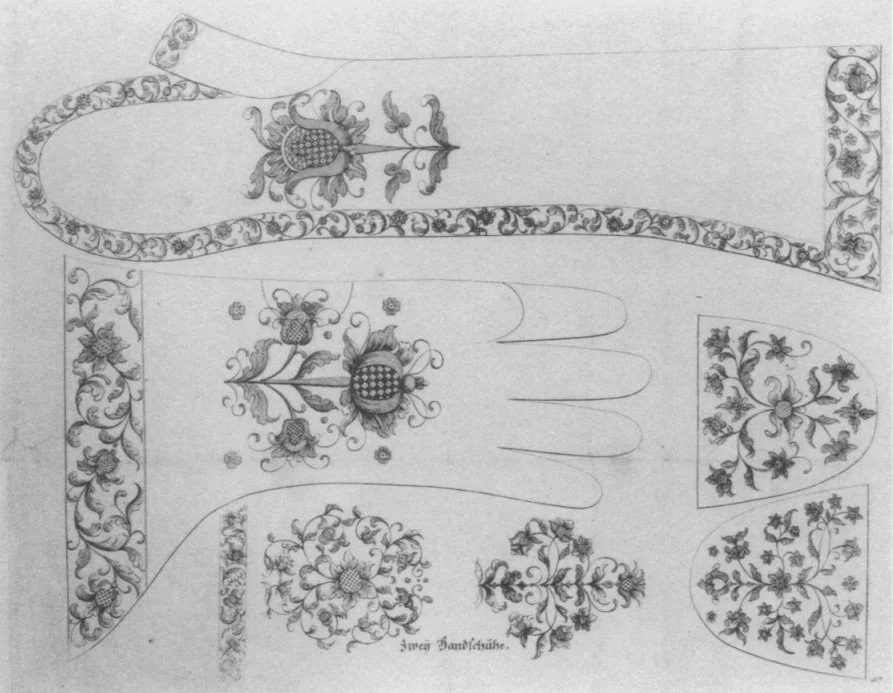
Margaretha Helm’s embroidery patterns for mitts and gloves from Kunst-und Fleiss-übende Nadel-Ergötzungen oder neu- erfundenes Neh- und Stick-Buch, 1725. This is from Met 30.68.18 (Ephemera and the Print Room), but it can also be found in V&A E.3408-1932, Cora Ginsburg’s 2005 catalog, and this auction lot.
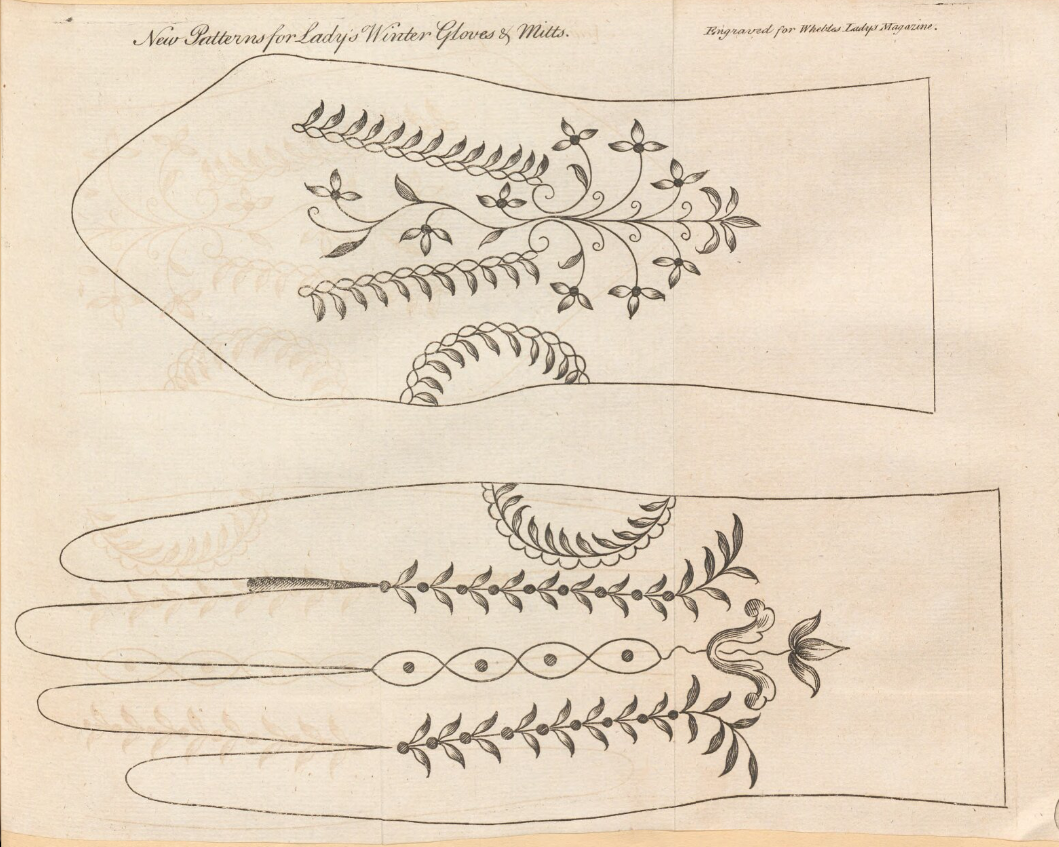
This embroidery pattern was published in The Lady’s Magazine in December, 1772, and reappeared in The New Lady's Magazine in January 1787.
I’m dividing up different extant mitts by aspects of their materials and construction below, but this doesn’t necessarily mean that only specific types were available or accessible at any particular time; I’m just trying to cluster similar examples together rather than providing a chronological list. A 1786 advertisement in Philadelphia advertised “Women and girls black and coloured worſted gloves and mitts” (i.e., knit) along with “Womens lamb gloves and mitts” and “Womens black and coloured ſilk gloves and mitts,” for example.
When selecting styles of 18th century mitts for a living history outfit, consider how you’ll be wearing them — a simple pair in off-white or unbleached linen will help protect your arms from sunburn while you’re working outdoors on a sunny day, while an embroidered pair of silk mitts will be more appropriate for a formal occasion. Different styles seem to be associated with different sorts of women; simpler pairs in linen or cotton for Quakers, for example. Mitts could be economically upcycled from old stockings.
Cloth mitts
Met 2009.300.2673a, b, embroidered silk, Britain, first quarter of the 18th century; “the design on these mitts is worked in a naturalistic style with the use of gradated color that adds depth and richness to the motifs. As an extra luxurious detail, the underside of the V-shaped extension, which would not have been visible, carries its own delicate floral embroidery.”
Velvet mitts, mostly Italian
Met 2009.300.2676, velvet-covered leather with metal-thread embroidery, Britain, c. 1680-1720
Met 2009.300.2674a, b, silk with metal-thread embroidery, Britain, c. 1680-1720
MFA 38.1329a,b, embroidered velvet, Italy; “Black velvet with crimson velvet turned back cuffs. The mitts and ruffles embroidered with gold thread in rococo floral pattern. Trimmed with gold bobbin lace.”
MFA 38.1331a,b, embroidered velvet, Italy; “Black velvet embroidered with silver (conventionalized vine and fruit, border and over hand). Lined with bright salmon pink silk. Open; six small buttons on one mitt, five on other.”
MFA 38.1332a,b, embroidered velvet, Italy; “Black velvet embroidered with gold thread, and lined with deep reddish orange silk. Embroidered motif on flap over hand alike on face and reverse. Mitts not fastened, on one three button-holes on each side, on other similar button-holes and six small buttons.”
Met 26.56.104 and Met 26.56.105, Italy, c. 1750-1775
MFA 38.1355a,b, Italy, “Black velvet embroidered with silver (rococo floral border and floral motif in center). Lined with salmon, green, white, silver and gold brocade. Open, no fastenings.”
MFA 43.1972a,b, Italy, “Black silk velvet embroidered with gilt-silver yarns and wires in vining motif on flap and cuff. Gilt-silver galloon at edges and button-holes, gilt-silver buttons. Pink silk lining.”
Met C.I.44.8.5a, b
Met C.I.44.8.17a, b, silk
Met C.I.44.8.7a, b, silk
Rijksmuseum BK-NM-8539-A, white cotton mitts with whitework floral embroidery, c. 1745-1800
Rijksmuseum BK-NM-12188-A-1/BK-NM-12188-A-2, grey-blue shot silk taffeta mitts lined with linen, embroidered on the back, c. 1750-1800
The Rijksmuseum has several pairs of white linen mitts with monochromatic (usually red, sometimes blue) embroidery, c. 1750-1800, including: BK-NM-8258-A/BK-NM-8258-BBK-NM-8538-A/BK-NM-8538-BBK-1978-375-B-1/BK-1978-375-B-2BK-1978-375-A-1/BK-1978-375-A-2BK-1978-377-A-1/BK-1978-377-A-2BK-1978-377-B-1/BK-1978-377-B-2
MFA 38.1340a,b, probably Italy; “Pinkish orange silk with cuffs of cream colored silk damask trimmed with gold thread worked in chains and sewed to mitts.”
MFA 38.1346a,b, child’s mitts, Italy; “Pair of crimson silk mitts. Design: conventionalized flowers and foliage, embroidered with gold thread and spangles, on back of each hand, and around fingers and thumbs. Lined with linen, point over fingers lined with crimson velvet.”
S-curve
Colonial Williamsburg 1985-216,1, England, c. 1760-1780; “Pair of mitts (fingerless gloves) in cream silk taffeta, ribbed tabby weave, lined with white leather. The mitts have a point over the hand that could be folded back to reveal blue silk lining. Set-in thumb cut off at tip, serpentine open work band at underside of arm for expansion. Blue silk needlework herringbone stitch edgings. Cut on bias of silk … The embroidery on these mitts has a useful as well as decorative function. The stretchy fagoting and herringbone stitches hold the pieces together while providing ease for pulling the mitts on and off.”
MFA 38.1338a,b, probably Italy; “Blue silk trimmed with bright pink silk and embroidered with flowers worked in long and short stitch with pink, blue, green, and yellow silk and tarnished metal thread.”
Met C.I.44.8.8a, b, silk
Met C.I.44.8.18a, b, silk
Simple cotton mitts
A pair of fine white cotton mitts, c. 1750-1800, in Fitting & Proper
Met 2009.300.2130a, b, cotton, Britain, c. 1770
MFA 44.367a,b (undated); white cotton
Colonial Williamsburg 2009-43,6A&B, a pair of white cotton (possibly nankeen) mitts from a family of Philadelphia Quakers, c. 1785-1840
Linen mitts
LACMA M.80.43.4a-b, linen with silk embroidery, probably made in India for the Western market, c. 1700-1725
Museum Rotterdam 20890-1-2, a pair of mitts of unbleached linen with white embroidery on the back
Met C.I.44.8.9a, b
DAR 99.72.1, “bias-cut diaper-woven linen mitt with lace trim, 1780-1810”
Met 2009.300.1685a, b, American, 1800-1824
MFA 43.1968a,b(undated); light brown linen
Monmouth County Historical Association 3042.1, brown linen mitts made in Forty Fort, Pennsylvania, c. 1790
Karen Augusta 2433, embroidered mitts, America, c. 1790-1800; “Unbleached cotton muslin, tan embroidery floss, metallic thread, brass spangles, silk ribbons … Trailing floral design is delicately embroidered in a tambour stitch embellished with tiny spangles.”
MFA 38.1236, Italy or France, 18th or early 19th century; “Pair of changeable taffeta, with delicate wreath of flowers embroidered around hand, and sprig of flowers on back of hand, worked with green and pink silk and tarnished sequins. Feather stitch in cream colored silk around hand and thumb.”
V&A T.30&A-1973, Britain, c. 1780-1800; “A pair of women’s elbow-length mittens in yellow taffeta with gusset thumb and point at back of the hand. The seams are embroidered over in herringbone stitch with white silk. The points are raised with outline stitch in white silk.”
MFA 38.1263, yellow taffeta mitt, probably France, late 18th or early 19th century
MFA 43.1969a,b (undated); satin embroidered with white silk
London Museum A15175, invoice issued by London haberdasher Francis Flower to Mrs Hucks, July 21, 1757, for “3 pr Black Lutestring Mitts”
Met 1979.175.5a, b, cotton lace, Britain, late 18th century
Knit mitts
Met 2009.300.2675, silk and metal thread, late 17th century; “Knitted in the round with no seams, this mitt is among a finite number of extant 17th century silk and metallic knit objects. Fine workmanship was required to incorporate the rigid metallic yarns into the silk stockinette without distorting the pattern. The brocade lining at top of this piece adds both beauty and stability to the knitted extension.”
MFA 38.1335a,b, Italy, 17th century; “probably ecclesiastical. Knitted silk with polychrome design of conventional carnation motif on flap and upper arm, decorative bands along bottom with letters on white ground.”
Kerry Taylor Auctions 12 Dec 2016, Lot 37, “A rare pair of ladies’ knitted silk and metal thread mittens, probably Italian, late 17th-early 18th century, of fine rose-pink silk with diapered and spotted patterns in gold and silver thread, the curved finger guard lined in lustrous gold braid, and edged with gold fringes”
Glove Collection Trust 23416, c. 1675-1725; “A pair of womenswear elbow-length mittens, in ivory knitted silk and cotton mix fabric with a design of flowering plant sprouting carnations and honeysuckle amid small birds worked in pink and green silks, zig-zag band worked in blue silks.”
Colonial Williamsburg 1991-555,1, knit linen mitts, England, c. 1700
Glove Collection Trust 23417, c. 1700-1725; “A pair of womenswear mittens, in pink knitted silk and cotton with a design of carnations and pomegranates worked in yellow, white and green silks.”
MFA 38.1234, Italy; “Openwork knitting in coral colored silk with flap of plain knitting over hand. Lined with brocade (silver, gold, green and coral). Three lines of gold embroidery on back of hand.”
Rijksmuseum BK-1978-374-B, light turquoise knitted silk mitts trimmed with silver lace and lined with brocade on the hand, c. 1750
Rijksmuseum BK-1978-376-A/BK-1978-376-B, blue silk knit mitts with an openwork floral pattern, c. 1750-1780
The Rijksmuseum has knit silk mitts in striped patterns, often with lace trim, from the Zaan district in the Netherlands in the second half of the 18th century, including: BK-NM-12130-A/BK-NM-12130-B, BK-NM-12128-B, BK-NM-12129-A, BK-NM-14313-H-2, BK-16063-D/BK-16063-E
Rijksmuseum BK-NM-8256-A/BK-NM-8256-B, silver-blue knit silk mitts with a floral motif, c. 1750-1800
The Rijksmuseum has several knit mitts in white cotton, mostly dating to c. 1750-1800, including: BK-1978-372-A-1/BK-1978-372-A-2, BK-1978-372-B-1/BK-1978-372-B-2, BK-1978-373-A/BK-1978-373-B, BK-NM-8257-A/BK-NM-8257-B, BK-NM-10254-2-A/BK-NM-10254-2-B, BK-NM-10254-4-A/BK-NM-10254-4-B, BK-NM-10254-5-A/BK-NM-10254-5-B, BK-NM-10254-6-A/BK-NM-10254-6-B, BK-NM-10254-7-A/BK-NM-10254-7-B, BK-NM-10254-8-A/BK-NM-10254-8-B, BK-NM-10254-9-A/BK-NM-10254-9-B, BK-NM-10254-10-A/BK-NM-10254-10-B, BK-NM-10254-11-A/BK-NM-10254-11-B, BK-NM-10254-13-A/BK-NM-10254-13-B, BK-NM-10254-14-B, BK-NM-10298-A/BK-NM-10298-B, BK-NM-10299-C/BK-NM-10299-D
“217. KNITTING MITTS. For the greateſt quantity of Mitts made of thread, in imitation of lace, and made with knitting-needles, fit for womens wear; not leſs than one dozen pair; each pair to be not leſs than fourteen inches in length, made by one perſon; the goodneſs, clearneſs, and fineneſs of the work, and beauty of the pattern, to determine the preference; Twenty Guineas. The whole ſum to be divided in proportion to the merit; to be produced on or before the firſt Tueſsday in January, 1766.” (Museum rusticum et commerciale, Premiums offered by the Society for the Encouragement of Arts, Manufactures, and Commerce, for Encouraging and Improving Manufactures)
Concord Museum 2006.351A & 2006.351B, knit cotton, said to have been knit during the Battle of Lexington
A pair of stützl knit of black wool with metallic pattern; see also votive wax effigy from Kaufbeuren, 1776
MFA 99.664.18a-b, a pair of mitts, possibly made in England (worn in Lexington, Massachusetts), late 18th century; “Frame-knitted silk lined with silk satin and trimmed with silk cord … Knitted black mitts with vertical openwork bands; black cord trim at finger and thumb openings, fringe at arm opening; flap lined with black silk satin”
Colonial Williamsburg 2018-255,1&2, cream hand-knit linen mitts with blue cross-stitched initials on each (“A S” for Abigaile Steere), Massachusetts, c. 1780-1800; see also Knitted Mitts, and the 18thc Women Who Wore (and Didn’t Wear) Them
Karen Augusta 2432, knit mitts of unbleached flax thread, America, 1787; “An intricate repeat of diamonds and interlocking parallel bars makes up the body of the pattern. Each mitt's top border has a knit monogram and date worked into it: ‘R M R 1787’.”
National Trust 657607, c. 1795-1805; “A pair of Regency cream knitted silk elbow-length 'mits' or half gloves covering the palm of the hand, with a short thumb open at the end. The body of the glove has a machine-stitched lace pattern, with three lines of stitching on the back of the hand.”
DAR 99.72.2, a pair of green silk mitts repurposed from a pair of silk stockings; “The feet have been cut off and some of their fabric has been used to make the thumbs; the openings are bound with matching green silk satin ribbon. The striped tops of the stockings have been retained.”
Additional Resources
Tutorials and mitts made by longrunknitter (includes pattern), amostpeculiarmademoiselle
Patterns for knit mitts by Mara Riley and Gloria Sheu
The knit armlet in The Workwoman’s Guide (1840)
Leather mitts
Rijksmuseum BK-KOG-1750-A/BK-KOG-1750-B, chamois leather mitts decorated with green, pink, white, and yellow silk, c. 1750-1800
National Trust 1362792.1/1362792.2, c. 1760-1810; “elbow length buff coloured leather mittens with 1 in vent at top, open thumbs. Hemmed lower edge with five rows of embroidered silk pointing embroidered around the thumb piece … Slightly later in date than 1760, due to the fact that the backs are not peaked but straight.”
MFA C.I.44.8.27a, b, embroidery on lining of flap
MFA 43.1966a,b (undated), “Pair of brown leather mitts, bird and flowers embroidered with polychrome silks on back of hand.”
MFA 43.1973 (undated); “Single dark brown leather mitt, polychrome silk embroidered flowers on back of hand.”
MFA 38.1248a-b, crimson soft leather mitts with cream-colored silk braid, France or Italy, 18th or early 19th century
18th century depictions of girls and women wearing mitts
Detail from Moll’s arrival in London (The Harlot’s Progress) by William Hogarth, 1731-1732
Patrician interior by Jan Jozef Horemans II
Conversation piece (portrait of a family) by Joseph Francis Nollekens, 1740
Mother and child with a parakeet by Pierre Allais, 1740
Lady in a red dress with an embroidered headdress, c. 1740-1770
Pamela shows Mr Williams a hiding place for their letters by Joseph Highmore, c. 1744
Pamela having divided her clothes into three bundles …, 1745
Interior with a wool-winding girl by Louis Aubert, 1746
Patrician Interior by Jan Jozef Horemans II
Portrait of an old lady, c. 1750-1790
Portrait of a lady in a landscape by Arthur Devis, 1750
Sir Joshua Vanneck and his family by Arthur Devis, 1752
Madame Roubiliac by François Xavier Vispré, c. 1760
A lady with hands folded by Samuel Scott, c. 1760
Mrs. Oswald by Johann Zoffany, c. 1763-1764
Mrs. Thomas Boylston (Sarah Morecock) by John Singleton Copley, 1766
Mrs. Sylvanus Bourne by John Singleton Copley, 1766
The Lady with the Veil by Alexander Roslin, 1768
Mrs. Robert Hooper (Hannah White) by John Singleton Copley, 1767
Mrs. James Russell (Katherine Graves) by John Singleton Copley, c. 1770
María Luisa de Borbón, gran duquesa de Toscana by Anton Rafael Mengs, 1770
Mrs. Humphrey Devereux (Mary Charnock) by John Singleton Copley, 1771
The Spirit is Willing but the Flesh is Weak, 1773
Is this my daughter Ann, 1774
The Mutual Embrace, 1774
Pages 69 and 79 in an untitled album of watercolor paintings, c. 1775
Miss Crewe by Sir Joshua Reynolds, c. 1775
Mrs. James Smith and grandson by Charles Willson Peale, 1776
La Paysanne, Les Costumes François, 1776
Lady Caroline Howard by Sir Joshua Reynolds, c. 1778
Portrait of the Sayer family with a view of Bridge House, Richmond and the Shakespeare Temple beyond
Mrs. Samuel Chandler by Winthrop Chandler, c. 1780
Sophia Dumergue by Johann Zoffany, c. 1780
The Twelve Months: February and March, 1781
A Girl Gathering Filberts by William Redmore Bigg, 1782
The Haymakers by George Stubbs, 1783
Portrait of a lady by Ralph Earl, 1784
The Haymakers by George Stubbs, 1785
Reapers by George Stubbs, 1785
A Visit to the Grandmother, 1785
Mrs. Jordan, in the character of the Country Girl, 1786
Penelope Boothby by Joshua Reynolds, 1788
Mrs Martyr as Rose, 1792
Mrs. Joseph Wright (née Hannah Gilbert) by Ralph Earl, 1792
The Spreull Family by David Allan, c. 1793
Haymakers by George Stubbs, 1794
An older housekeeper wears mitts in several plates of Diligence and Dissipation, including The Modest Girl and the Wanton, Good Advice from an Old Servant to the Young Ones, and The Wanton turn’d out of Doors for Misconduct, 1797
The Reapers by James Ward, 1800
Mrs Mary Garnett by Thomas Barber the elder, c. 1800
Portrait of a young girl, said to be a Stanley of the Derby family, by John Hoppner, c. 1805