18th Century Sleeve Buttons & Sleeve Links
A pair of shank-buttons linked together for the cuff of a lady’s shift or a man’s shirt. Some modern sources refer to these as cufflinks.
A more precise description from Diagnostic Artifacts in Maryland: “button-like clothing attachments that were not actually sewn to the garment. For the most part, this category consists of pairs of buttons attached by a metal chain link or bar, known today as cufflinks. Each button could be inserted into a buttonhole, and the tension between the two buttons connected by the metal link would hold the garment together.”
Gold sleeve-buttons appear in wills (for example, the wills of Thomas Fisher, 1771, and John Barclay, 1779). Sleeve buttons also appear in over 100 court cases in the Proceedings of the Old Bailey between 1734 and 1800, including silver sleeve buttons and gold sleeve buttons.
(Modern reproductions of 18th century sleeve links & sleeve buttons are available from At the Eastern Door, At the Sign of the Golden Sciessors, Burnley & Trowbridge, Goose Bay Workshops, Najecki Reproductions, and Wm Booth Draper.
Additional Resources
British cuff links in the Portable Antiquities Scheme database
Diagnostic Artifacts in Maryland: Sleeve Buttons, Cufflinks, and Studs
Linked Buttons of the Middle Atlantic, 1670-1800
Virginia Gazette Index (s.n. “Buttons, sleeve”)
Casemates and Cannonballs: Archeological Investigations at Fort Stanwix National Monument
Sleeve buttons in American Artifacts of Personal Adornment, 1680-1820
Buttons and Sleeve Buttons in A Guide to the Artifacts of Colonial America
18th Century Material Culture: Shirt/Sleeve Buttons I and Shirt/Sleeve Buttons II
The Fox: A Bygone Symbol of Liberty (includes a list of “TALLIO” sleeve links found at archaeological sites in the American colonies)
Extant 18th century sleeve buttons
Post-medieval linked buttons at the London Museum, including 2009.33/655
Queen Anne cufflink found on the Thames foreshore
V&A M.30&A-1960, “gold, set with a cipher in gold wire under crystal,” early 18th century
Winterthur 1953.0165.001 A and 1953.0165.001 B, silver sleeve buttons made by Francis Richardson in Philadelphia, 18th century
Winterthur 2000.0048.001 and 2000.0048.002, gold engraved sleeve buttons made in Boston, 1720-1750
Yale University Art Gallery 1959.17.2a-b, a pair of round gold sleeve buttons with engraved rosettes made by Paul Revere Sr. in Boston, c. 1725-1735
V&A 962-1864, agate set in silver, mid-18th century
Met 40.53.1 and 40.53.2, octagonal gold sleeve buttons engraved with rosettes, probably made by Jonathan Clarke in Providence or Newport, Rhode Island, c. 1740
Pair of gold cuff links attached to a card indicating that they were “Given by Prince Charles Edward to Flora Macdonald during his flight AD 1746”
MFA 62.959a and 62.959b, octagonal gold sleeve buttons with rolled edges and engraved with stylized rosettes, made in Boston c. 1750
Met 67.82.1, octagonal gold sleeve button made by William Simpkins in Boston, c. 1750
Met 67.82.2, round gold sleeve button with floral engraving, c. 1750
Winterthur 1952.0276.001, octagonal gold engraved sleeve button made by James Butler in Boston, 1751-1776
Portrait of the artist’s son as a boy by Philip Mercier, 1756
Historic New England 1932.507ab, square cuff links “composed of quartz with beveled edges and red foil back, center features two gold interlocking Cs within a gold frame, all set in gold and connected with S link,” c. 1760-1800
Historic New England 1927.830, square cuff links “composed of pastes with beveled edges set over a red foil back. The center features a gold wire pseudo-cipher, all set in silver and connected with an S link.” c. 1760-1800
MFA 1978.428, a child’s linen shirt with “gold double button cuff links with incised blossoms,” Boston, c. 1764
Cooper Hewitt 1916-29-40-a,b, silver oval links engraved with initials
Mount Vernon 1785993, pair of cast copper alloy sleeve buttons with link
Met 59.173.1 and 59.173.2, engraved gold oval links made by Daniel Rogers in Newport, Rhode Island, c. 1770-1792
Winterthur 1962.0236.001 and 1962.0236.002, silver sleeve buttons engraved with the initials E M, made in England or the United States, c. 1770-1800
A Campaign Button of the 18th-Century (Or was it?) - a glass inset for a button molded with PHIPPS AND DELAVAL, made in 1774, found in Baltimore County, Maryland
Colonial Williamsburg 2007-103, two-button “Tallio” brass sleeve links, made in England c. 1775
William Paca’s “Sleeve Buttons,” which are also brass “Tallio” buttons
NT 1298809.1, NT 1298809.2, and NT 1298809.3, 18th century gold sleeve links inscribed with 'John Egerton' under faceted crystal
Peabody Museum 2014.14.815, a set of paste sleeve buttons in pewter and cut glass, found at Harvard Yard,s c. 1700-1820
Lady’s Repository Museum: Rare 18th c Sleeve Links, mother of pearl buttons joined with a linen thread
Historic New England 1932.80ab, “pair of brilliant cut crystal cuff links with red foil backs set in silver connected with S link,” c. 1780-1820
Colonial Williamsburg 2020-25, two pairs of brass cuff links mounted on their original cardstock with paper cover, probably made in Birmingham c. 1785
Mount Vernon W-2558, gold enameled sleeve buttons made in England c. 1797
Historic New England 1928.1112-1114, “three silver octagonal shaped cuff links, two with an engraved geometric design and one with an engraved floral design,” c. 1800
Nelson’s buttons, a set of octagonal blue linked buttons embossed with floral motifs said to have been “taken from the Shirt worn by Vice-Admiral Viscount Nelson, shortly after the Mortal Wound received by him 21 October, 1805 on board H.M.S. Victory.”
Portraits and illustrations of people wearing sleeve buttons
The Pot-Boy, c. 1720
Elizabeth “Betje” Van Dyck Vosburg by Pieter Vanderlyn, c. 1725
Adam Winne by Pieter Vanderlyn, 1730
Life-size horse with huntsman blowing a horn by John Wootton, 1732
The House of Cards by Jean-Siméon Chardin, c. 1736-1737
Deborah Glen, c. 1739
Jacques Dumont Le Romain playing the guitar by Maurice Quentin de la Tour, by 1742 (also here)
The Duke of Devonshire’s Flying Childers by James Symour, 1742
Cornelis Wynkoop by Pieter Vanderlyn, c. 1743
The Hon. John Spencer, his son the 1st Earl Spencer and their servant, Caesar Shaw by George Knapton, c. 1744
Portrait of two boys, probably Joseph and John Joseph Nollekens by Joseph Francis Nollekens, c. 1745
The idle 'prentice return’d from sea & in a garret with a common prostitute, 1747
Trade card of William Baylis, pencil seller, c. 1748
Louis François Roubiliac by Andrea Soldi, 1751
A Sportsman by Edward Haytley, 1752
Joseph Mann by John Singleton Copley, 1754
Young girl writing a love letter by Pietro Antonio Rotari, c. 1755
The Comte and Chevalier de Choiseul as Savoyards by François-Hubert Drouais, 1758
Benjamin Badger by Joseph Badger, c. 1760
Mrs. Richard Galloway by John Hesselius, 1764
Joseph Warren by John Singleton Copley, c. 1765
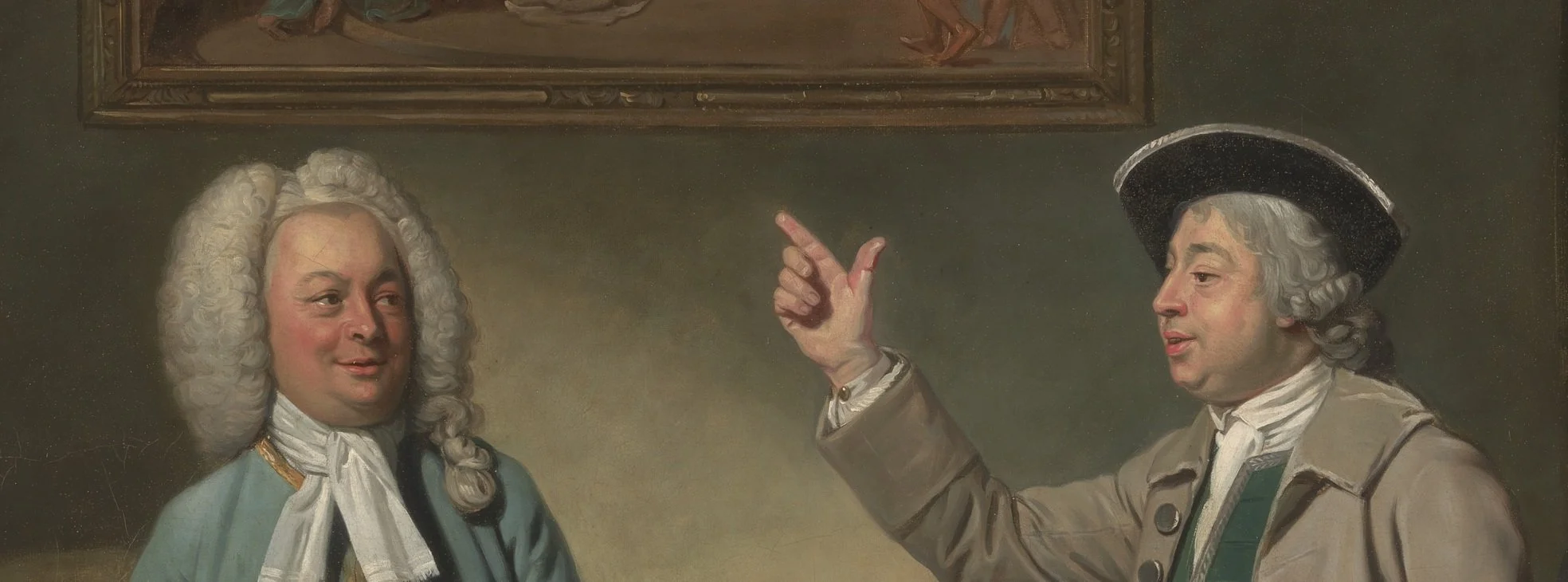
A scene in Love in a Village by Johan Joseph Zoffany, 1767; see versions at the Detroit Institute of Arts and Yale Center for British Art
Joseph Pemberton by James Claypoole, Jr., c. 1767
An experiment on a bird in the air pump by Joseph Wright of Derby, 1768
Fleetwood Hesketh by Joseph Wright of Derby, 1769
The Sailor’s Pleasure, 1770
Joseph Nollekens by Mary Moser, c. 1770-1771
Thomas Nuthall with a dog and gun by Sir Nathaniel Dance-Holland
Portrait of a man, possibly John Baird by John Durand, c. 1770-1776
Richard Cocke IV by John Durand, 1771
Reverend Ebenezer Gay, Sr. by Winthrop Chandler, 1773
Benjamin Waterhouse by Gilbert Stuart, 1775
Married Moravian woman by Johann Valentin Haidt
Capt. Paul Jones shooting a sailor who had attempted to strike his colours in an engagement, 1780
A young mariner by John Durand, c. 1780
Rabbi Raphael Haijm Isaac Karigal by Samuel King, 1782
Patrick Heatly by Johan Joseph Zoffany, 1783-1787
A drawing boy by Nicolas Bernard Lépicié
John Mix, c. 1788
Quarrelsome Taylors, or Two of a Trade Seldom Agree, 1793-1795
Lessons for shaving!!!, 1796
Samuel Thomas Russell in Samuel Foote’s “The Mayor of Garratt” by Samuel De Wilde, 1810-1811