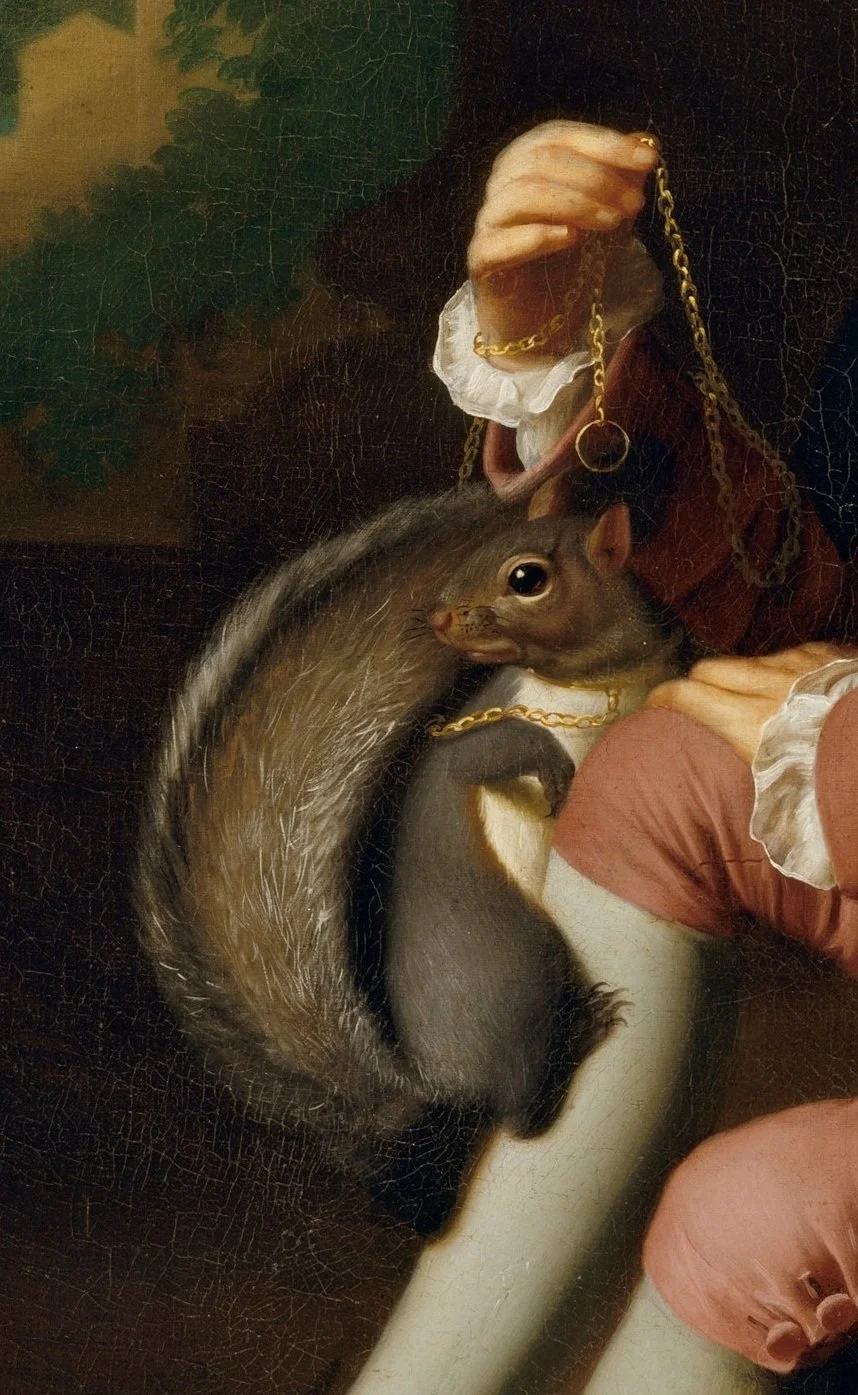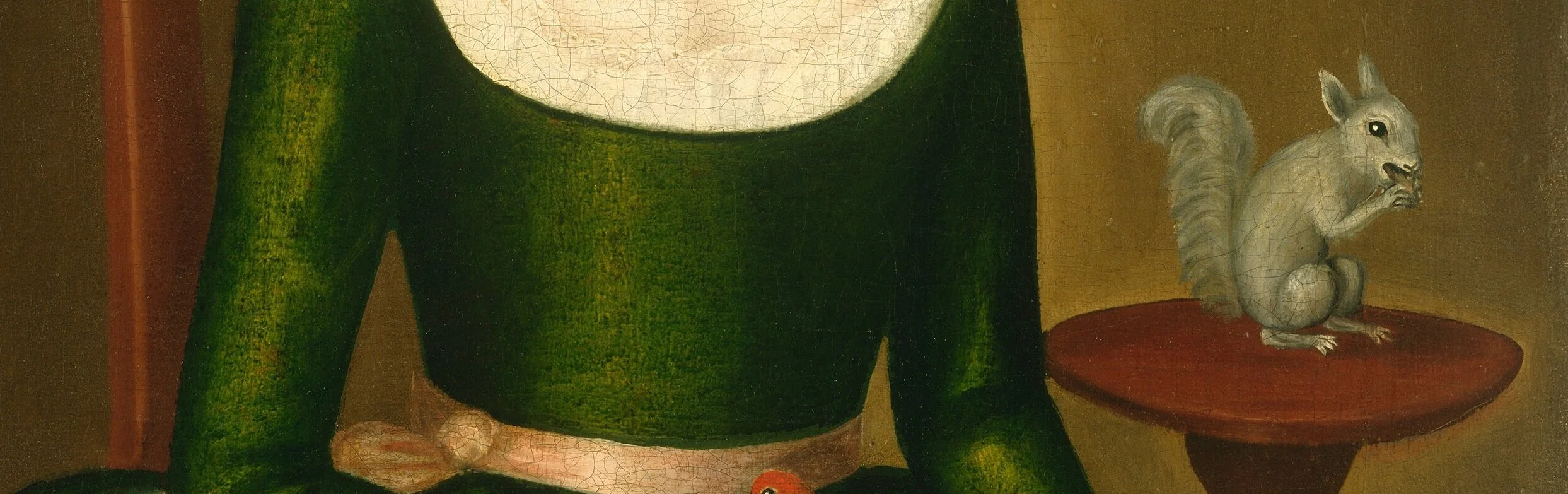
Pet squirrels in the 18th century
Detail from
Miss Denison of Stonington, Connecticut, c. 1790
Courtesy National Gallery of Art, Washington
While pet squirrels appear in European art (and descriptions) from the 13th-16th centuries, most of the depictions in the 18th century are Americans with gray squirrels. Some pet squirrels were depicted with fine collars and chains, which also appear in some of the 16th and 17th century depictions.
Henry Pelham, Frances Deering Wentworth, and Deborah Hall have flying squirrels.
Additional Resources
Dear Miss,
I lament with you most sincerely the unfortunate End of poor Mungo: Few Squirrels were better accomplish’d; for he had had a good Education, had travell’d far, and seen much of the World. As he had the Honour of being for his Virtues your Favourite, he should not go like common Skuggs without an Elegy or an Epitaph. Let us give him one in the monumental Stile and Measure, which being neither Prose nor Verse, is perhaps the properest for Grief; since to use common Language would look as if we were not affected, and to make Rhimes would seem Trifling in Sorrow.
Alas! poor Mungo!
Happy wert thou, hadst thou known
Thy own Felicity!
Remote from the fierce Bald-Eagle,
Tyrant of thy native Woods,
Thou hadst nought to fear from his piercing Talons;
Nor from the murdering Gun
Of the thoughtless Sportsman.
Safe in thy wired Castle,
Grimalkin never could annoy thee.
Daily wert thou fed with the choicest Viands
By the fair Hand
Of an indulgent Mistress.
But, discontented, thou wouldst have more Freedom.
Too soon, alas! didst thou obtain it,
And, wandering,
Fell by the merciless Fangs,
Of wanton, cruel Ranger.
Learn hence, ye who blindly wish more Liberty,
Whether Subjects, Sons, Squirrels or Daughters,
That apparent Restraint may be real Protection,
Yielding Peace, Plenty, and Security.
You see how much more decent and proper this broken Stile, interrupted as it were with Sighs, is for the Occasion, than if one were to say, by way of Epitaph,
Here Skugg
Lies snug
As a Bug
In a Rug.
And yet perhaps there are People in the World of so little Feeling as to think, that would be a good-enough Epitaph for our poor Mungo!
If you wish it, I shall procure another to succeed him. But perhaps you will now chuse some other Amusement. Remember me respectfully to all the good Family; and believe me ever, Your affectionate Friend
B Franklin
Benjamin Grymes and Ludwell Grymes by Charles Bridges, c. 1735-1744
The Family of Eldred Lancelot Lee by Joseph Highmore, 1736
Thomas Mason, c. 1750-1775
Rebecca Orne by Joseph Badger, 1757
Portrait of two children, 1760
Olive Craster by Sir Nathaniel Dance-Holland, 1762
James Beekman Jr. by John Durand, 1767
Henry Pelham (A boy with a flying squirrel) by John Singleton Copley, 1765
Mrs. Theodore Atkinson Jr. (Frances Deering Wentworth) by John Singleton Copley, 1765
John Bee Holmes by John Singleton Copley, 1766
Lord Carteret’s daughter by John Smart, 1766
Deborah Hall by William Williams, 1766
Portrait of a girl with a squirrel by Cosmo Alexander, 1770
Daniel Crommelin Verplanck by John Singleton Copley, 1771
The Wiley Family by William Williams, 1771
The Amorous Thief or, The Lover’s Larceny c. 1777
Portrait of a boy with a pet squirrel by Joseph Highmore
Mrs. Congreve with her children by Philip Reinagle, 1782
Miss Denison of Stonington, Connecticut (possibly Matilda Denison), c. 1790
Mrs. Gershom Burr by Ralph Earl, 1798
Portrait of two children by Henri-Pierre Danloux, c. 1800