Knotting in the 18th century
The V&A has a good description of knotting:
Knotting was a popular and widely practiced occupation for women in the 18th century. A length of linen or silk thread was wound onto a knotting shuttle, and with it a series of knots made at close intervals, to form a length of trimming. This could then be applied to a ground fabric decoratively as a type of embroidery, or made into fringes for trimming furnishings like bed hangings and covers.
It further notes that “the Comtesse de Genlis, in her Dictionary of Court Etiquette, maintained that knotting had no other purpose than to enable a woman to appear composed when in company.” Several 18th century portraits of girls and women depict their subjects as they work on knotting.
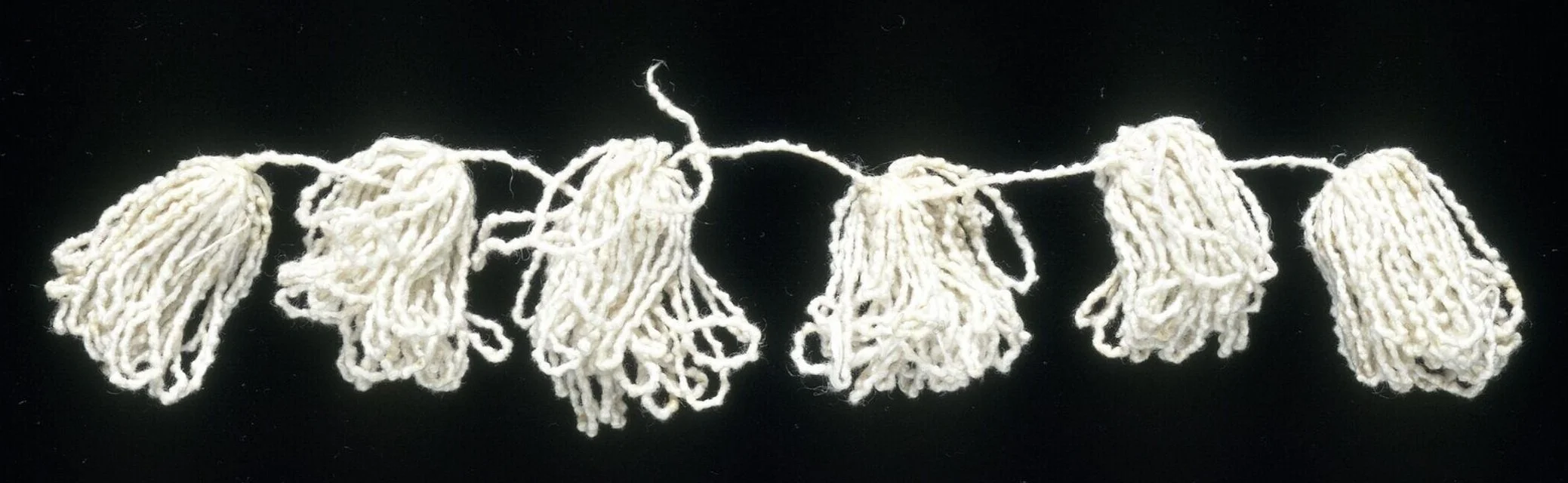
Tassels formed of looped white knotted threads arranged along a white knotted thread. © Victoria and Albert Museum, London
From the Letters from Mrs. Delany (a letter to Mrs. Frances Hamilton, October 10, 1783):
The King, with his usual graciousness, came up to me, and brought me forward, and I found the Queen very busy in showing a very elegant machine to the Duchess of Portland, which was a frame for weaving of fringe, a new and most delicate structure, and would take up as much paper as has already been written upon to describe it minutely, yet it is of such simplicity as to be very useful. You will easily imagine the grateful feeling I had when the Queen presented it to me, to make up some knotted fringe which she saw me about. The King, at the same time, said he must contribute something to my work, and presented me with a gold knotting shuttle, of most exquisite workmanship and taste; and I am at this time, while I am dictating the letter, knotting white silk, to fringe the bag which is to contain it.
She also references knotting for chairs in her Autobiography & Correspondence. See Tatting Myths Dispelled for photos of the knotting on Mrs. Delany’s chairs or the 1765 Delany quilt at the Ulster Museum.
Additional Resources
Quaintrelle Life: About Knotting
Video tutorials:
Cynthia Griffith
Florencia Moore, Part I and Part II
Song Spinner, Part I and Part II
Lace in American Revolutionary War Reenacting: Knotting—yes, but it’s not lace
Henry Purcell, “The Knotting Song”
Knotting shuttles are available from Burnley & Trowbridge, Wm. Booth Draper, and Song Spinner
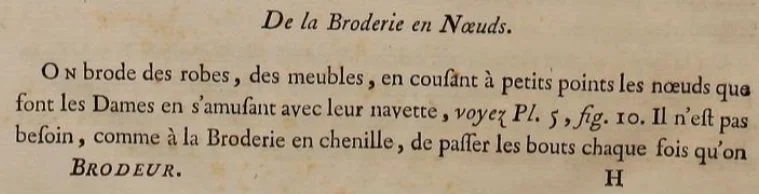
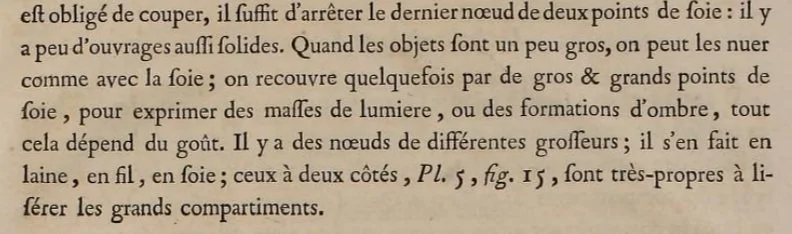


In L’Art du brodeur (1770), Charles Germain de Saint-Aubin describes la Broderie en Nœds — knot embroidery — “on gowns, on furniture, by sewing with small stitches the knots that ladies make while playing with their shuttles.” Figure 10 shows the regular style of knotting, while figure 15 is a double-sided knotting “very suitable for outlining large sections.”
18th century objects made of or decorated with knotting
Several workbags & purses may also have knotted fringe and/or knotted tassels.
Colonial Williamsburg 1967-699,1, England, c. 1730; “Valance or bed furnishing textile of yellow (Munsell 5Y 7/6) silk satin with design of knotted and couched red wool threads stitched through inner lining of damask linen; couching done with red wool and coral silk thread.”
Colonial Williamsburg 1972-1, Great Britain, c. 1730-1750; “This is a counterpane made of white twilled linen and cotton ground fabric with all-over repeating pattern of leafy vines, various flowers, and pear-shaped fruit, embroidered in a knotted stitch through the ground. Colors include blue-greens, shaded rose, blues, and golds on white. The flowers and vines seem to be made of a series of knots couched onto the ground. The centers of most of the flowers are made of bullion knots and French knots.”
The V&A has some examples of knotting from the second half of the 18th century, including several balls of knotted silk (T.353C-1965, T.353D-1965, T.353E-1965, T.353G-1965), some tassels (T.353B-1965), and some fringe (T.353-1965).
'The Most Splendid Bed in the Universe'? Knotted-work hangings made for George III (“some hangings and chair covers of knotted work embroidery, commissioned and partly made by Queen Charlotte for a bed and suite for George III but not used; sold after her death and redeployed on other furniture”), including a a bedcover from the King’s Bed Chamber, Windsor Castle (RCIN 71467)
Cowper and Newton Museum OLNCM.2657, an appliqué coverlet in cotton and linen, with knotting along the edges of the figures, England, 1790; see also Cowper’s Counterpane and Patchwork and Plum Cake
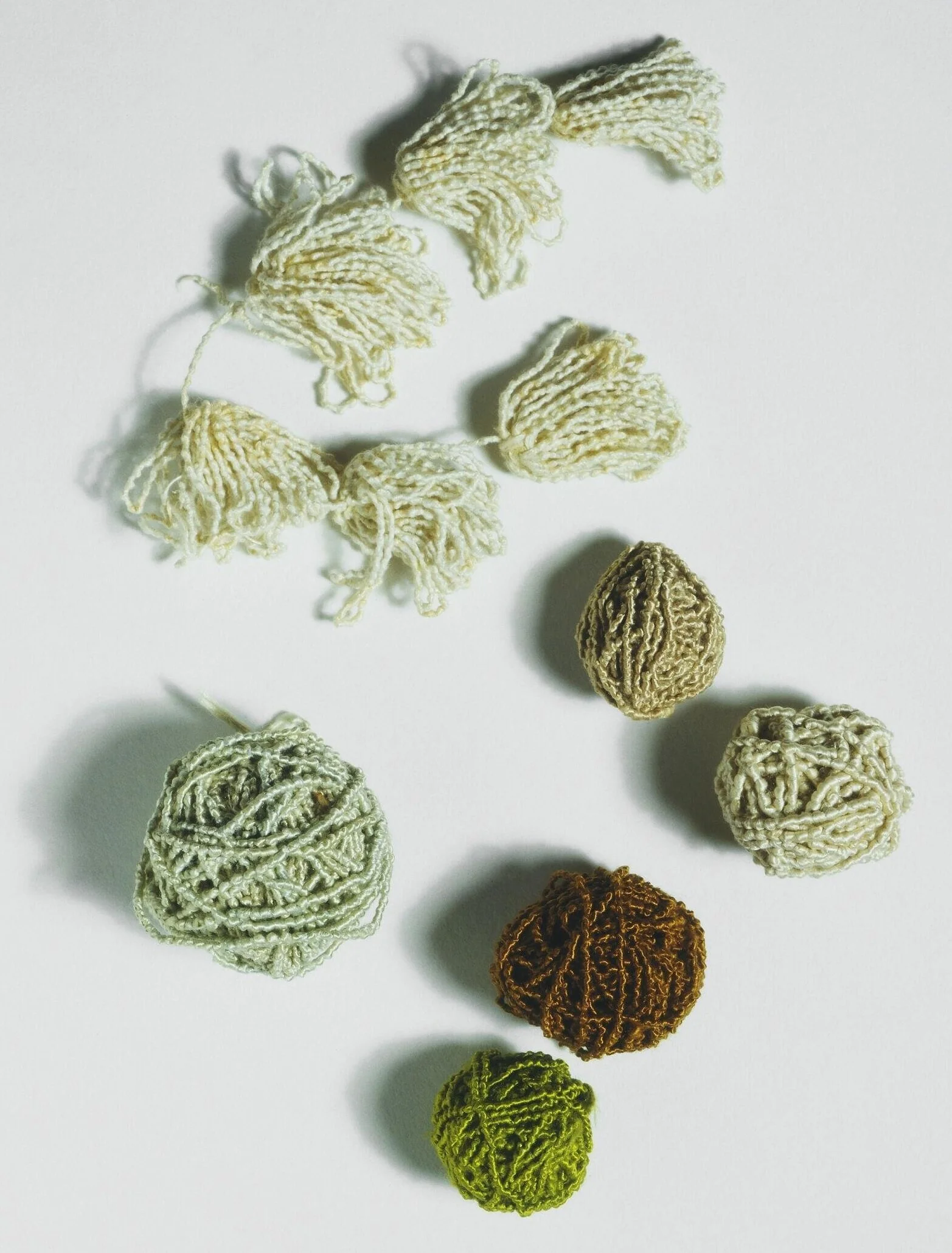
© Victoria and Albert Museum, London
18th century knotting shuttles
London Museum A1548, a bone knotting shuttle
A golden knotting shuttle, c. 1756-1762
V&A 560-1907, a pierced steel knotting shuttle, Woodstock, c. 1770-1790
French knotting shuttles in the Wallace Collection:
W210, gilded and chased steel, mid-18th century
W221, varicolored gold, c. 1757-1758
W223, in rock crystal with gold and garnets, c. 1768-1769
W293, gold with enamel, c. 1772-1773 (see also Handwork for 18thc Ladies: A Beautiful Knotting Shuttle)
Inlaid shell knotting shuttle, England, c. 1790
A vari-coloured gold knotting shuttle, “each side with a central oval reserve chased with armorial trophies in yellow, rose and white gold on a ground of chased and pierced flutes within a Greek key border on a sable ground,” late 18th century
Silver inlaid tortoiseshell knotting shuttle, late 18th - early 19th century

Portraiture and depictions of knotting
Three Ladies of the Leman Family and their Dogs on a Terrace by Benjamin Ferrers, 1728
Madame Mercier surrounded by her family, 1731
The Du Cane and Boehm Family Group by Gawen Hamilton, 1734-1735
Lady Lucy Manners, Duchess of Montrose by Benjamin Vandergucht, 1793, after an Andrea Soldi portrait c. 1740
Double portrait presumed to represent François de Jullienne and his wife Marie Élisabeth de Séré de Rieux by Charles Antoine Coypel, 1743
A portrait of the Vigor family: Jane Vigor, Joseph Vigor, Ann Vigor, William Vigor and probably John Penn by Joseph Highmore, 1744
A portrait painter and his wife, c. 1745
Lady Lloyd and Her Son, Richard Savage Lloyd, of Hintlesham Hall, Suffolk by Thomas Gainsborough, 1745-1746
Portrait of a Woman by John Wollaston, 1749-1752
Maria Anna Sophia of Saxony by Georg Desmarées
Portrait of a lady by Arthur Devis, c. 1750-1751
Madame Dange by Louis Tocque, 1753
Princess Maria Kunigunde von Sachsen by Pietro Antonio Conte Rotari, c. 1755
Maria Amelia von Hessen-Kassel by Johann Heinrich Tischbein, c. 1755-1760
Princess Marie Adelaïde de France by Jean-Marc Nattier, 1756
Marie Angélique Vérany de Varennes, Mme Georges Gougenot de Croissy by Jean Baptiste Greuze, 1757
The Buckley-Boar Family, c. 1758-1760
Miss Harriett Murray, afterwards Mrs Henry Westenra, c. 1760
Anne, 2nd Countess of Albemarle by Sir Joshua Reynolds, c. 1760
Mrs. Charles Tudway by Thomas Gainsborough, c. 1760-1765
Infanta Maria Josefa of Spain by Anton Raphael Mengs, c. 1761-1769
Madame Rigaud de Vaudreuil by Louis Carrogis Carmontelle
Archduchess Maria Antonia of Austria, the later Queen Marie Antoinette of France, at the age of 7 years by Jean-Etienne Liotard, 1762
Lady Lepel Hervey, Lady Mulgrave, c. 1765
Conversation piece attributed to Benjamin Wilson
Elizabeth Kerr, née Fortescue, Marchioness of Lothian by Angelica Kauffmann
Elizabeth de la Vallee de la Roche by Michel-Pierre Hubert Descours, 1771
Madame la Comtesse de Belsunce by Louis Carrogis Carmontelle, 1775
Family group by Francis Wheatley, c. 1775-1780
Queen Charlotte with Charlotte, Princess Royal, by Benjamin West, 1776
Mrs. Seymour Fort by John Singleton Copley, c. 1780
A lady (possibly Charlotte Pochin of Barkby Hall) with an ivory knotting shuttle by John Singleton Copley
Mrs. Pearce by Francis Wheatley, 1786
Margot Wheatley by Francis Alleyne, 1786
The Rookes-Leeds Family by Arthur Devis
Lady Jane Mathew and her daughters, c. 1790
Mrs. Abney by Joseph Wright of Derby