
18th Century Masks
Pages on vizards and invisories (black masks) of the 16th-17th centuries and other masks from the 12th-17th centuries are available on the old website.
There is a new page on the 18th century domino, a silk cloak worn as a masquerade costume.
H/T to Márcio and Trisha da Cunha for their suggestions on this page.
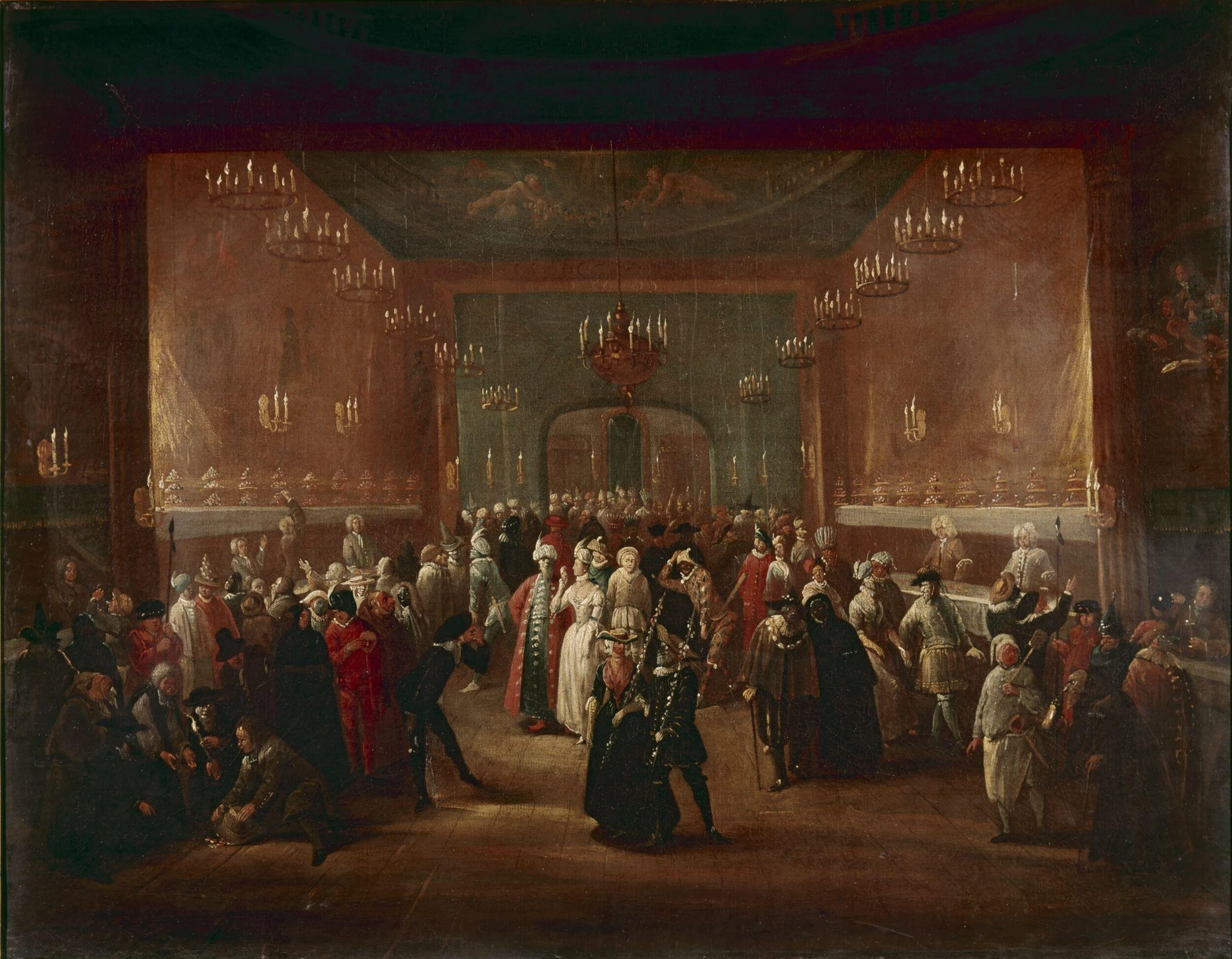
© Victoria and Albert Museum, London
Additional Resources
This site contains affiliate links for which I may be compensated
Masquerades in London’s Pleasure Gardens
Venice Incognito: Masks in the Serene Republic
18th Century Material Culture: Masks & Masquerades
An account of, with observations upon, the masquerade at the Pantheon on Thursday, Feb. 18, 1773
In disguise: masquerades, masks and race in the eighteenth century
Clothing and Consumers in Rural New England, 1760-1810
The Mask of Civility: Portraits of Colonial Women and the Transatlantic Masquerade
Moretta and similar full-face black masks
These black masks seem to be the descendants of the vizards and invisories of the 16th-17th centuries. This is also noted in the Galerie des Modes in 1779:
With respect to the masks, they were very fashionable in the sixteenth century, especially among the Ladies of quality: they were usually of black velvet, and were called loups. And it had been an indecency for a Woman to appear in the streets without a loup over her face Marguerite de Valois, first Wife of Henri IV, protected this fashion singularly, which, little by little, was abolished, and the masks were reserved for Balls and other pleasures.
A masked lady by Luca Carlevarijs, c. 1700-1710
Henrietta Hobart, The Hon. Mrs Howard, later Countess of Suffolk by Thomas Gibson, c. 1720
Felicità Sartori in Turkish dress by Rosalba Carriera, c. 1740
The Marquise de la Ferté-Imbault by Jean-Marc Nattier, 1740
Lady Sophia and Lady Charlotte Fermor by Thomas Bardwell
Children Playing with a Hobby Horse by Joseph Francis Nollekens, c. 1741-1747
David Garrick and Mrs. Pritchard in Benjamin Hoadley’s “The Suspicious Husband” by Francis Hayman, 1747
Louise Geneviève Le Blond, Madame Royer by Jean-Marc Nattier, c. 1750
The Ridotto in Venice by Pietro Longhi, 1750s
Il Ridotto by a follower of Pietro Longhi
Portrait of a woman with a mask, 1750s
Exhibition of a Rhinoceros at Venice by Pietro Longhi, c. 1751
The Ridotto Pubblico at Palazzo Dandolo by Francesco Guardi, c. 1765-1768
Lady Betty Bustle and her maid Lucy preparing for the masquerade at the Pantheon, 1772
Miniature portrait of a woman holding a mask to her face, late 18th century
Domino, Columbina, and similar half-face masks
A masked lady by Luca Carlevarijs, c. 1700-1710
Eva Maria Veigel, Mrs. David Garrick, with a mask by Johann Zoffany, mid-18th century
Arabella Astley Swimmer, Lady Vincent of Stoke D’Abernon by Anton Raphael Mengs, 1753
The Charlatan by Giandomenico Tiepolo, 1756
Wantonness Mask’d, 1771
A Masquerade Scene at the Pantheon, 1773
The Return from a Masquerade – a Morning Scene, 1784
Dressing for a Masquerade, 1790
Three women in Roman masquerade costumes by Daniël Dupré, 1790
Half-face masks with beards
These half-masks have a sort of silk drape that covers the bottom half of the face. According to the Galerie des Modes, “The demi-masks, or masks with taffeta beards, were made, more convenient than the full masks for speaking, breathing, and taking refreshments.”
Julines Beckford, 1734
Portrait of a lady with a mask and cherries by Benjamin Wilson, 1753
Unknown lady, called Baroness de Neubourg-Cromière by Alexander Roslin, 1756
Young Lady who is decked out in a large, hooded, taffeta Domino, Galerie des Modes, 22e Cahier, 2e Figure, 1779
Masquerade mask, 1780s
Wine is a Mocker, strong Drink is raging, 1782
Lady dressed in a very elegant grand Domino to go to a masked Ball, Galerie des Modes, 39e Cahier (bis), 6e Figure, 1784 (?)
A Woman in Ball dress, Cabinet des Modes, 4e Cahier, 1ere Planche, 1786: “In the hand, a mask of black card, with beard of pink taffeta.”
The Woman represented in this Plate wears a Domino of canary’s-tail colored taffeta, Magasin des Modes, 10e Cahier, Plate II, 1787; “In the right [hand], she holds her shining black mask, which has a long lappet of pink taffeta.”
Dressing for a Masquerade, 1790
Six Stages of Mending a Face, 1792
Men of Pleasure in their Varieties: A Maſquerade Adventure, 1794
Bauta masks
The Ridotto in Venice by Pietro Longhi, 1750s
Exhibition of a Rhinoceros at Venice by Pietro Longhi, c. 1751
Il Ridotto by a follower of Pietro Longhi
The Charlatan by Giandomenico Tiepolo, 1756
The Scent Seller by Pietro Longhi, c. 1756
Magrat the Giant by Pietro Longhi, 1760
The Visit by Pietro Longhi, 1760
The Conversation by Pietro Longhi, 1760
Maskers at the Mondo Nuovo by Giovanni Domenico Tiepolo, c. 1765
The Soho masquerade conference between the premier and his journeyman, 1770
Le Masque au Caffe, 1775
Il Nobile Veneziano, c. 1783
Stanislaus Augustus with a mask by Johann Baptist von Lampi the Elder, c. 1788-1789
Character masks and other full-face masks
Sacksa family portrait by Martin van Meytens the Younger, c. 1730-1731
Scene in a park, with figures from the Commedia dell’Arte by Marcellus Laroon the Younger, c. 1735
Fan Museum HA151, a mask fan, c. 1740; “The leaf is decorated on the recto with a series of amusing vignettes (one shows a shopkeeper selling mask fans) and a central mask-like face, the eyes cut away and forming peepholes.”
FAMSF 1980.66, The Mask fan, c. 1740-1750; “Mask fans are designed with large oval faces in the center, with small cutouts for the eyes of their wearers. While masquerades were a widespread form of entertainment in eighteenth century Europe, in Spain the penchant for mask fans coincided with the adoption of veils, mantillas, masks, and spectacles. These accessories allowed wearers to cover or expose their faces as they wished, to coquettishly draw attention, or to create anonymity.”
Princess Luise Ulrike of Prussia by Antoine Pesne, c. 1744
Met 63.90.10, a folding fan depicting a mask, c. 1745; “the design decorating the paper leaf of this fan imitates a life-size mask, its eyeholes cut out to allow the bearer of the fan to peep through. The flanking vignettes represent scenes of commerce- fan and music shops- and intriguing narratives, of an irate woman beating a man, and of a partially masked lady scanning a newssheet in the street. A small group of eighteenth-century fans decorated in this fashion survive in museum collections (the Fine Arts Museums of San Francisco; the Hermitage in Saint Petersburg; and The Fan Museum, Greenwich, U.K.), some painted and some printed. It is believed that they were produced in England, but targeted at the Spanish market.”
Elizabeth of Russia in masquerade dress by Georg Cristoph Grooth, 1748
.jpg)
The Jubilee Ball or the Venetian manner, Or masquerade at Ranelagh Gardens, 1749
Miss [Chudleigh] in the actual dress as she appear'd in ye character of Iphigenia, at ye Jubilee Ball or Masquerade at Ranelagh, 1749; see also An epistle to Miss — &c, &c.
A view of the dresses at the late masquerade given by the King of Denmark, 1768
Frances Abington as the Comic Muse by Joshua Reynolds, 1769
The Soho masquerade conference between the premier and his journeyman, 1770
A Gentleman in Masquerade Costume (probably as Captain Wilts in 'The Times'), 1770
Isabel Parreño y Arce, Marquesa de Llano by Anton Raphael Mengs, 1771-1772
Mr. Shuter, 1773
View of all the principal Masquerade Figures at the Rotunda May 12th 1789
Men of Pleasure in their Varieties: A Maſquerade Adventure, 1794
A Masquerade, 1795
Woman Holding a Mask of a Black Man by John Raphael Smith, c. 1795-1800