Dominos as masquerade costume in the 18th century
The domino is a cloak-like overgarment worn at masquerade balls. The style changes somewhat over the course of the 18th century, and different colors become fashionable at different times. It likely derives from cloaks worn at Carnival and at Il Ridotto in Venice, as seen in paintings by Pietro Longhi, for example.
The garment gradually spread throughout Europe and into England, with the rise in popularity of the masquerade and related entertainments. After leasing and transforming the Spring Gardens at Vauxhall, Jonathan Tyers held a Ridotto al Fresco — an Italian-inspired masked ball — in 1732. In 1749, Horace Walpole described “what was called ‘a jubilee-masquerade in the Venetian manner’ at Ranelagh: it had nothing Venetian in it, but was by far the best understood and the prettiest spectacle I ever saw” in a letter to Sir Horace Mann.
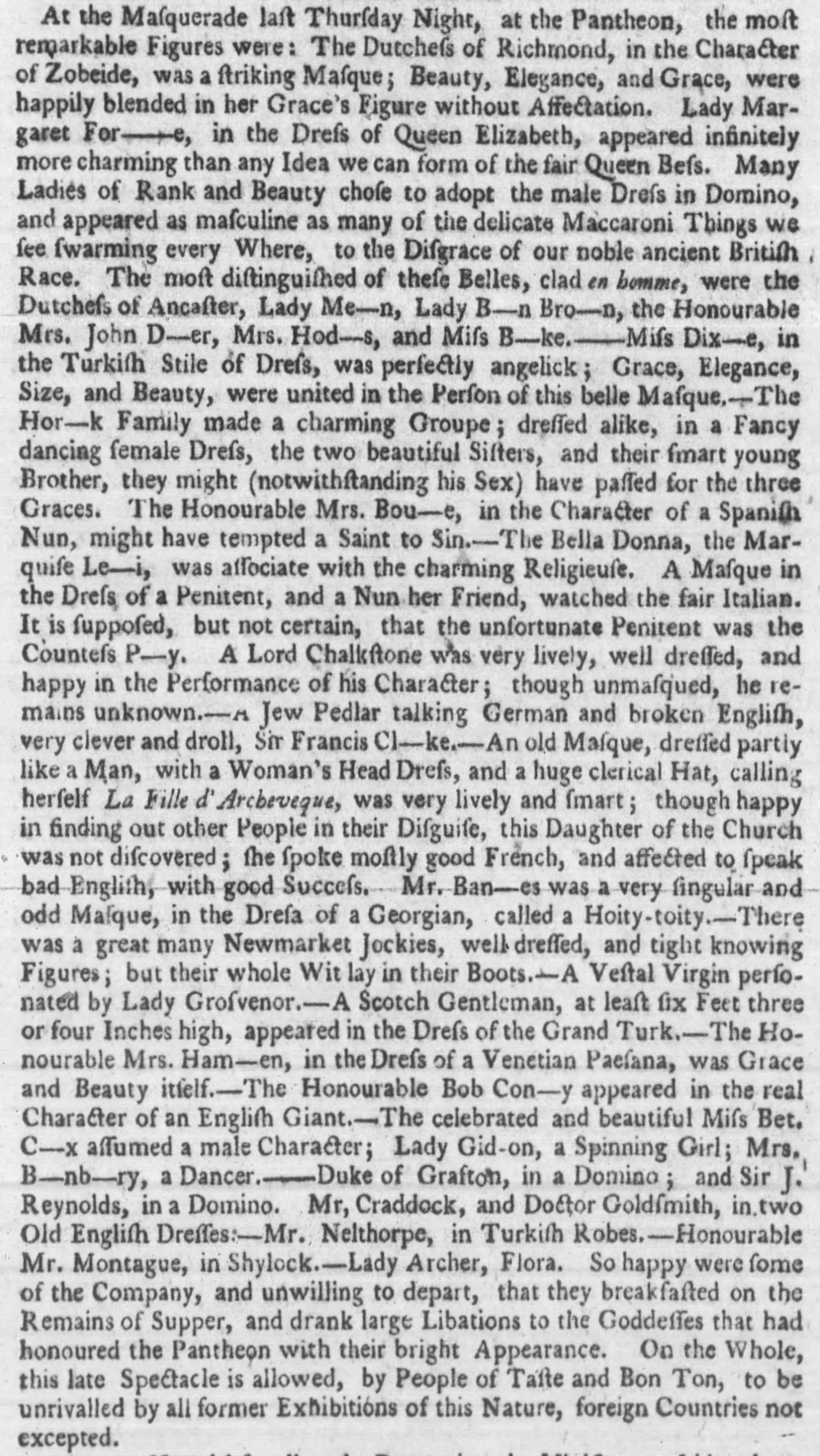
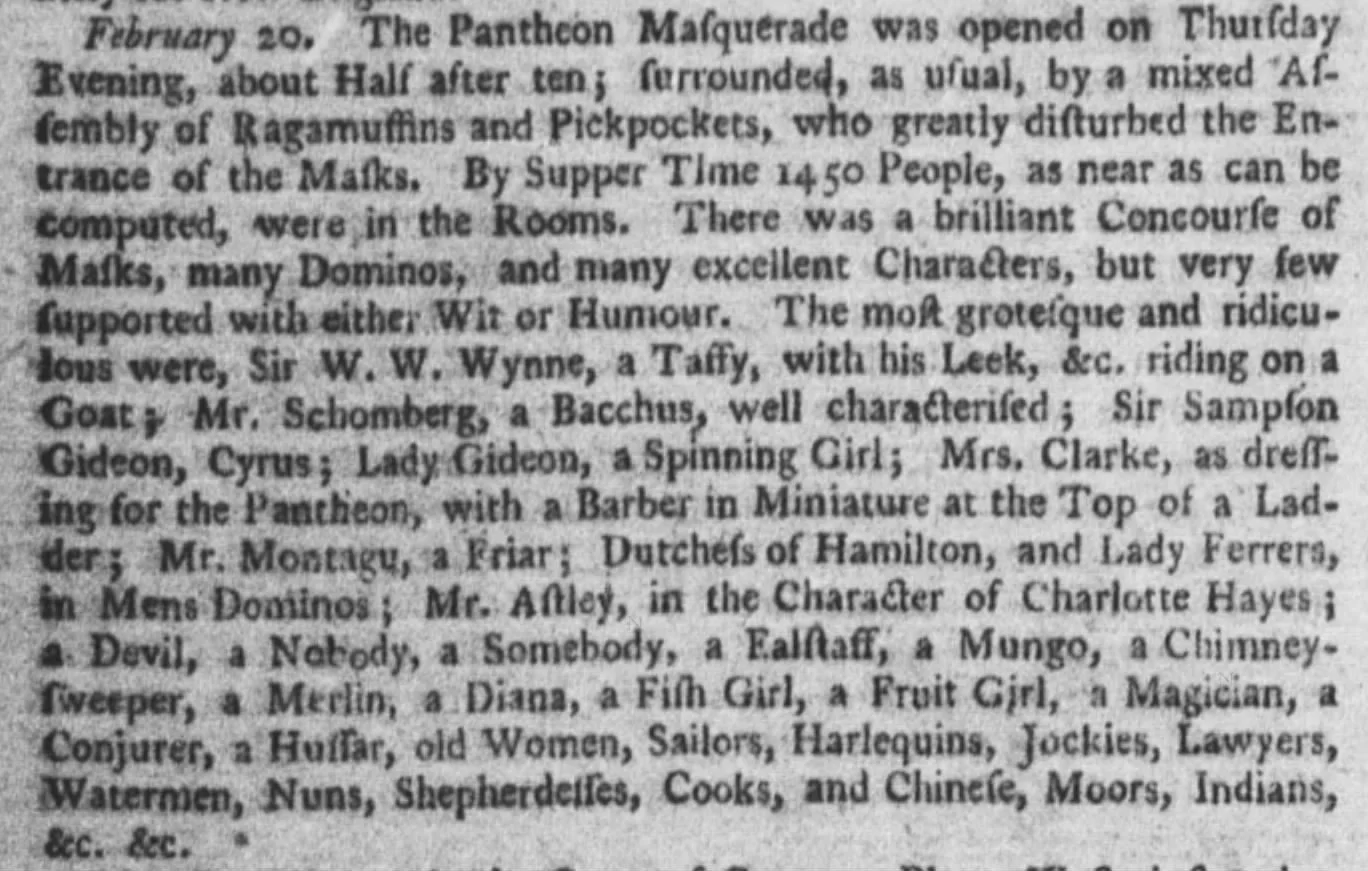
While guests at masquerades were encouraged to dress in costumes and masks and portray characters (much like those described in an account of, with observations upon, the masquerade at the Pantheon on Thursday, Feb. 18, 1773), the option of wearing a domino and mask required less effort; dominos could be purchased or rented, and did not require performing to the stereotype as dictated by the choice of costume.
The domino could conceal its wearer, preventing other guests from guessing the wearer’s identity, socioeconomic status, or gender. For the modern re-enactor, a domino represents a generic and generally innocuous costume, while many other forms of masquerade costume lean uncomfortably into ethnic stereotypes.
Dominos, like other masquerade costumes, were sometimes worn for formal portraiture. (See The dress worn at masquerades in England, 1730 to 1790, and its relation to fancy dress in portraiture for more on this topic.)
The page on 18th century masks has additional images of masquerade costumes.
Additional Resources
This site contains affiliate links for which I may be compensated
The Domino and the Eighteenth-Century London Masquerade: A Social Biography of a Costume
A Pink Domino c. 1760-70 at the Victoria and Albert Museum in Costume (1969)
The Habit of Habits: Material Culture and the Eighteenth-Century London Masquerade in Studies in Eighteenth-Century Culture
All Things Georgian: 18th Century Masquerade Balls
This Is Versailles: The Domino
The Spectacle of the Masquerade and Pleasure Gardens: English Society in the Eighteenth Century
Masquerade and Gender: Disguise and Female Identity in Eighteenth-Century Fictions by Women
Masquerade and civilization: the carnivalesque in eighteenth-century English culture and fiction
The Philosophic Game: Eighteenth-Century Masquerade in German and Danish Literature and Culture
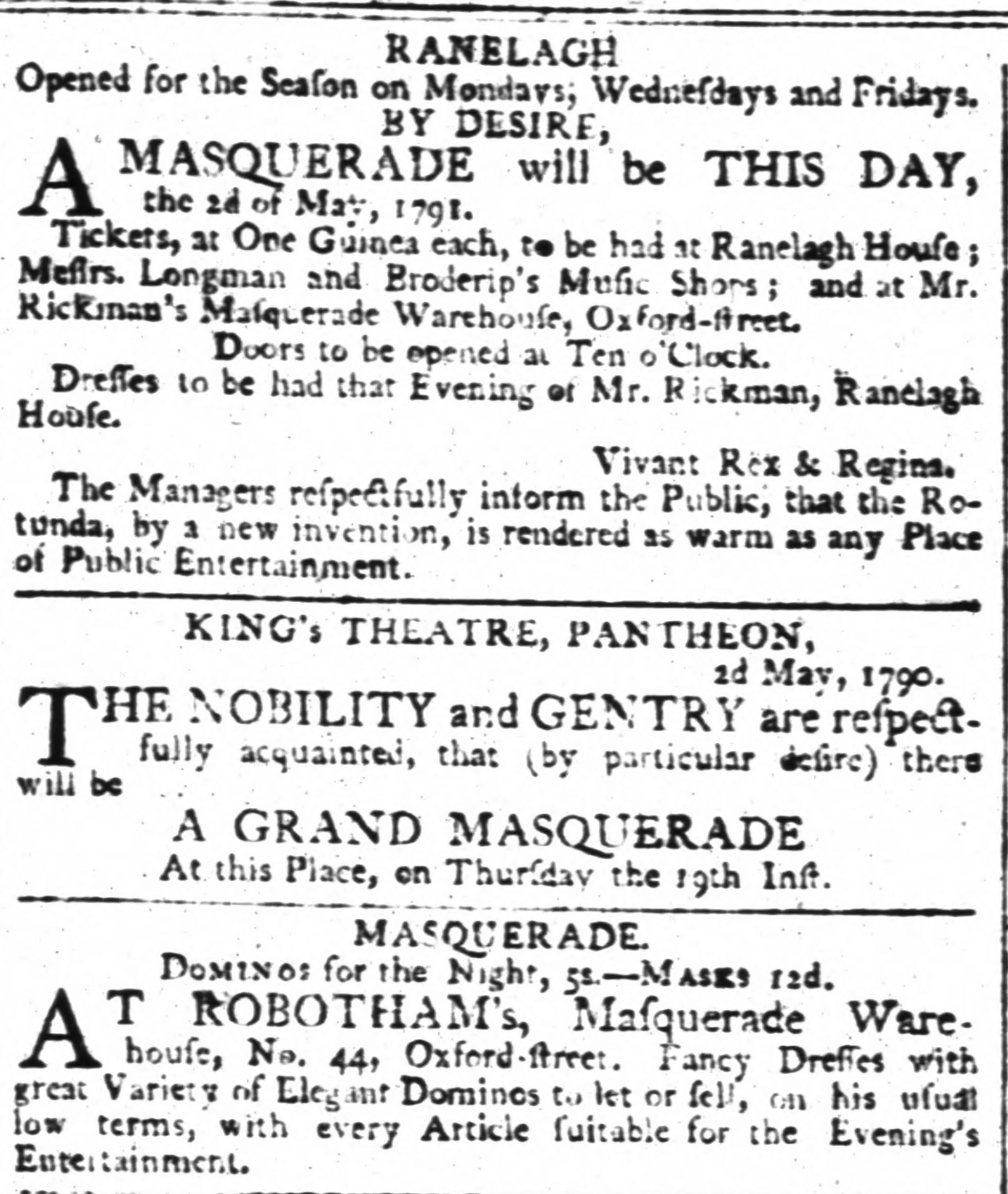
On masquerade warehouses in 18th century England
“For MASQUERADE DRESSES. FURR and Feather Trimmings of all Sorts and Colours, and the greateſt Variety ever ſeen in this Kingdom, or any where elſe, to be had at the Furr and Feather Shop in Aungier-ſtreet, with all Sorts of Plumes and Plumage, done by D. Murray, who principally ſerved Long's Ware-houſe, and others, in Taviſtock-ſtreet and Panton-ſtreet by the Hay-market, with the above Articles for above 20 Years.” (The Public Register, or, Freeman’s Journal, September 22, 1770)
“PRITCHARD'S Maſquerade WAREHOUSE, Taviſtock Street, LONDON, BY J. SPILSBURY Her MAJESTY'S Habit and Robe MAKER,” a draft trade card c. 1770
Billhead of James Spilsbury, owner of Pritchard’s Warehouse, with an invoice for the loan of a domino costume for £3-3-0 to Earl Winterton in March 1772
“PRITCHARD's MASQUERADE WAREHOUSE in Cheſter. MRS. SPILSBURY begs Leave to acquaint the Nobility and Gentry, that at the Inſtance of ſeveral Perſons of Diſtinction ſhe has ſent down and has opened her extenſive Maſquerade Wardrobe in Cheſter, and will be there on Friday next, to receive the Honour of their Commands for the enſuing Ball of the 18th Inſtant.” (The Public Advertiser, June 11, 1772)
“A : ATKINSON, Domino and Mask, Warehouse, No. 132 Pall Mall, near the Hay Market, NB, Great Choice of Elegant new Domino's, Masks, Feathers, &c.,” a draft trade card c. 1775
“MASQUERADE DRESSES. THE greateſt Variety of Rich and Elegant MASQUERADE DRESSES to be Lett or Sold at Brackſtone's Warehouſe in York-ſtreet, Covent Garden. N.B. Great Choice of Venetian and Silk Masks.” (The Public Advertiser, December 13, 1775)
“I live in Oxford-street: My husband [Drayson Moore] keeps a haberdasher's shop masquerade warehouse” (Proceedings of the Old Bailey, 4th June 1783)
“Q. I believe you are servant to Mrs. Bacon, of Little-street, Leicester-fields? - A. Yes; she is the wife of Thomas Bacon, and keeps a masquerade warehouse: On the 9th of February, the defendant Ronalds came to our house; he ordered four hats, four dominos, four masks, and four tickets, for the masquerade.” (Proceedings of the Old Bailey, 4th July 1804)
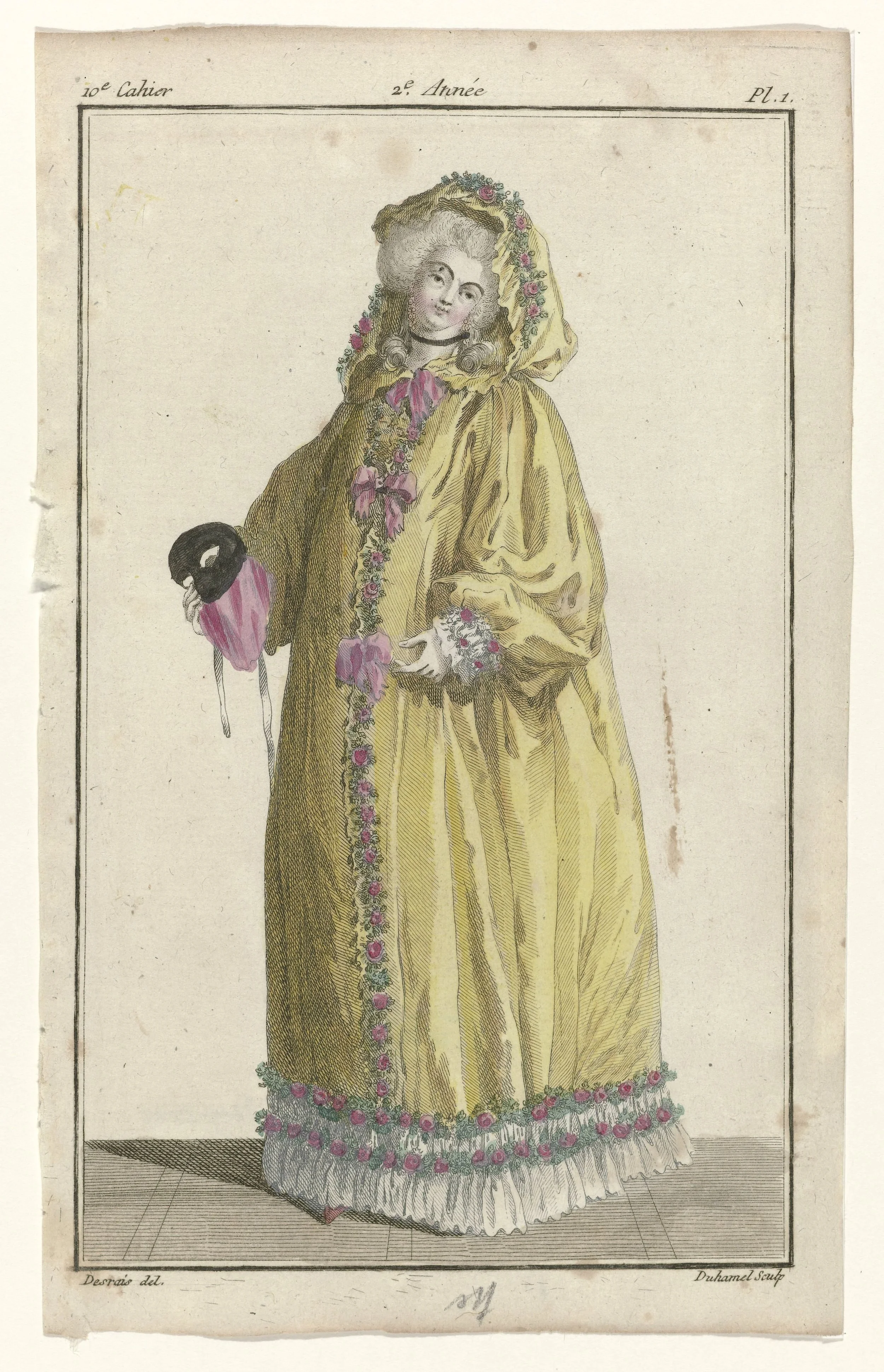
For the bals masqués of honest people, and the Opera balls, there is only the disguise of the Domino, strictly speaking. More or less of the costumes of Harlequins, Pierrots, Pulchinellos, coquettish peasants that were worn in great quantities in times long passed; more or less of the costumes of Old Men, Mendians, Podagres, Blind Men, Turks, the Chinese, or other grotesque disguises with which a thousand offenses have been permitted, or a thousand unpleasant scenes; all these accoutrements are relegated to the balls of City dance masters, and even to the balls of La Courtille or the Grand-Salon. Only Dominos serve for the beautiful and grand balls.
But which is worn? or instead, which color is worn, since they must all have nearly the same shape, and be of the same fabric (taffeta)? That is what we must say. Those that are worn the most this year are of canary’s-tail color. In previous years, black, puce, or other somber colors were worn; this year, bright colors are worn, or soft colors, pink, lilac, unbleached linen, violet, canary’s tail, poppy, white, etc. In previous years, they were worn trimmed with gauzes, ribbons, and garlands of artificial flowers. It is only masks which are put on the face which don’t change.
— from Cassidy Percoco’s translation of Magasin des Modes, 10e Cahier, Plate II, February 10, 1787
Extant dominos
Met 1971.47.4, a white silk domino cloak, British, 18th century
V&A T.195-1968, a pink silk lustring domino with a cape and hood, made in England c. 1765-1770
London Museum 70.59/1, a black silk domino robe, c. 1770-1790
Two-piece shot silk taffeta domino with coat and cape, c. 1800
Depictions of men and women with dominos
A man in a white domino seen from behind by Luca Carlevarijs, c. 1700-1710
Eva Bielke in the Sack family portrait by Martin van Meytens the Younger, c. 1730-1731
Julines Beckford, c. 1734
The Marquise de la Ferté-Imbault by Jean-Marc Nattier, 1740
Elizabeth of Russia in masquerade dress by Georg Cristoph Grooth, 1748
.jpg)
Louise Geneviève Le Blond, Madame Royer by Jean-Marc Nattier, c. 1750
A Fortune Teller by Pietro Longhi, c. 1756
The Charlatan by Pietro Longhi, 1757

Young Lady who is decked out in a large, hooded, taffeta Domino, Galerie des Modes, 1779: “Domino à la bahoute,* or negligé Domino. This was approximately the Domino, when the French imported it from the Venetians. That worn by Men only opens to the waist in front; it was, after this, entirely open. Women wore it closed, with a hood, as in the Print; Men added a cape.”
Il Nobile Veneziano, c. 1783
Dame habillée en grand Domino tres élégant pour aller au Bal masqué, 1783 (see also Lady dressed in a very elegant grand Domino to go to a masked Ball, Galerie des Modes, 1784)
The Woman represented in this Plate wears a Domino of canary’s-tail colored taffeta, trimmed on the hood and the fronts with a garland of artificial roses, and at the bottom with a flounce of white gauze, and two garlands of artificial roses. Her Domino is fastened with two large knots of pink ribbons., Magasin des Modes, 1787
The Prodigal Son Revelling with Harlots, 1792
Men of Pleasure in their Varieties: A Maſquerade Adventure, 1794
Descriptions of dominos
“And that laſt Monday ſe’nnight there was a Maſquerade at the French Court, which held till ſeven o’clock in the Morning, at which all the Princeſſes and Court Ladies were moſt richly dreſs’d and adorn’d with Diamonds and Precious Jewels; and at which the King chang’d his Domino and Mask ſeveral Times, as did alſo ſeveral Lords of the Court.” (The Daily Gazetteer, January 26, 1739)
“Well, West, I have found a little unmasqued moment to write to you; but for this week past I have been so muffled up in my domino, that I have not had the command of my elbows. But what have you been doing all the mornings? Could you not write then? — No, then I was masqued too; I have done nothing but slip out of my domino into bed, and out of bed into my domino. The end of Carnival is frantic, bacchanalian; all the morn one makes parties in masque to the shops and coffee-houses, and all the evening to the operas and balls. Then I have danced, god gods! how have I danced! The Italians are fond to a degree of our country dances: Cold and raw they only know by the tune; Blowzybella is almost Italian, and Buttered peas is Pizelli al buro. There are but three days more; but the last two are to have balls all the morning at the fine unfinished palace of the Strozzi; and the Tuesday night a masquerade after supper: they sup first, to eat gras, and not encroach upon Ash-Wednesday. What makes masquerading more agreeable here than in England, is the great deference that is showed to the disguised. Here they do not catch at those little dirty opportunities of saying any ill-natured thing they know of you, do not abuse you because they may, or talk gross bawdy to a woman of quality.” (Horace Walpole’s letter to Richard West, writing in Florence on February 27, 1740)
“All the women were desirous of having the bundle immediately opened; which operation was at length performed by little Betsy, with the consent of Mr Jones: and the contents were found to be a domino, a mask, and a masquerade ticket.” (The History of Tom Jones, A Foundling by Henry Fielding, 1749)
Dominos feature heavily in the plot of “What happened at the masquerade,” chapter 2, book 10 of Amelia by Henry Fielding, 1751
“I CANNOT omit to mention the honour Mr. * * * has done me by inviting me to the next maſquerade, and offering me a domino for that purpoſe. But as I can ſee no reaſon why people, whoſe intentions are honeſt, ſhould be aſhamed to ſhew their faces, I have declined his invitation. His argument for the morality of theſe midnight meetings, viz. ‘that by reducing all mankind to a level, they teach the GREAT a uſeful leſſon againſt pride,’ is I own ingenious; though I am apt to think, as men’s manners are generally borrowed from their outward circumſtances, a lady of quality, when ſhe finds herſelf degraded to the rank of a milk-maid, may be tempted to familiarities, which ſhe never would have ſuffered in her own exalted ſphere.” (The World by Edward Moore, writing as Adam Fitz-Adam, May 30, 1754)
“I hear, I am to see you in town on Monday. Lady Grace informed me, she believes, you would have lent me a clean Domino for the Masquerade at Richmond House. I wish I had known it sooner, for I am to pay 2 Guineas for the Hire of a Domino, which I have already bespoke; I should have been pleased to have spared that sum, for it is better than giving 4 Guineas & ½ to have it entirely to myself: I shall be extreamly beautiful, a straw colour trimed with Purple; what say you to that.” (Letter written by James Brudenell to his brother Thomas, 1763)
“To the account given in our laſt poſt, relative to the King of Denmark’s Maſquerade Ball, on Monday laſt at the Opera-houſe in the Hay-market, we have the following particulars to add: … His Daniſh Majeſty was dreſſed in a yellow tiſſue Domino, trimmed with ſilver lace, but wore no maſk; their Royal Highneſſes the Dukes of Glouceſter and Cumberland were alſo in Dominos” (The Western Flying Post; or, Sherborne and Yeovil Mercury, October 17, 1768)
“Miss Strange had a white satin Domino trimmed with blue” (The early diary of Frances Burney, January 10, 1770)
Several in an account of two masquerades in The Town and Country Magazine, 1772
“MASQUERADE INTELLIGENCE. THE Company at the Pantheon Maſqued Ball, on Thurſday Evening, were near 2000 in Number; among others we diſcovered the following Perſons in the ſeveral Characters they aſſumed … Mr. D—n, in a White and Silver Domino, ſaid more witty Things than any dozen Maſks in the Room” (The Derby Mercury, May 8, 1772)
“JOSEPH DAY, Gent. was indicted for stealing … one domino silk waistcoat and a pair of breeches, value 3 l.” (Proceedings of the Old Bailey, 6th July 1774)
“The prosecutor deposed, that, as he was going into the opera-house, on a masquerade-night, he felt a man drawing his domino aside, and he missed his watch; that he immediately seised the prisoner, who was close to him” (Proceedings of the Old Bailey, 15th May 1782)
“Sir Geo. I can’t take the trouble to ſupport a character.
Lady Fran. You’ll wear a domino then; I ſaw a pink domino trimm’d with blue, at the ſhop where I bought my habit; wou’d you like it?
Sir Geo. Any thing! any thing!” (The Belle’s Stratagem by Hannah Cowley, 1783)
“IRELAND. We hear, that ſeveral of our nobility and principal gentry have a maſquerade in contemplation in the courſe of this ſpring, from the laudable and truly patriotic intention of encouraging the manufactures of their country. In order that this praiſe-worthy deſign ſhould more effectually contribute to the ſalutary object in view, it is ſaid, that one regulation of this propoſed maſquerade will be, that no maſque ſhall be admitted in a Domino, but each perſon to appear in ſome character or other that may neceſſarily require a greater conſumption of the various fabrics of the Iriſh loom.” (Poulson’s American Daily Advertiser, May 17, 1786)
A ticket for a masquerade & supper at Powderham Castle in 1790 with a handwritten note: “Black Dominos not admitted”
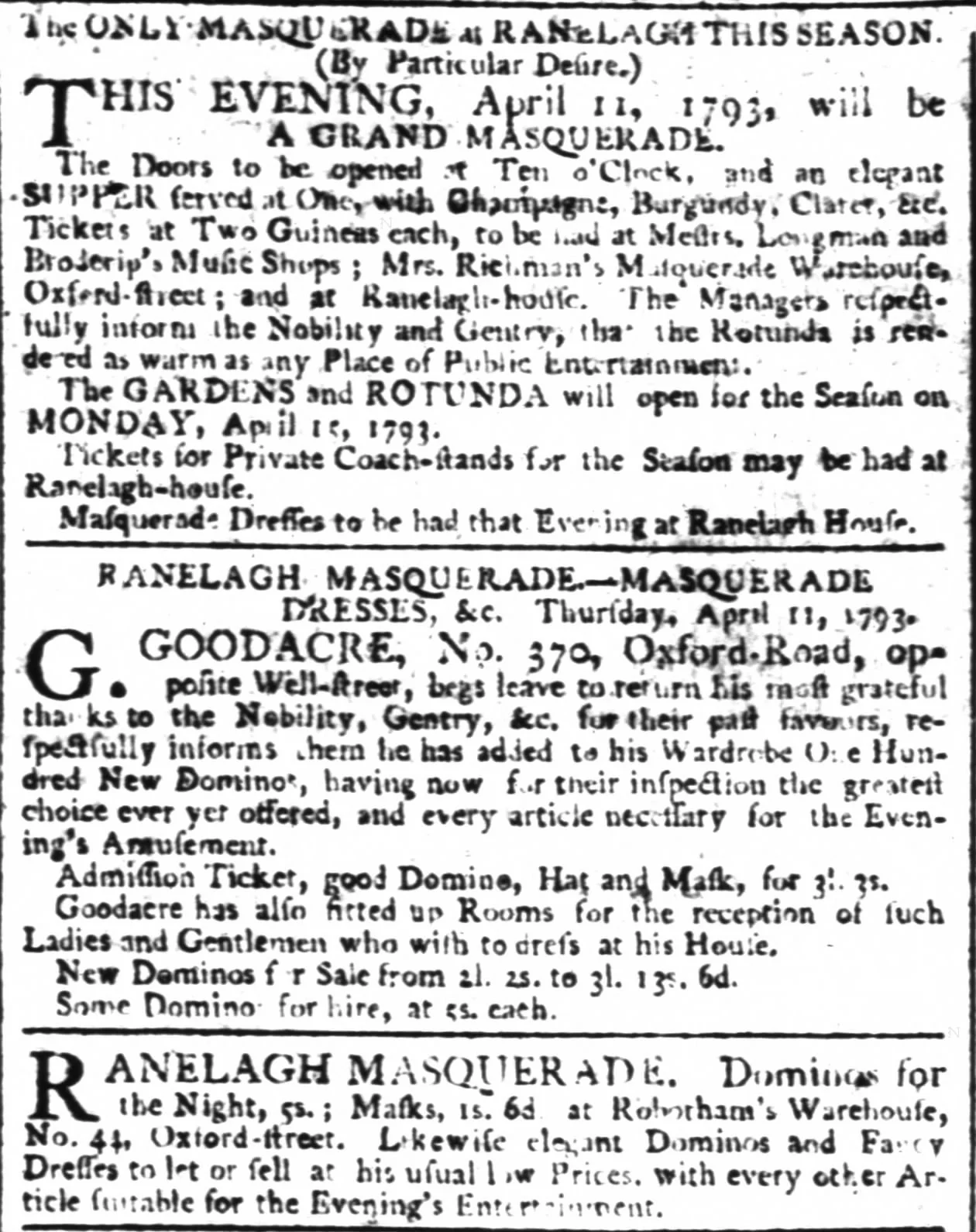
“THOMAS LAWRENCE was indicted for feloniously stealing, on the 7th of April, two black silk masks, value 2s. two black silk dominos, value 30s. and a hat and feather, value 30s. the property of Edward Thomas.” (Proceedings of the Old Bailey, 6th April 1796)
“FOR more than a month there had been given maſqued Balls at the hotel de Richlieu, in Paris, and in this gay ſcene of debauchery, Pariſian youth of both ſexes, had ſpent the night in folly and extravagance. They were chiefly compoſed of kept women and actreſſes, but at the ſame time many women of character were drawn by curioſity to partake, under the concealment of a domino, in the feſtive ſcene.” (A description of a masquerade in Paris from a Parisian newspaper, as published in The Portland Gazette, September 10, 1798)
A ticket for a Cumberland House Ball that says “No Dominos Admitted,” 1802
“Mrs Chichester at Home, the 18th of June, / A Masked Ball / This Ticket to be exchanged for an admission Ticket on the fifteenth and suixteenth of June & which is to be sent for / Portland Place / An Answer is particulalry requested / No sort of Domino will be admitted / Lloyd Harley St,” 1810