18th Century Men’s Caps
Men in the 18th century wore caps in less formal situations. A cap could be worn to keep the head warm and covered when not wearing a wig, or to keep one’s head covered when working indoors. Gentlemen wore caps when they were en déshabillé, sometimes with a morning gown or banyan.
There are no formally established rules to indicate when an 18th century man might wear a cap instead of a hat, or which type of man would wear which type of cap. I’ve included contemporary illustrations that may help guide your selection.
Caps could be homemade, but there are certainly plenty of advertisements for selling ready-made caps of many different materials, from worsted (knit) caps to caps in silk, velvet, or fur. Historical documents and advertisements do not differentiate much between styles, beyond indicating the material of the cap or the color. The categories below — nightcaps, tied-tube caps, knit caps, and working men’s caps — are entirely arbitrary. The names I’m using for them are modern descriptions, rather than historical.
Runaway advertisements in colonial American newspapers tend to describe caps by their materials, but the range of materials can be somewhat surprising, based on what we know about socioeconomic levels. Tom wore “an old black velvet cap” in 1781, for example, while Frederick wore “an old stript silk cap” in 1774. The “old double worsted Cap” that Mona wore in 1746 was probably knit.
None of the styles of 18th century men’s caps are inherently off-limits to any particular class, though not all caps are appropriate for all living history portrayals; a particularly posh cap (with gold embroidery or silver spangles, for example) would have been less practical for a working-class man to wear, but may represent an easily-concealed stolen item to be sold to a pawn shop. If you’re browsing for a new 18th century cap for your living history portrayal, take a look at the images in each of the sections on this page, see which styles may be relevant for your portrayal, and consider how the cap was made — and whether it’s practical for the person you’ll be portraying, and what it is that you’ll be doing while you’re wearing your cap.
Additional Resources
This site contains affiliate links for which I may be compensated
What Clothes Reveal: The Language of Clothing in Colonial and Federal America
Costume Close-Up: Clothing Construction and Pattern, 1750-1790
Of the Cap-Makers.
THESE are ſhop-keepers who make and ſell velvet caps for men or women to travel in; as alſo mens morning caps. They deal in many ſorts of millinery goods, as ladies hats, bonnets, cloaks, cardinals, ſhort aprons, hoods, handkerchiefs, or almoſt any thing made of black ſilk or velvet.
Nightcaps
This group of 18th century men’s caps tend to be made from more expensive materials, such as silk or velvet, often with embroidery. They tend to have more structured forms, sometimes imitating Asian styles (or what, to the 18th century man, would have looked exotic and Asiatic). The nightcaps in this group were often made from wedge-shaped panels and a turned-up brim, much like the 16th-17th century nightcaps.
If you’re looking for a luxurious cap to wear with your banyan, this is the section to peruse.
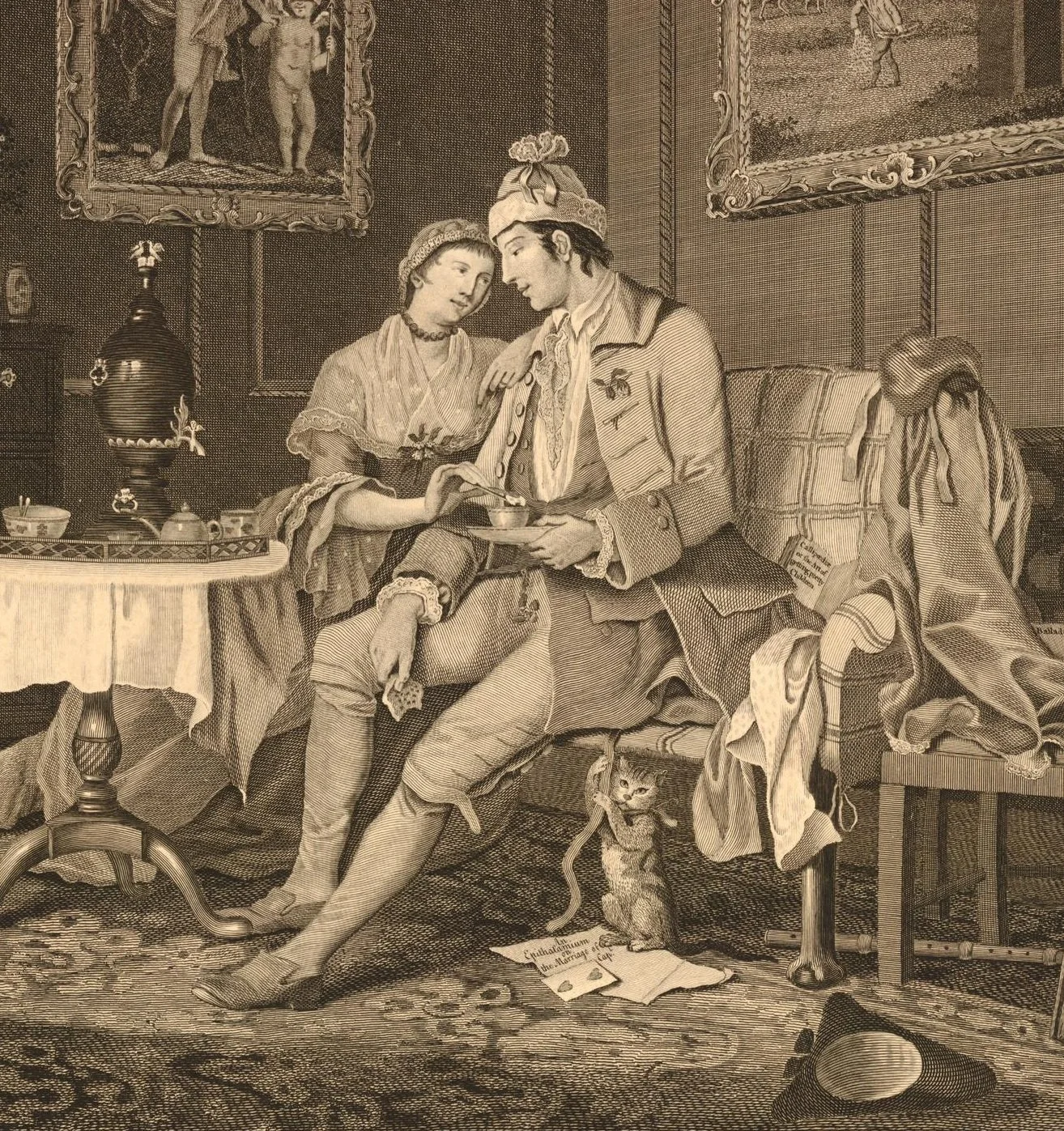
© The Trustees of the British Museum. Shared under a Creative Commons Attribution-NonCommercial-ShareAlike 4.0 International (CC BY-NC-SA 4.0) licence.
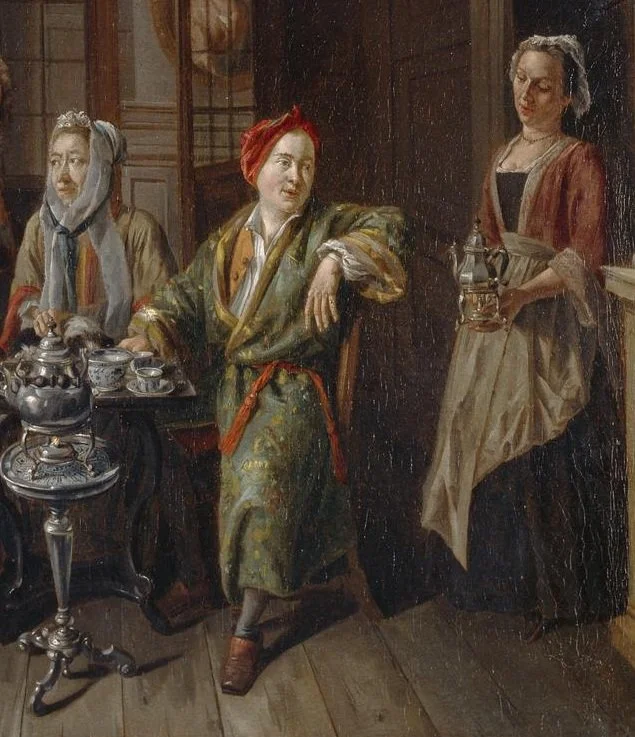
Image courtesy of Manchester Art Gallery
MFA 38.1308, silk embroidery, Italy, late 17th or early 18th century
Met 26.231.9, linen embroidered with silk, 17th-18th century
PMA 1909-113, Venice, late 17th or early 18th century; yellow silk embroidered with silks and metal threads, with metallic braid outlining panels
Manchester 1952.123, linen with silk embroidery in chain stitch and hexagonal backstitches, England, c. 1675-1700
Manchester 2012.82, England, c. 1675-1700; “White linen cap in the chinoiserie style; with a stitched ground of vermicular lines in bright yellow silk. Embroidered with the main design, also in acid yellow, mainly in chain stitch in a bold design of scallop shells. Domed crown in 4 sections; wide turned up, peaked brim with meandering floral embroidery as an edging; cap is unlined.”
MFA 38.1298, green velvet with padded gold satin stitch, Italy, c. 1675-1725
MFA 43.309, gold thread on green velvet, France
National Trust 1348949, c. 1700-1720; “Medici crimson silk velvet. Interlining wool, lining black silk. Cuff lined with old rose coloured twilled silk. Made in two sections gathered at top. Deep, shaped cuff. Cuff embroidered in silver thread in clumsy design. Silver thread tassel at top.”
MFA 43.1053, coral-pink satin with metal-thread embroidery
MRAH/IRPA 20049258, a linen cap embroidered with wools, and trimmed with lace
Met 1986.106.13, yellow silk with metal-thread embroidery, Italy, early 18th century
Christie’s Lot 94 / Sale 5982, a French gentleman’s night cap, early 18th century; ivory silk embroidered with flowers in silk, and silver thread scrolls (and grapes in silver paillettes?)
MFA 38.1307, white satin embroidered with orange silk and trimmed with metallic lace, France, early 18th century
Colonial Williamsburg 1991-496, c. 1700: “Man's cap of golden yellow ribbed silk, embroidered in yellow silk satin stitches and knots and couched silver metallic threads. Design consists of scrolls enclosing strapwork or basketweave pattern with additional stylized flowers and leaves. Cap has high rounded crown cut from two pieces of fabric with the addition of two darts to shape the curve. Cuffs angle out to peaks. Cap is lined with cream color finely ribbed silk; cuff self lined.”
Cooper Hewitt 1951-105-30, an 18th century nightcap in silk with metal-thread embroidery
National Trust 1348925, 1680-1699; “Fine linen top with coarse linen backing. Unlined. Made in four sections with shaped turn up brim slit at sides. Tall shape wtih upstanding linen tag on top. Vaguely quilted in straight lines with large running stitches.”
DHM KT 97/108, white linen with whitework embroidery and quilting, England, c. 1700
Manchester 1948.1, linen in whitework and drawn-thread work, England, c. 1700-1725
MRAH/IRPA 20049572 and 20049573, white linen caps with whitework embroidery, c. 1701-1750
National Trust 1348924, c. 1700-1759; “Fine linen top and coarse linen backing. Lined with white linen. Made in four sections with 3.25 inch (83 mm) - 4 inch (102 mm) turnup brim. Drawstring at base of headpiece. Quilted with white cotton thread. Design outlined with back stitched and waved ground in running stitch. Although designed for cord tie, two close lines made the cord unnecessary. Worked linen button at top intersection.”
Colonial Williamsburg 1971-1375, England or France, linen embroidery on linen fabric with linen bobbin lace and linen lining, c. 1730-1760
MFA 43.318, whitework embroidery, France
MFA 43.307, France, early 18th century
FIT 2007.30.1, silk damask brocade with metallic lace and cording; France, c. 1700-1725
Man’s brocaded silk undress cap, early 18th century; “The crimson red satin damask is brocaded with polychrome silk and silver filé and frisé threads; red and gold metallic cord and gold lace trim the edges of the crown and the brim; and the silk tassel adds an exotic touch. The cap is lined in green cotton, diamond quilted with red silk thread. The sculptural shape is achieved with a stiff interlining, probably of heavy paper.”
MFA 43.316, embroidered, France
V&A 528-1898, handpainted silk, Italy, c. 1700-1730
Christie’s Lot 244 / Sale 9662, “a gentleman’s night cap, of raspberry silk, brocaded in coloured silks and metal thread with 'bizarre' fruit and flowers, with a deep crimson velvet brim lined in salmon silk, first half 18th century”
MFA 38.1315, blue silk embroidered with straw, France, c. 1700-1750
MFA 43.310, France
Met C.I.46.9.224, silk embroidery on green silk, Germany, c. 1700-1750
Colonial Williamsburg 1971-1382, silk and metallic threads on silk fabric, probably Italy, c. 1730-1750
Meg Andrews 5786, a brocade man’s cap, edged with metallic bobbin lace, c. 1715-1720
National Trust 1348950, 1740-1760; “Shot silk in green/yellow making bronze. Interlined with hessian, lined with striped sateen. Round cap made in 4 sections. Plain round cuff. Covered button on top.”
Colonial Williamsburg 1971-1378, white silk embroidery on green silk, probably made in Italy, c. 1700-1730
Meg Andrews 12/2020, Italy, first half of the 18th century; “Domed crown in four curving segments connected by narrow mesh panels, with deep peaked brim, the panels and brim worked with Oriental shaped flowers, their centres in mesh, achieved by silk wrapped linen? thread, outlined with similar silk wrapped linen? thread couched to the blue green silk ground, with floss silks leaves, a small silk wrapped button to the crown, unlined”
Met C.I.39.13.278, white crown, peach brim, polychrome and metal-thread embroidery, France, 1720
MFA 43.312, crown in white silk taffeta, brim in yellow-green silk taffeta, polychrome and metal-thread embroidery, France
MFA 43.313, white silk taffeta with polychrome floral embroidery in “satin, stem, knot, bullion knot and chain stitches”; “Brim edged with gold bobbin lace; small tassel of gold bobbin lace at top center of cap crown”; France
MFA 43.311, patterned silk satin with polychrome silk and metal-thread embroidery, first half of the 18th century
MFA 1973.486, England, c. 1700-1750; “Undyed plain woven linen ground embroidered with yellow-green, dark green and vermillion silk yarns and satin stitches in back. Pattern of floral blossoms on stems in baskets on background of random undilating line. Worked in three pieces; wide border at bottom cap, dome-shaped body of cap with four points, and conical finial attached to top of cap.”
MFA 64.13, embroidered in blue silks on linen, New England; “Worked with pale blue silks on natural colored fine linen in variety of stitches including satin, stem, split, buttonhole, speckling and outline. Design of floral sprigs and undulating floral vine at bottom border. When worn, shape resembles a dome with four points; when stored, shape is rectangular and flat. Ornamental cone of fabric is attached at center top.”
Met 1980.444.4, silk and metal thread on blue silk fabric, Switzerland, c. 1700-1725
LACMA M.81.97.12, silk and metal-thread embroidery and metallic-thread lace on green silk fabric, Switzerland, c. 1725-1750
MFA 38.1281, knit linen, Italy
LACMA M.61.6, a “man’s at-home cap” with silk and metal-thread embroidery on a silk woven with supplementary warp-float patterning, France, c. 1725-1775
Designs for nightcaps in Margaretha Helm’s Kunst-und Fleiss-übende Nadel-Ergötzungen, c. 1725: V&A E.3393-1932, a quilted floral motif; V&A E.3394-1932, a floral motif in drawn-thread work; another pattern
National Trust 1348948, c. 1700-1720; “Sky grey finely-ribbed silk. Lined with begonia grosgrain. High pointed cap, cut in two pieces with wide shaped cuff edged with silver lace. Cap embroidered with sprigs of naturalistic flowers in polychrome silks and silver thread.”
V&A 711-1899, silk embroidered in silks and metal threads, Italy, 1740s
MFA 43.1051, brown musseline de soie embroidered with colored silks, France
Colonial Williamsburg 1991-499, c. 1740-1760: “Man's cap of polychrome silk needlework flowers and scrolls on brown ribbed silk, lined with striped silk and cotton with an inner stiffening of paper composed on pages cut from a history text.”
Rijksmuseum BK-1978-792, a chintz cap, mid-18th century. “The design on this chintz was probably developed in the Netherlands. The decorative motif is clearly meant to take account of the four-part pattern of the crown and the upturned rim on which the cap was based.”
MFA 43.308, France; “Ground: crown, gray blue velvet with stamped floral pattern; brim, red velvet. Design: in each section of crown roughly trefoil shaped ornaments of appliqué red velvet and silk and metal brocade, pendant from appliqué narrow gold ribbon; tape with minute metal rectangular repeat over seams; rosette at top of gold fleur de lis motifs, from center of rosette a gold cord ending in large red silk tassel; on brim silver oak leaves and acorns in high relief appliqué. Lined with red silk taffeta.”
MFA 38.1297, white linen embroidered with silk and silver threads, France, c. 1750-1800
Colonial Williamsburg 1952-53, England or France, c. 1760-1780: “Domed cap with turned up cuff; chain stitch embroidery of floral sprays in varicolored silks; edged with bobbin lace.”
MFA 43.315, polychromatic embroidery, France
MFA 43.314, silk and metal-thread embroidery, France
The so-called “tied tube” cap
While this style of cap resembles a tied tube of white linen, the sole extant example — William Cowper’s cap — was clearly cut and shaped to fit around the head, with an applied brim and tassel (in Cowper’s case, made of a finer grade of linen, much like the ruffle on a gentleman’s shirt).
They’re also typically worn in similar sort of undress situations as the more elaborately constructed nightcaps — or for wearing to bed — but the simpler materials suggest that they might have been worn by men of lower economic standing as well. An advertisement for a runaway Irish servant (The Pennsylvania Gazette, June 9, 1743) mentions that he wore a “linen Cap made out of an old Shirt,” and this style could certainly be an example of similar reuse.
This is often re-created as a white linen tube that’s tied off at the top, as Ruth Hodges describes: “Cut a rectangle of linen slightly longer than the circumference of the man’s head. Seam the ends together so it’s a tube, open on top and bottom. Get a piece of cord (I used hemp) and tie up one end about an inch or so from the top. Roll up the lower opening a bit and voila, you have a cap..” Kannik’s Korner’s men’s accessories pattern also includes a cap in this style, and there’s also a Burnley & Trowbridge video tutorial.
A Midnight Modern Conversation c. 1732
A Rake’s Progress: Surrounded by artists and professors by William Hogarth, 1732-1735
Le Marchand d’Orviétan ou l’opérateur Barri by Étienne Jeaurat, 1743
Pamela fainting by Joseph Highmore, 1743-1744
A servant in Captain Lord George Graham, 1715-47, in his Cabin by William Hogarth, c. 1746
O the Roast Beef of Old England (The Gates of Calais) by William Hogarth, 1748
Saint Nicholas Day in the Imperial Family of Austria, 1762
The card-players by Léonard Defrance, 1763
The Sacrifice, 1767
High Life at Noon, 1769
He! Ho! — Heavy, Dull and Insipid by all that’s good, 1770-1772
The Modern Beau in Distress, c. 1770-1775
Self-portrait by Jean-Baptiste-Siméon Chardin, 1771
A City Taylor’s Wife dreſsing for the Pantheon, 1772
John Cuff by Johan Joseph Zoffany, 1772
The Contented Cobler, 1772
The Old Free Method of Rouzing a Brother Sportsman, 1772-1773
A tailor in The Hen Peckt Huſband, 1776
The Doctor’s Visit, or The Charlatan by Étienne Jeaurat
Brutality Display’d, 1780
Fielding’s Myrmidions ſpoiling Bob Booty’s Morning Draught, 1781
William Cowper by George Romney, 1792 (also, William Cowper’s cap)
The Sleep-Walker, 1795
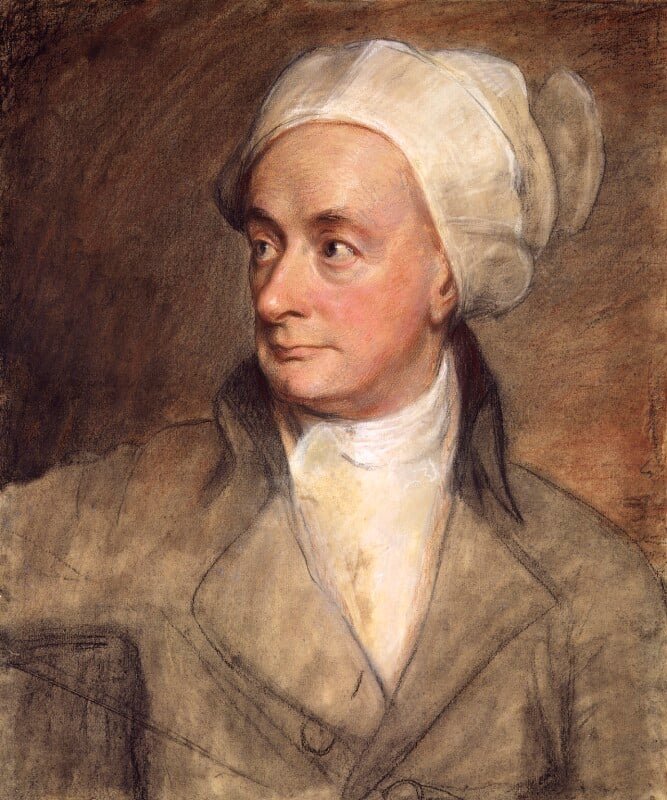
© National Portrait Gallery, London. Shared under an Attribution-NonCommercial-NoDerivs 3.0 Unported (CC BY-NC-ND 3.0) license.
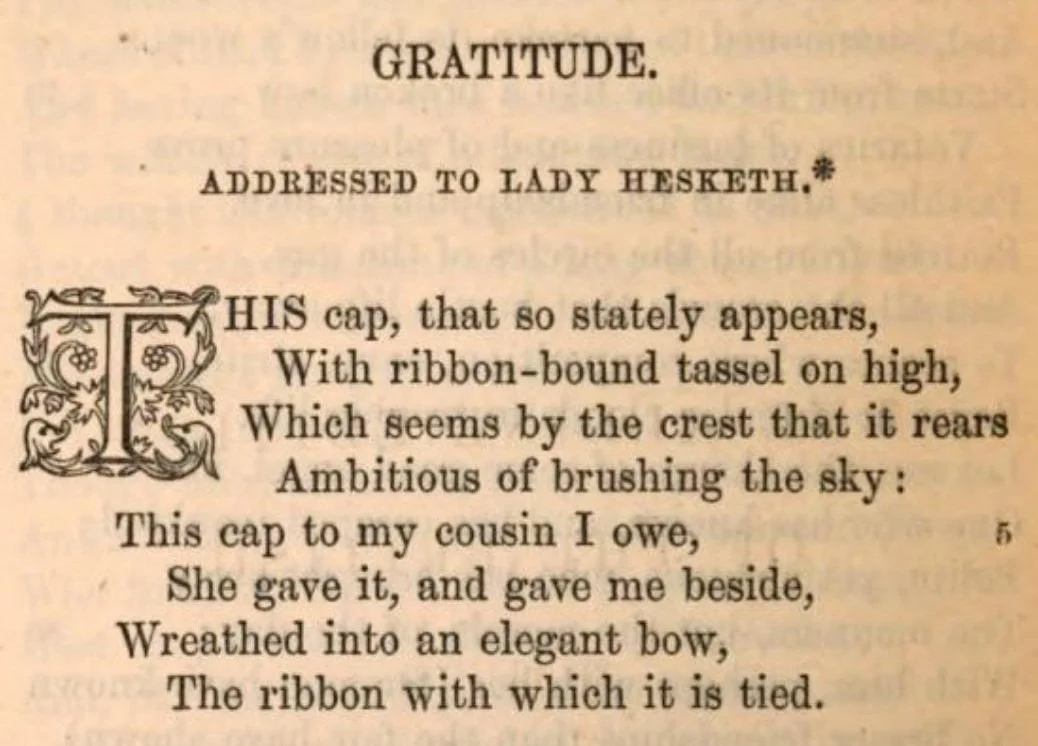
William Cowper’s portraits often depict him wearing a linen cap of this style. The cap itself is in the collection of the Cowper & Newton Museum, and is described in one of his poems.
Knit caps
These knit caps could be purchased ready-made in shops (often in silk or worsted wool), or homemade.
18th century knit caps tend to appear on sailors. See also Clothing the Royal Navy Sailor, 1765 to 1775. Many of the working-class men and boys of Amsterdam depicted by H.P. Schouten seem to be wearing knit caps, such as this boy playing marbles in 1778.
Runaway advertisements suggest that these were also worn by other working-class men in colonial America, such as George Curren (1729), William Cole (1739), Mona (1746), Bedford (1749), Tapley (1755), George (1759), and Thomas Woodcock (1760). Antoney Maria wore a “ſailor’s knit cap“ (1770), and Richard Pastow wore “a Sailors Jacket a knit Cap ſtriped red and white“ (1720). Knit caps were also trade goods for Native Americans (see The Buffalo Trace).
Scotch bonnets were also knit.
National Museum of Scotland H.NA 1041 and H.NA 1042, the Gunnister Man’s knit caps, Scotland, late 17th century (see Maeve Kane’s pattern)
Knit caps at the Rijksmuseum, including NG-2006-110-8 (c. 1740-1750) and NG-2006-110-4 (18th century)
A boy standing next to The Merchant by Peter Snijers, c. 1700-1752
Plates 3, 9, and 10 from Industry and Idleness by William Hogarth, 1747
Without, 1757
Detail from The Imports of Great Britain from France by Louis Philippe Boitard, 1757
Chatham Historic Dockyard Trust INV.33 and INV.111, knit caps from the Invincible, 1758
Dr Oliver and Mr Peirce, the First Physician and Surgeon Examining Patients Afflicted with Paralysis, Rheumatism and Leprosy by William Hoare, 1761
David Garrick as Sir John Brute in Vanbrugh’s 'The Provoked Wife' by Johann Zoffany, 1763-1765
The Female Orators, 1768
The Porter and the Hare by Johann Zoffany, 1768
Scene in a London street by John Collet, 1770
A Marine & Seaman fishing off the Anchor on board the Pallas in Senegal Road, Jany 75 and A Sailor fishing off a gun [on the] Pallas Jany 75 by Gabriel Bray
London Museum 90.322/61, c. 1779-1820
A porter in an illustration from Sophiens Reise von Memel nach Sachsen by Daniel Chodowiecki
Blacksmiths by Pehr Hilleström, 1781
Greensboro Historical Museum 1926.155.0001, a knit liberty cap worn by militia officer Captain Arthur Forbis, mortally wounded at the Battle of Guilford Courthouse in 1781
Hat from the wreck of the General Carleton of Whitby, 1785; see also The General Carleton Hat and a reverse-engineered pattern
18th century Dutch knit bed cap with a star on the crown
A Cobler, 1786
Knit cap from the wreck of the DeBraak, 1798
V&A T.322-1982, machine-knitted wool cap made in Great Britain c. 1800; note similarity to the “tied-tube” caps
Additional Resources
Mara Riley: 17th & 18th Century Knitted Caps & Scots Bonnets
A Bluestocking Knits: Woollen Caps ("Muts") Worn by Dutch Whalers at Smeerenburg
Costume Historian: Seventeenth and Eighteenth century whalers' knitted caps
18th Century Material Culture: Knit Caps
The French in Wisconsin: Thoughts on Knit Caps
Monmouth cap patterns by Sarah Bradberry, Jen Thies, Mara Riley, and Miranda Sterling
Notes and patterns for a cap found in a latrine at Louisbourg: Knit an Eighteenth-Century “Latrine Hat”, Ravelry, Unraveling the Secrets of 18th-Century Knitted Hat in a Latrine
A history of hand knitting
Video tutorial on how to wash a stocking cap
Working men’s caps
This is sort of a catch-all category for caps worn by working-class men. They’re not made of expensive fabrics, like the nightcaps above. Some of them might be knit caps or tied-tube caps.
The most basic form of these caps is a sort of two-panel dome shape, probably in white linen, like Colonial Williamsburg 1999-216 and Crocker Farm May 4 2013 Lot 200. Bouchardon’s baker boy may be an illustration of this style. Paul Sandby’s sketch of Noel Desenfans and Sir Francis Bourgeois may be showing a looser, slouchier form of this cap — or it may be a knit silk cap.
Another style is built a bit like the more refined nightcaps above — essentially, four wedge-shaped panels with a turned-up brim. Sue Felshin describes a pattern for this sort of cap: “Take medium weight cloth and cut four eye-shaped pieces. Each should be wide enough at the middle to go a quarter of the way around your head (plus a ½ inch seam allowance at each side). Each should be long enough to go from wherever you want the edge of the cap to the top of your head, plus one inch for the brim, plus twice that whole amount so you have both inside and lining. If you have a baseball cap, you can use that as a guide, but a workmans’s cap should sit a little looser on your head – it should sit a little lower and stick up a little higher – so the pieces should be a bit longer. Sew them together into a football shape, leaving one seam open for a couple of inches. Turn the cap right side out through the gap and sew the gap closed. Make one end of the ‘football’ into the lining by pushing that end up into the other. Fold up an inch of the edge for a brim and stick it on your head. The simplest way to find out how to curve the pieces is to cut rectangles at first, pin them together, stick them on your head, move the pins in until you like the fit, and then cut a little outside of the pins (for the seam allowance).”
These sorts of seamlines are visible in some illustrations, such as Evening at the Piazza or this Chodowiecki sketch of a boy. Historical interpreters sometimes wear this style in a check linen fabric, which vibes with descriptions of runaway servants (e.g. Christopher Major in 1750, Jacob Hagie in 1751, William Palmer in 1752, etc.) despite a lack of physical evidence for the style.
Cast iron figure of a seated man wearing a cap
Poultalier, brigand exécuté sous Louis XVI
Evening at the Piazza by Giacomo Ceruti, c. 1730
Family scene in an interior by Giacomo Ceruti, 1730
Baker boy and vinegar seller by Edme Bouchardon, c. 1730s
Garçon boulanger, 1737
A boxing match in London by Andreas Möller, 1737
A cook in The wretched shoe-boy by J.S. Müller, 1740
Dice-players by Giuseppe Maria Crespi, 1740s
Beer Street by William Hogarth, 1751
Pit Ticket (after Hogarth)
London Cries: A Fishmonger by Paul Sandby, c. 1759
Concia Careghe, c. 1760-1770
Three sketches of boys (attributed to Daniel Chodowiecki) - 1956,0211.3, 1956,0211.4, 1956,0211.5
The card-players by Léonard Defrance, 1763
The Methodist Tailor Caught in Adultery, 1768
The Newsmongers, 1769
A cabinet-maker’s office, England, c. 1770
Scene in a London street by John Collet, 1770
A cobbler mending a shoe, c. 1770s
The Modern Beau in Distress, c. 1770-1775
Docking the Macaroni, 1773
Cobler’s Hall, c. 1778
A tailor asks an officer for payment, 1788
A cobbler (at right) in St. James’s Day, 1793
Attention, 1800