What’s on the wall?
Taking a closer look at the art in the art
Taste in High Life
from a 1742 painting by William Hogarth
Depictions of living and working spaces frequently include framed paintings or tacked-on prints on the walls. In some cases, the image shown on the internal artwork (or the subject of the ballad or advertisement printed on the broadside) is a way for the artist to add a subtle comment on the main scene; in others, it may just be a way to create a sense of depth and realism in a more decorated interior space, or a reflection of the tastes of the family depicted in the portrait.
Consider whether the art-within-the-art serves a deeper narrative function: a vehicle for satire, an omen of foreshadowing, or a symbol or allegory underscoring the central theme.
While the method of display (tacked to the wall, framed, etc.) may have been typical of the era, the actual print may not have existed beyond the artist’s imagination. When possible, the prints are identified or described below; if it exists in reality, a link has been provided for further study.
Graphic prints could originally have been purchased at shops, such as those depicted in Dorothy Mercier’s trade card (c. 1760), A Macaroni Print Shop (1772), Miss Macaroni and her Gallant at a Print-Shop (1773), Spectators at a Print-Shop in St.Paul's Church Yard (1774), or this drawing by J. Elwood (c. 1790) or this watercolor of William Holland’s print shop by Richard Newton (c. 1794).
This page focuses largely on interior spaces. Works by H.P. Schouten show broadsides in outdoor public spaces, such as West-Indisch Huis and Vijgendam 16-18.
I’m also working on a page with trompe l'oeil works, which often copy or mimic other pieces of artwork.
Tea Party at Lord Harrington’s House, St. James’s, by Charles Philips, 1730
A large landscape, and two floral still-life paintings
The Rake’s Progress, 1734
Read Sir John Soane’s Museum’s in-depth commentary on The Heir, The Levee, The Orgy, and The Marriage
He comes to the possession of his fathers estate, c. 1735
Prints titled “The Prodigal Son going from his carefull father” and “The Prodigal Son wasting his substance on Harlots”
He Revels with Common Whores at a Tavern in Drury Lane, 1735
From left to right: portraits of Polly Peachum and Captain Macheath from The Beggar’s Opera; an equestrian portrait of Emperor Tiberius; a large print of The Famous Seven Wonders of the World; an equestrian portrait of Caesar Augustus; an equestrian portrait of Julius Caesar; a portrait of Sarah Malcolm; a portrait of Henry Sacheverell; and an equestrian portrait of Nero
The Strode Family by William Hogarth, c. 1738
The Tate notes that “the pictures on the wall - a large Salvator Rosa-type landscape, a small view of Venice, perhaps by Guardi, and another small landscape in the style of Gaspard - are suitable reminders of the Grand Tour.”
A painting of a man and a woman in old-fashioned dress, possibly dancers or characters from a play, with An unknown man in a library by Arthur Devis, c. 1740-1741
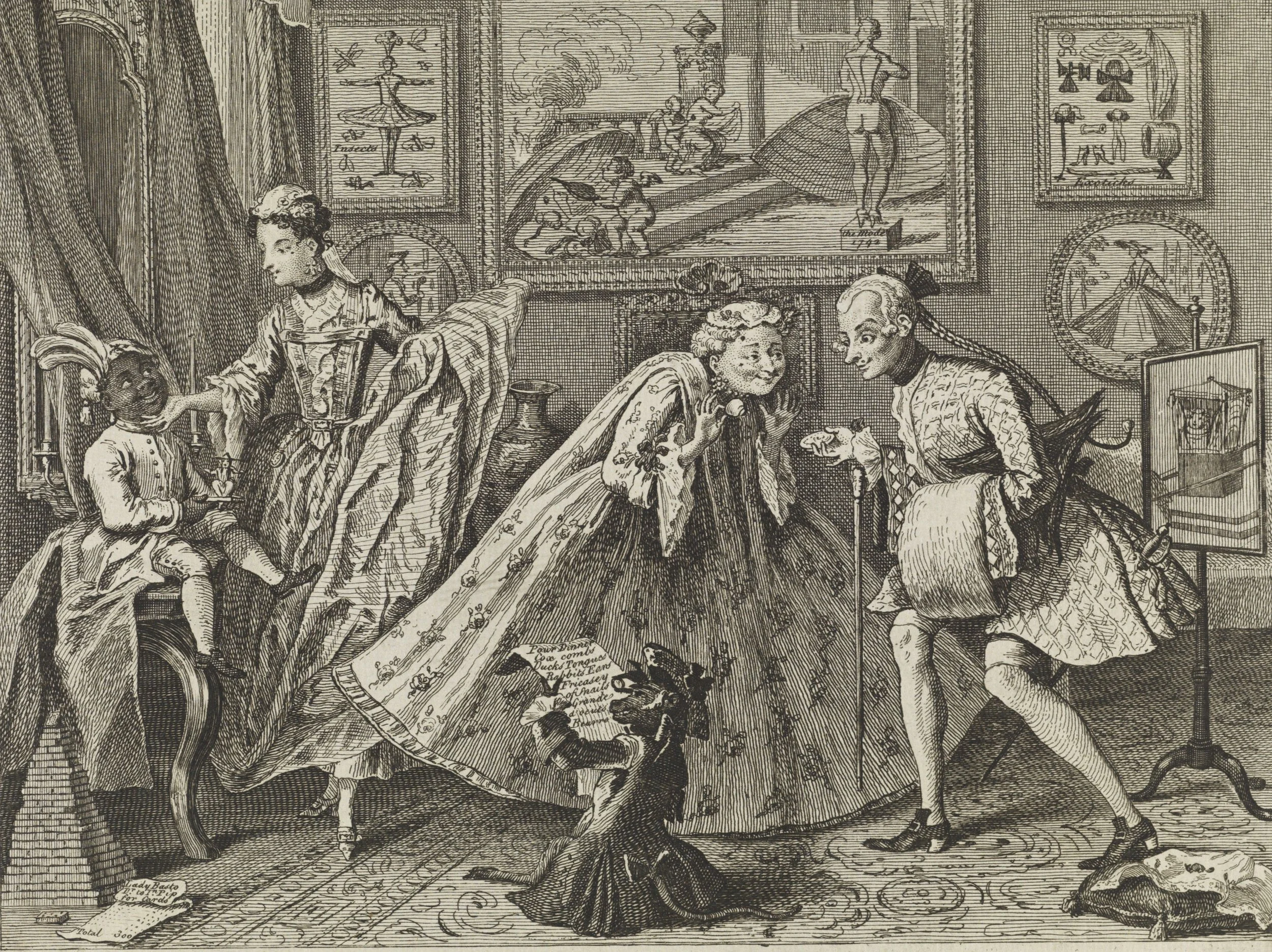
Taste in High Life (or Taste à-la-Mode) by William Hogarth, c. 1742
The artwork mocks contemporary fashions. Hogarth returned to the ridiculous figure of a woman trapped in a sedan chair by her own hoops (here on a firescreen) about ten years later, in the background of Beer Street. The rear view of the Medici Venus wearing a cutaway hooped petticoat also appears in A Section of the Petticoat or the Venus of 42 and 94.
Marriage A-la-Mode by William Hogarth, c. 1743
Read the National Gallery’s in-depth commentary on The Marriage Settlement, The Tête à Tête, The Toilette (look for Ganymede, Jupiter & Io, and Lot & His Daughters), The Bagnio, and The Lady’s Death
A seascape painting above Children in an interior by Arthur Devis, c. 1743
A Venetian scene, and a hunt-themed still life, in Mr. and Mrs. William Atherton by Arthur Devis, 1743
The Fellow 'Prentices at their Looms by William Hogarth, 1747
Thomas Idle has a “Moll Flanders” broadside tacked to a post of his loom; Francis Goodchild has more virtuous literature tacked to the wall behind his loom, including broadsides titled “The London Prentice” and “Whitington Ld Mayor”
Several of Arthur Devis’s indoor conversation pieces feature landscapes, which could either represent Grand Tour souvenirs or studio props used across multiple works. (Earlier in his career, Devis produced copies of Italian landscapes while training with Peter Tillemans.)
John Bacon, Catherine Bacon, and their children John, Charles, Catherine, and Dorothy, c. 1742-1743
The Reverend Streynsham Master and His Wife, Margaret of Croston, Lancashire, c. 1743-1744 (with portraits of other family members)
Mr. and Mrs. Richard Bull, 1747
A lady seated at a harpsichord, 1749
Conversation piece with a family at a harpsichord, c. 1750
A couple, traditionally identified as Mr. and Mrs. Hill, c. 1750-1751
Lady Juliana Penn, 1752
John Orde, his wife, Anne Orde, his eldest son, William, and an unnamed servant, c. 1754-1756
Lady with a Bird-Organ by Jean-Siméon Chardin, c. 1753
A framed engraving of Painting Ejecting Thalia
Pride, c. 1753-1766
A framed painting with a pair of courting lovers
A group of framed landscapes with The Buckley-Boar family, c. 1758-1760
David Garrick in 'The Farmer's Return' by Johan Joseph Zoffany, c. 1762
A framed print with two men on horseback (?)
Tavern interior by John S C Schaak, 1762
A print of a man on horseback above the fireplace on the back wall
High Life Below Stairs by John Collet, 1763
To the left (on the wall behind the singers), prints depicting Elizabeth Canning, The Empress of Russia, and Moll Flanders; “The Order of the Procession at the Coronation” (similar to The Magnificent Form of the Procession) above the fireplace; to the right, near the laundress’s elbow is a print depicting Cleopatra
George, Prince of Wales, and Frederick, later Duke of York, at Buckingham House by Johan Joseph Zoffany, 1765
The paintings include George Villiers and Lord Francis Villiers, The Infant Christ Holding a Cross, and The Three Eldest Children of Charles I, along with portraits of the boys’ parents
A Pleaſing method of rouzing the Doctor — or a Tythe Pig no bad ſight, c. 1765
A map titled “A PLAN of the DOCTORS PARISH”
Dick Swift, 1765
A print of Arthur Beardmore and his son
A painting of the Judgment of Solomon appears in the versions of Zoffany’s Scene from “Love in a Village” at Yale and Detroit Institute of Arts; the version at the Holburne has The Three Eldest Children of Charles I
The Sacrifice, 1767
A framed painting of a biblical scene with a sacrifice of a lamb
The Monkey’s Downfall or Cat’s-Paw Reſcu’d, 1767
On the left, “Chatum in Prosperity” (sunrise over a port); on the right, “Iſle of Boot in Adversity” (Scotsmen scratching themselves against posts under a solar eclipse)
Grown Ladies & taught to Dance, 1768
A picture of a monkey holding a violin, dancing with a cat
The Hen Peckt Husband, 1768
A broadside titled “A NEW Summons to Horn Fair,” a framed picture titled “MARS VENUS & VUL[CAN],” a print of “LUCRETIA,” and a broadside with “The Happy PAIR”
Out of Place and Unpension’d, 1769
On the left, a portrait of a man at his desk (probably John Wilkes); on the right, a broadside titled “The Middleſex Petition”
High Life Below Stairs, 1770
A pair of broadsides pasted on the wall behind the servants
The Shaver and The Shavee, 1772
Prints and broadsides include “DEATH & LADY [?],” “STATION [?] FOR 177[?],” “LIST OF THE LENT PREACHERS,” and “T STERNHOLD”
The Dutton Family in the Drawing Room of Sherborne Park, Gloucestershire by Johann Zoffany, c. 1772
Several framed paintings in an idealized interior, including landscapes and a depiction of Venus at Vulcan’s forge
The Jealous Maids, 1772
A print titled “The RIVAL MAIDS”
Artwork depicted in The Tribuna of the Uffizi by Johan Joseph Zoffany, c. 1772-1777
The Old Beau in an Extasy, 1773
A framed painting of Narcissus
Sir Lawrence Dundas and his grandson by Johann Zoffany, c. 1775
See Craske’s analysis (or The Inventory of 19 Arlington Street, 12 May 1768); several paintings in the collection of the elder Dundas, mostly Dutch and Flemish, including A Calm, The Guardroom, and The Card Players
Cobler’s Hall, 1775
“DUKE of CUMBERLAND” framed on horseback over the fireplace, with other broadsides on the back walls
The Captain’s so kind as to thrust in a Note, While old Lady Cuckoo is straining her Throat, 1777
Framed pictures of street entertainers, including musicians with a dancing dog and a dancing bear
Bachelors Fare — or Bread and Cheese with Kisses, 1777
On the back of the door, a sign says “A Light Heart & a thin Pair of Breeches goes thorough the World brave Boys”; a picture on the back wall shows a naval battle, titled “The Free Briton closely engag’d with the Charming Sally”
The Manchester Hero, or Arts yield to Arms, c. 1778
A notice on the tavern wall starts with the words, “All aſpiring Young Men who despiſe Slavery”
The Whore’s Last Shift, 1779
Just inside the window, a broadside ballad titled ”The Comforts of Single Life, an Old Song”; on the back wall, a torn print of “Ariadne Forſaken”
My Wife and Your Wife, 1779
Broadside ballads titled “The Goſſips Delight” and “Madams Gins Triumph”
Corporal Cartouch teaching Miss Camp-love her Manual Exercise, 1780
A picture titled “Camp at Winchester” and a female archer (Diana?)
Benjamin Vandergucht’s portrait of Henry Woodward hangs on the wall behind William Brereton by Henry Walton, c. 1780
A Kitchen Maid, last quarter of the 18th century
A ballad titled “Black Tom” on the left, and a broadside titled “Dialogue between Father Time and a Spinster” (h/t Susan Holloway Scott)
Bow Street Myrmidons Spoiling Bob Booty’s Morning Draught, 1781
A picture of “Jack Sheppard”
Sir Richard Worse-than-Sly, Exposing his Wifes Bottom; — O fye!, 1782
A map of the Isle of Wight pinned to the wall behind the bath
Razor’s Levée, or ye Heads of a new Wig Ad—n on a broad Bottom, 1783
Portraits of Charles I and Oliver Cromwell, a broadside titled “By his Majesty’s Servants This Day will be presented A new Way to pay old Debts,” a map titled “A new Map of Great Britain and Ireland, a broadside titled “Rule Britannia Set to a new Tune 27th July”; see also Caricature History of the Georges
Long Sermons and Long Sieges are apt to Lull the Senses, 1784
A map titled “Plan of the Battle of Dettingen” is on the back wall of the tavern, with a portrait of George II above the fireplace
A St Giles’s Beauty, 1784
A broadside with an illustration of a Tyburn crowd with four bodies hanging from the gallows
The country club by William Dickinson, 1788
A tilted picture of a man on horseback over the door; a map of the world on the wall to the right
The Dull Husband, 1789
A framed painting of Apollo playing his lyre
Seeing, 1791
The man examines a broadside with an illustration of a monkey farting on a lit candle
Oh! Dear! What can the matter be! Johnny has been at the fair, 1793
Just behind the young woman attempting to conceal her pregnancy is a picture titled “The Broken Pitcher” (see Some Observations on the Symbolism of The Broken Pot in art and literature)
Settling a Political Debate, 1795
A print of the game board for “Royal Game of the Gooſe” (reference)
Diligence and Dissipation, 1797
The Modest Girl and the Wanton: “Almanack” behind the Modest Girl, “State Lottery” behind the Wanton, and “The Wise and Foolish Virgins” above the door between them
The Wanton in her Bed Chamber: advertisements including “Olympian Dew, Bloom of Ninnon, Cream of Roſes, Milk of Violets and Bloom of Circaſsia Sold by Mrs. Adrian only Hermitage Stairs on St. James Street” and “Good fortunes foretold to Young Ladies by Mrs. Williams in the Old Bailey”; she’s fallen asleep while reading The Sopha
The Modest Girl in her Bed Chamber: prints titled “Twelve good rules of K. Charles the first,” “Connubial Happiness,” and “Duty of Servants to their Masters and Mistresses” under the window; an embroidered sampler with the Lord’s Prayer on the door; the book on the table appears to be The Young Man’s Best Companion
The Modest Girl rejects the Illicit Addresses of her Master: a painting of a nymph struggling to free herself from Father Time
The Good Girl Receives the Honourable Addresses of her Master: various allegorical subjects, including a wedding
Country Characters: Publican, 1799
Prints of horses and their riders from the Horse Accomplishments series: An Astronomer, A Land Measurer, An Arithmetician, and A Loiterer
Interior of a country inn by George Morland
Framed pictures on the back wall, with broadsides attached to the door
T. Rowlandson the Caricaturist, c. 1800
Pictures tacked to the wall (presumably Rowlandson’s prints)
Knavish Pat — A Tale, 1804
A framed print of a game board for Game of the Goose (reference)