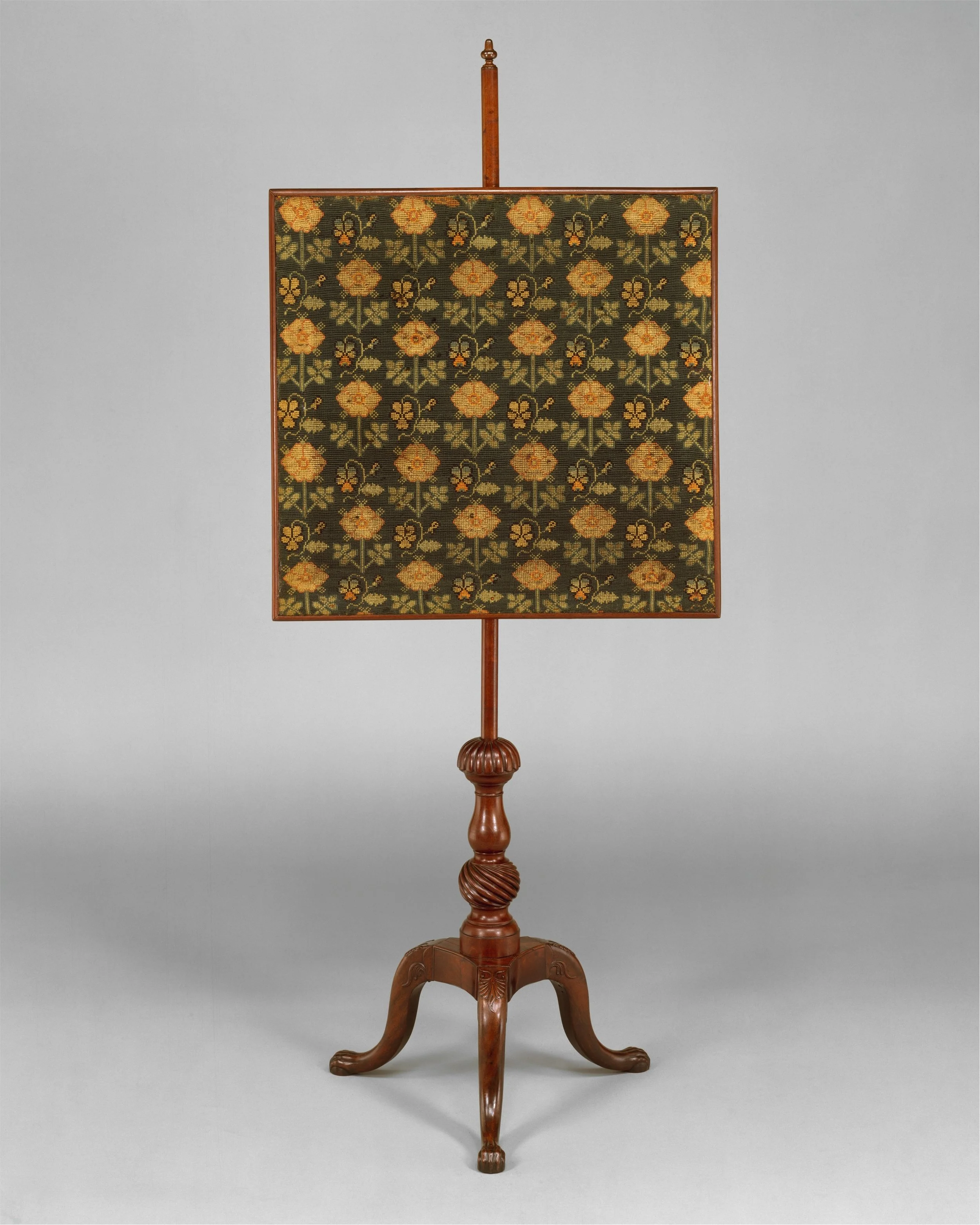
18th Century Fire Screens
Depictions of firescreens in 18th century domestic interior spaces provide a better perspective of how cheval firescreens and pole screens would have originally looked, and how they had been used in rooms (especially drawing rooms).
There are more extant examples than depictions. Several of the embroidered panels have become separated from the wooden framing over the years, like V&A T.2-1929 and Met 41.205.3c.
This page has sections for cheval firescreens and pole screens. Hand screens are discussed on another page.
Fire screens are often available through antique dealers, but the extant examples linked below are largely from museum collections.
Additional Resources
This site contains affiliate links for which I may be compensated
18th Century Material Culture: Hand & Fire Screens
Conversations and Chimneypieces: The imagery of the hearth in eighteenth-century English family portraiture
Find original and reproduction 18th century fire screens on eBay
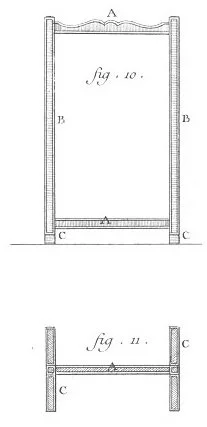
10. Élévation d'un chassis d'écran dont la fig. 11. est le plan, A A en sont les traverses, B B les montans, & C C les piés.
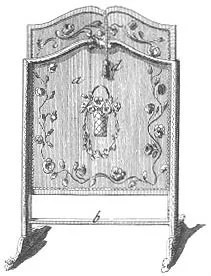
Ecran. a, piece d'étoffe. b, bâti de l'écran. c, clou doré. d gland dans lequel il y a un plomb qui sert de poignée.
Cheval firescreens
Depictions in 18th century interiors:
La Toilette by François Boucher, 1742
William Brereton by Henry Walton, c. 1780
(Also, designs by Chippendale, 1762)
Extant examples:
V&A W.11-1958, c. 1700-1725
V&A W.40:1 to 2-1949, c. 1714-1718
Met 64.101.1154, c. 1730-1740
V&A W.55-1962, c. 1730-1750
Met 35.23.1, .2, c. 1736-1740
Met 1971.206.15, c. 1750-1760
V&A W.2-1933, c. 1750-1770
Colonial Williamsburg 1936-10,1, c.1755
Met 64.101.1155, c. 1755-1760
V&A 1202:1 to 3-1882, c. 1770-1790
Met 41.13a–d, c. 1770-1800
Colonial Williamsburg 1939-246, c. 1775-1800
Firescreens at Versailles, including V2024.16 (1759), OA9370 (1777-1778), V2024.48 (1779), VMB14460 (c. 1780-1785), F610C (c. 1783), GME15272 (1784), GME16833 (1787), VMB14291 (1787), VMB14307 (1787)
Met 1971.206.16, c. 1786
Pole firescreens
Depictions in 18th century interiors:
Taste in High Life (or Taste à-la-Mode) by William Hogarth, 1742
The Lady’s Last Stake by William Hogarth, 1759
George, Prince of Wales, and Frederick, later Duke of York, at Buckingham House by Johann Zoffany, 1765
Portrait with members of a family, 1770s
The Dutton Family in the Drawing Room of Sherborne Park, Gloucestershire by Johann Zoffany, c. 1772
Conjugal Peace, 1782
The Detection, 1785
The Dull Husband, 1789
Jean-François de la Marche by Henri-Pierre Danloux, 1793
(Also, designs in Genteel Household Furniture in the Present Taste, 1762)
Extant examples:
Colonial Williamsburg 1967-458, c. 1720-1740
Colonial Williamsburg 1967-441,A and Colonial Williamsburg 1967-441,B, c. 1725-1745
Colonial Williamsburg 1960-665, c. 1740
Colonial Williamsburg 1967-252, c. 1745-1765
Mount Vernon M-2469, c. 1745-1765
Colonial Williamsburg 2001-6,A, and Colonial Williamsburg 2001-6,B, c. 1750-1775
V&A W.60-1926, c. 1750-1780
Colonial Williamsburg 1954-371, c. 1755-1780
Colonial Williamsburg 2003-174, c. 1760
Winterthur 1958.1506, c. 1760-1780
Mount Vernon W-2182/A, c. 1760-1790
Met 10.125.422, c. 1760-1790
Met 64.101.1153, c. 1765
Leeds Museums and Galleries CHIPSOC.2012.1, 1765: “This pole screen is one of two supplied by Thomas Chippendale to Sir Lawrence Dundas at Aske Hall, Yorkshire, invoiced on 28 October 1765: ‘2 large Mahogany pole screens cover'd wt India pict: … £2 14s 0d'. It is very similar to another documented example supplied to Blair Castle in 1758, although that one had a panel of French tapestry. The ‘India picture' is a piece of Chinese hand painted paper glued to a canvas, backed with hessian and tacked to a wooden frame or stretcher. However, the panel has been reversed so that the front now shows a piece of early 18th century floral needlework.”
Colonial Williamsburg 1961-43, c. 1770 (minature)
MFA 35.1845, c. 1770-1790
Met 49.51a, b, 1771
Met 25.115.28, c. 1775
Hammond Harwood House F25, c. 1775-1780
Winterthur 1963.1013 A, B, c. 1775-1810
Met 1975.1.2071, last quarter of the 18th century
V&A W.51-1950, c. 1780-1790
Met 1977.425, c. 1785-1795
V&A W.15&A-1951, c. 1785-1800
V&A W.31:1 to 3-1984, 1787
Met 1986.450.1, c. 1790