Patched clothing in the 18th century
This page focuses on clothing that has been repaired with patches, rather than clothing that has been entirely constructed or decorated with patchwork piecing (such as pockets). The intent here is to look at where clothing has been patched, and how the patches have been attached.
Some of these artistic depictions use patching as an element of a broader satire (e.g. the king’s breeches in Temperance Enjoying a Frugal Meal) or a visual cue for poverty or shabbiness (e.g. the patched curtain in The Modern Harlot’s Progress). Most patches on extant clothing show a preference for keeping the visibility of the repair as minimal as possible, as demonstrated in The Importance of Mending, so the visibility of the patches in many of these depictions may have been emphasized for effect.
(See also: patched clothing from the 14th-16th centuries.)
Old clothing could also be remade into new clothing or reused as household textiles.
The Cryes of the City of London Drawne after the Life: A Braſs Pott or an Iron Pott to mend, Troope every one one, Any Old Iron take money for, Maids any Cunny Skins
Covent Garden Market by Balthazar Nebot, 1737 (Tate/Guildhall/Christie’s)
The Blind Musician by J.S. Müller, c. 1740
Sketch of a boy sleeping on a block of stone by Daniel Chodowiecki
London Cries: Fun upon fun by Paul Sandby, 1759
Modern Love: The Elopement by John Collet, 1764
Children playing by Johann Conrad Seekatz
The Methodist Taylor caught in Adultery, 1768
The Female Orators, 1768
John Tait, 1772
A Polite Artist, 1773
Foolish Sam, 1773
The Human Passions 17, 26, and 34, 1773
John Brading, 1774
The Disbanded Soldier, 1775
's-Gravelandse Veer near the Amstel by H.P. Schouten, 1779
Mad Jack of Margate, 1780
Portrait of a hedge cutter from Broughton Castle; this portrait has been featured on episodes of Antiques Roadshow and A Stitch in Time
The Jovial Crew, or, Merry Beggar: A comic opera as performed at Brighton by the Carleton Company, 1786
The Return from Market by Francis Wheatley, 1786
The Blind Beggar and His Granddaughter by John Russell
Frying Sprats, 1791
The Dutiful Grandson, 1792
Queen of Patterdale, 1794
Iohn Doe & RichD. Roe, Brothers in Law, 1796
Man holding a staff by Thomas Barker, c. 1800
Guy Fawkes Day, The Costumes of Great Britain, 1805
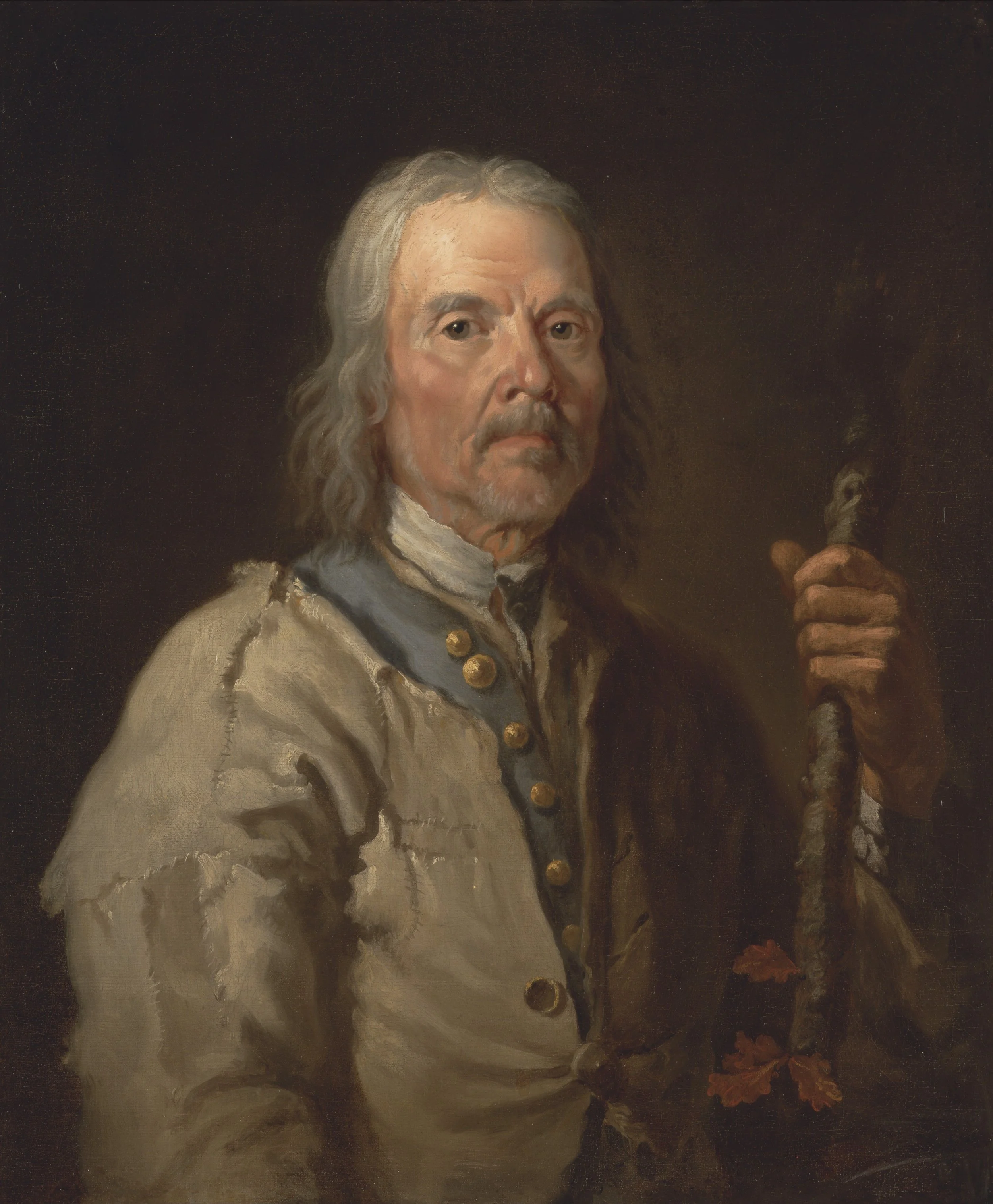
Thomas Barker, 1769-1847, Man holding a staff, ca. 1800, Oil on canvas, Yale Center for British Art, Paul Mellon Collection, B1976.7.3.
Patches on extant 18th century clothing
Extant patched clothing tends to keep the repairs as minimally visible as possible, but it is not always clear whether these repairs were actually applied in the 18th century or if they reflect later repairs and alterations. (Keep in mind that if clothing were actually deteriorating or otherwise shabby enough to have been patched, it would have been less likely to have been bought by discerning collectors or preserved in museum collections, so there’s an element of survivorship bias in terms of extant examples.)
National Trust 1430672, boy’s breeches in black knit silk, “wool patch to seat”
National Trust 1348765.2, a coat in shot silk taffeta, 1740-1755, “part of inside sleeve cut away and patched”
V&A T.148 to B-1964, a brocaded silk sleeved waistcoat, c. 1745; “The small of the back, the underarm and right elbow are patched with a coarser yellow silk.”
Colonial Williamsburg 1964-386, a child’s linen cap, 1750-1800, “patched repair on lace around the front edge”
On The Mend has a close-up photo of the mending and repairs to Historic Deerfield F.235, an American striped linen short gown c. 1750-1800; “Holes in both sleeves of this striped linen short gown have been patched from the inside with matching fabric. The edges of the holes have been neatly finished to prevent further fraying.”
National Trust 1350664, silk breeches, 1760-1770; “The front of the pockets are patched with a piece taken from the back of the waistband.”
Colonial Williamsburg 1993-336, front-lacing stays, 1760-1775; “The leather lining on the tabs has also been patched or reinforced with more leather.”
National Trust 1348767, a coat in uncut velvet, 1765-1775; “Appears to have been widened at centre back. Patched with original fabric.”
Connecticut Historical Society 1959.54.4, a printed cotton day dress, c. 1775-1785; “The lining is patched with blue and white linen gingham at the proper left inside edge.”
National Trust 1348785, velvet coat, 1780, “repaired under arm with patches of same fabric.”
National Trust 1348782.1, shot silk breeches, 1780-1790; “Lined with cream silk patched with white cotton … Has been patched with the same fabric.”
Monticello 1983-14-41, a frock coat c. 1795-1810 with patched elbows; see Thomas Jefferson Wore Patched Clothes and You Can Too!
Rare Everyday-Wear: A Woman’s Shortgown, c.1780-1800, “This shortgown has been patched, and patched again, with neatly squared patches and careful stitching … some of the patches are scraps of the original fabric, and others are simply similar fabric. Most of the patches are in places that would have received the most stress and wear, under the arm and along the sleeves.”
PVMA 2000.01.869, c. 1790-1840; “The several stains and patches suggest the hard use such garments saw; however, the seam under the bust line suggests that the garment was intended to conform to the silhouette popular in the late 18th century into the early 19th century, indicating that even work clothes responded in some ways to prevailing fashions.”
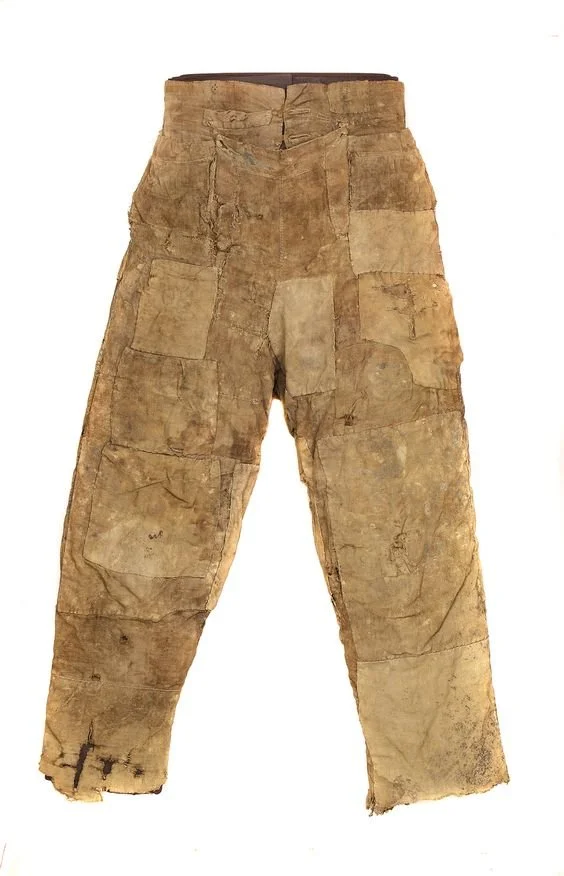
A well-patched pair of corduroy trousers, probably early 19th century, in the Norfolk Museums Collections.