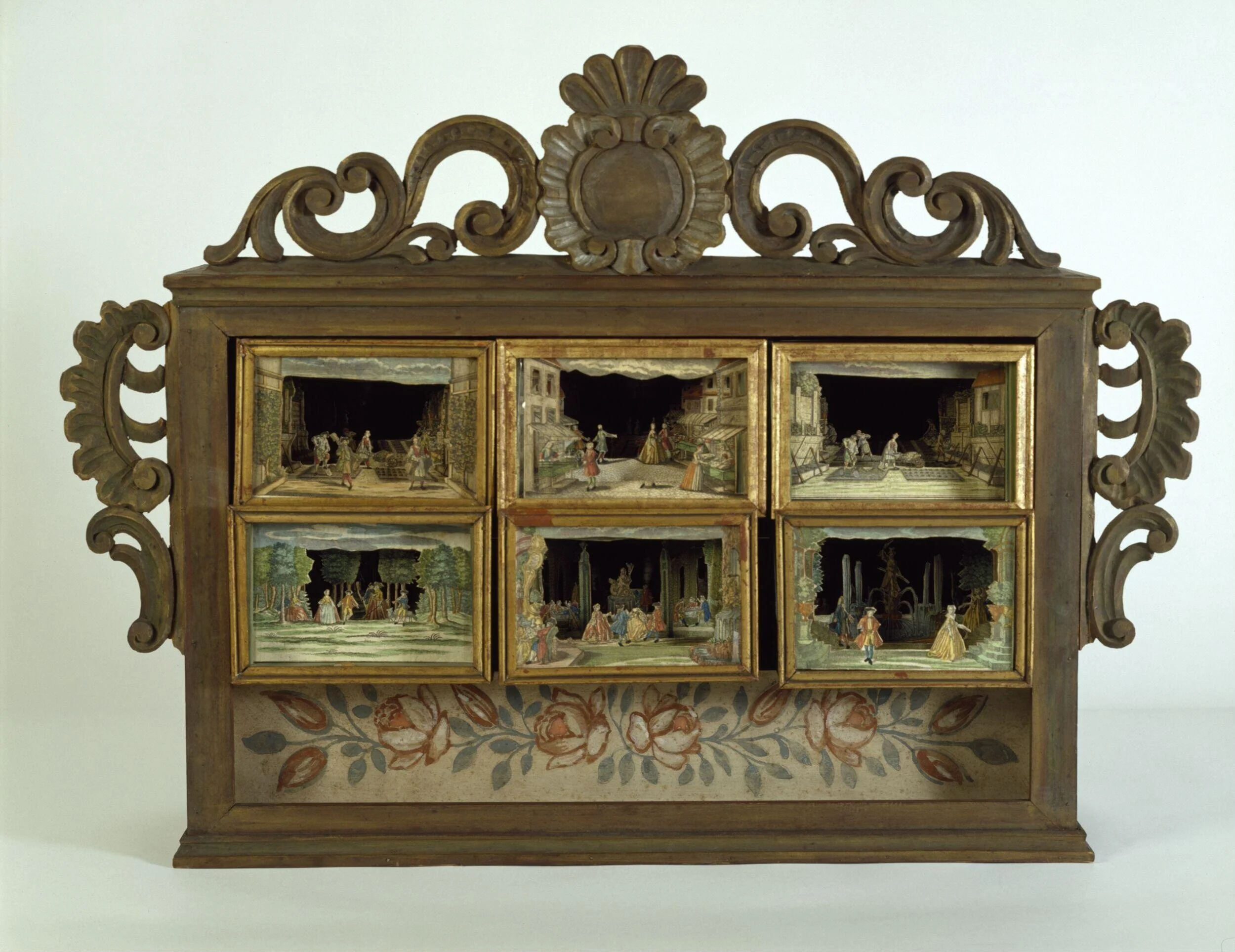
© Victoria and Albert Museum, London
Peep Shows and Raree Shows
in the 18th Century
A raree show, or peep show, essentially consists of a box with holes, allowing the viewer to look inside to view objects or diorama-like scenes. Such boxes were carried by itinerant showmen, who would allow paying customers to view the images in the box as entertainment. While this article in The Times (May 13, 1785) is a satire on current events, it likely emulates the sort of patter that raree show-men might have employed to attract paying customers.
What is a raree show? Johnson’s definition:

This “foreign” pronunciation also peppers ballads describing raree shows in The Compleat Academy of Complements and A Pill to Purge State-Melancholy. In a comic opera, The Raree Show: or, The Fox Trap’d, a character named Smart puts on a very silly accent when he disguises himself as a raree-showman.
The Museu del Cinema has a very good description:
The peep show box was, in essence, a travelling show that toured fairs and markets, squares and public spaces throughout Europe, as did other types of shows at the time: jugglers, theatrical performances, storytellers, fortune tellers, and so on. That is, a whole series of people who made a living from travelling shows. They were people who had probably had to emigrate from their place of origin – it is known that many came from mountain areas – and were forced to travel to towns and cities to earn the money they could not get at home. They were poor people, who travelled burdened down with the peep show box and views, on bad and sometimes dangerous roads. They travelled hundreds of miles, slept where they could and often had to deal with hostility from the authorities. But the fairground entertainer also had to be imaginative and ingenious. It took talent to attract the audience and entertain them with explanations and comments on the views that were offered inside the box.
Several itinerant showmen are depicted carrying a magic lantern mounted on top of a peep show box (e.g. depictions by Bouchardon and Huet, depictions in the Cries of Danzig and the Cries of Paris, etc.). The combination was also described in newspapers of the day; the Gloucester Journal (March 22, 1748) describes “A Gang of Fellows, who travel the Country with Magic-Lanthorns, Raree-Shews, &c.”
The method of showing the images is different. With a magic lantern, the image is projected onto a screen for a larger audience. With a peep show, the viewer is looking into a box. But then there are large-scale miniature theaters like the Eidophusikon that combine attributes of both; see Robert Poulter's New Model Theatre for a re-creation.
Additional Resources
This site contains affiliate links for which I may be compensated
Peep shows and related paraphernalia
Perspective box with views of the interior of a Dutch house by Samuel van Hoogstraten, c. 1655-1660
V&A W.37-1939, the Engelbrecht Theatre peep show, 1721; “Peep show of wood and engraved paper, composed of a theatre with six units of scenes, each unit having cards which slot into place one behind another. Scenes are mostly pastoral or battle-fields.”
An Engelbrecht peep show box with scenes from the life of Jesus Christ, c. 1720-1750
V&A E.592:1 to 6-2009, an artist’s studio, c. 1740; “Around 1730 Martin Engelbrecht introduced and popularised 'Dioramas', sets of cut-out cards which created the illusion of three-dimensional space when viewed en enfilade in a box or slotted frame. Several such series by him are recorded, depicting interiors, landscape and genre scenes or dramatic biblical subjects. The particular interest of this example for the museum is that it shows in great detail the interior of a grand artist's studio.”
V&A 801.AH Box I (vi), a perspective view of a printer’s workshop (“designed to be inserted into a wooden peep show box to give a perspective view of a printer's establishment”), c. 1750
Peepshow viewing box and 10 peepshows, c. 1750; “To use the box, the viewer looked through the magnifying lens and saw, reflected in a mirror placed at a 45-degree angle, a three-dimensional scene formed from a series of six layered images. Each of the 10 accompanying peepshow sets contains six views; all of the views are printed on stiff paper, are hand colored and have been cut out except for the sixth which forms the background and has the number 6 printed at the bottom.” Engelbrecht sets in the Beinecke Library also include an Artist’s Studio, Bordello, Printing Shop, Sugar Plantation, Synagogue, and Whaling.
Engelbrecht viewing theatre and a peepshow box for Engelbrechts from the Ganz collection. Additional Engelbrechts and similar views in the collection: gates, street scene with procession, shepherds and shepherdesses, dancing in a garden, a celebration in a garden, a staircase with a fountain, an opera, another opera, a trading office, a den of thieves, David and Goliath, the Judgement of Solomon, the Nativity, the Three Kings, Jesus teaching in a temple / Christ in the temple, the arrival in Jerusalem, scourging of Christ, the Crucifixion, trained animals at a circus, rowdiness at a seaport, a café in Paris, an autumn landscape with a deer hunt, stag hunting, goat hunting, a hermit monk, a dramatic shipwreck, a man on his sickbed having visions of heaven and hell, the four seasons
Museu del Cinema 01163, a peep-show box, c. 1775-1825
Museu del Cinema 05937, a folding peep-show box in book form, made in France c. 1780
V&A P.44:1 to 4-1955, Thomas Gainsborough’s exhibition box, c. 1781-1782. “In the 1780s [Gainsborough] made a series of landscapes, in oil on glass, to be viewed in this specially constructed 'showbox'. Gainsborough was probably inspired by the example of contemporary glass paintings and the 'Eidophusikon', a miniature theatre for the display of pictures invented by the painter Philippe-Jacques de Loutherbourg in 1781. He used these transparencies, whose subjects were mainly drawn from the landscape near his native Sudbury, as an aid for planning larger compositions and for exploring different effects of lighting.” The V&A’s collection of Gainsborough’s glass paintings include P.32-1955, P.33-1955, P.34-1955, P.35-1955, P.36-1955, P.37-1955, P.39-1955, P.41-1955, P.42-1955, P.43-1955
A replica viewing box, based on an illustration in Le arti che vanno per via nella citta di Venezia
Depictions of peep shows and raree shows
Raree show, c. 1655-1700
Interior scene with a cheerful group of people looking at a raree-show box and men playing cards by Bernardus van Schijndel, c. 1671-1709
Harlequin with a peep show and spectators in a village, c. 1680-1731
The peep-show box by Jan Steen, c. 1685-1695
The Cryes of the City of London Drawne after the Life: Oh Rare Shoe, 1688
Old HARRY with his Rare Show, Old HARRY with his Gallant Show, c. 1700-1729
The Peep Show (’t Fraay Curieus) by Willem van Mieris, 1718
Study for frontispiece to a Set of 'London Cries', c. 1730-1809
La Lanterne Magique, 1731 (see also de Luikerwaal)
Southwark Fair by William Hogarth, 1733 (easier to see in the 1734 engraving)
The Charlatan and the Peep Show, tapestry designed in 1736
Two girls and a boy with an optical display case, 1742
La Boëte Curieuse, 1750
The Peep Show, or the Magic Lantern c. 1757
A Meissen porcelain figure of a peep-show man, c. 1757
Oh. You ſhall See, Vat you ſhall See, 1760
Porcelain figures with a peep show box, 1762
Two men at a magic lantern, 1764
Greeting card with a street scene and a cartouche, 1768
“Newcaſtle, May 29. At Belford Fair on Tueſday a foreign Renegado, exhibiting a Raree Show to a Sailor and two Countrymen, and telling them to notice the King of France and Attendants on Horſeback, contraſted with the King of England and Attendants on Foot, the Sailor was ſo enraged at the partial Diſtinction, that he broke the optical Machine, and gave the Owner a very ſevere Drubbing.” (Berrow's Worcester Journal, June 3, 1773)
Tapestry: a child with a peep-show box, c. 1775
The political raree-show, or, A picture of parties and politics, during and at the close of the last session of Parliament, June 1779; see also The Political Raree-Show: A Dream
A Vieu of Plymouth, 1780
Il Mondo nuovo, 1785
“In sta cassela mostro el Mondo nuovo / Con dentro lontananze, e prospective; / Vogio un sold per testa; e ghe la trovo,” Le arti che vanno per via nella citta di Venezia, 1785
The Show, 1787
A peep show in China, c. 1790
The Show-Man, 1793
Het Commite van Buitelandsche Zaaken, 1795
An image seller, c. 1799
Raree-Show, 1800
Peep show in a courtyard by Jan Josef Horemans the Younger
A Showman, 1804
A woman and children at a peep show, 1805
Raree-Show from Thomas Rowlandson’s Characteristic Sketches of the Lower Orders, 1820
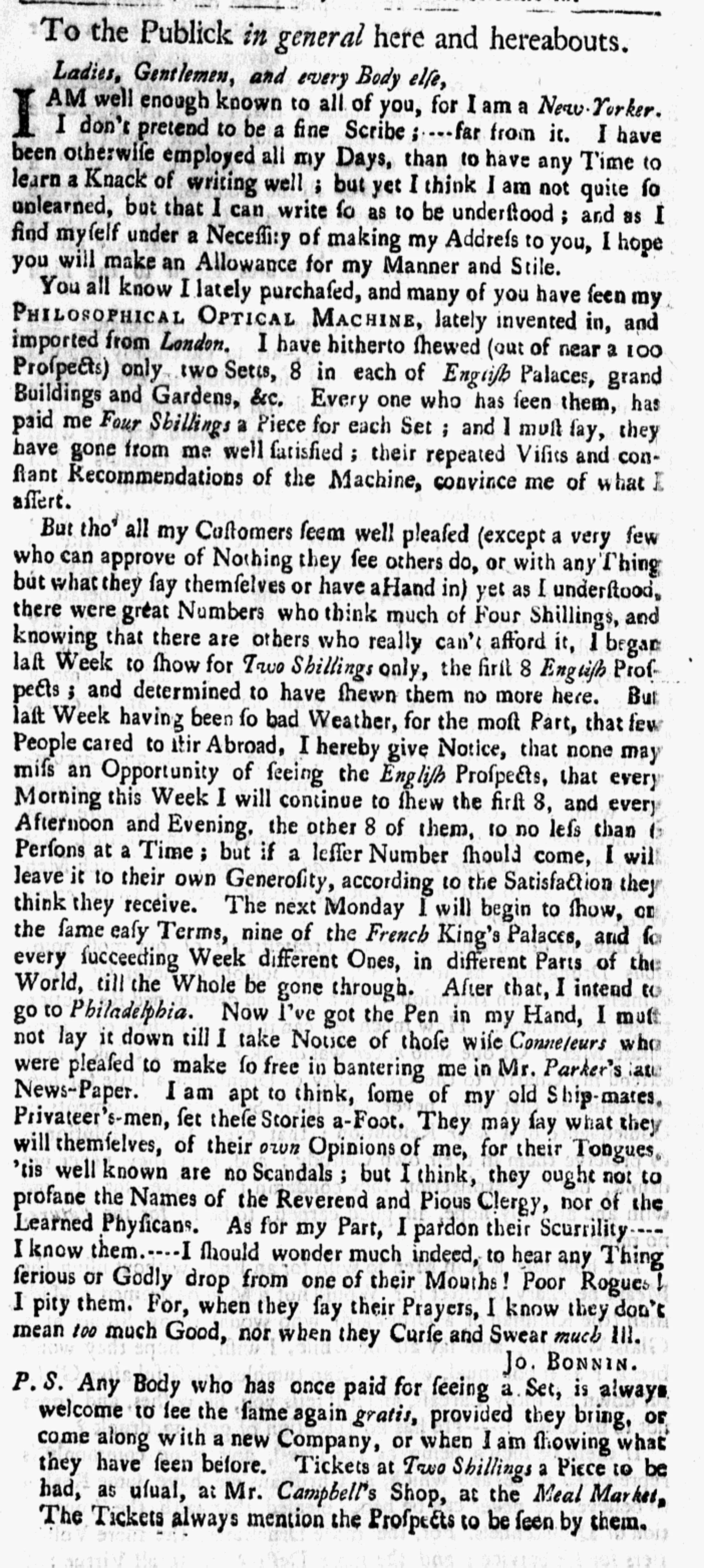
Sometimes it’s hard to determine exactly which form of spectacle is being described. In The New-York Gazette, or, the Weekly Post-Boy (December 19, 1748), John Bonnin advertised his marvelous Philosophical Optical Machine; the description suggests a peep-show box displaying scenes like Engelbrecht’s dioramas:
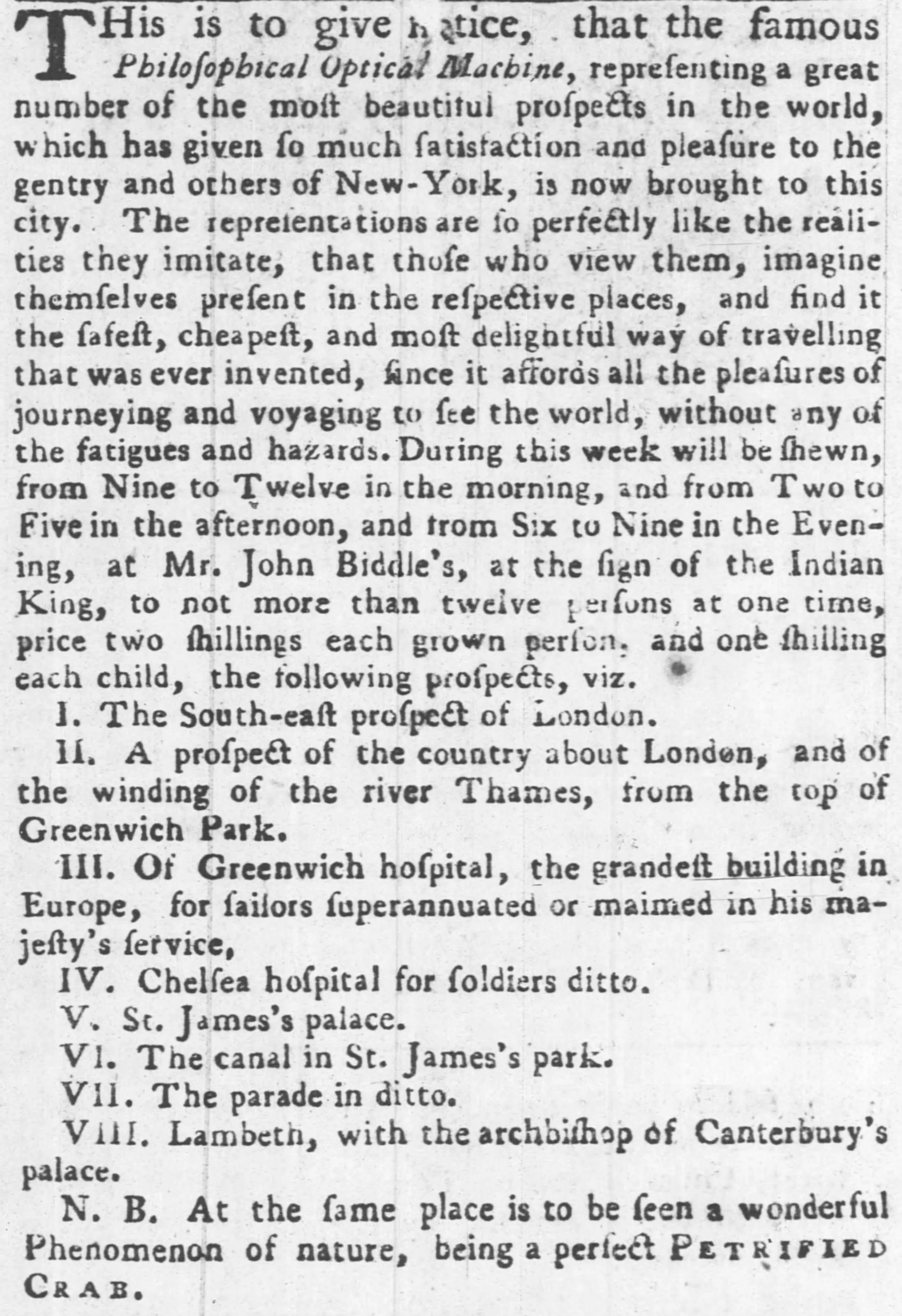
Bonnin advertised his Philosophical Optical Machine and its prospects in Philadelphia in The Pennsylvania Gazette (May 11, 1749):
Two years later, Bonnin advertised again in the New-York Gazette (May 14, 1750) that he “hereby gives Notice to his Friends and Well wishers, That, After having tried many different Ways to support himself and Family, tho’ with the utmost Honesty and Care, yet not being attended with desired Success, has now, by the Assistance of some Merchants, opened a Shop in Crown-Street … his kind Customers may depend on buying of him at the lowest Prices; and for their Encouragement, they shall be wellcome to view his famous Optical Machine Gratis.”
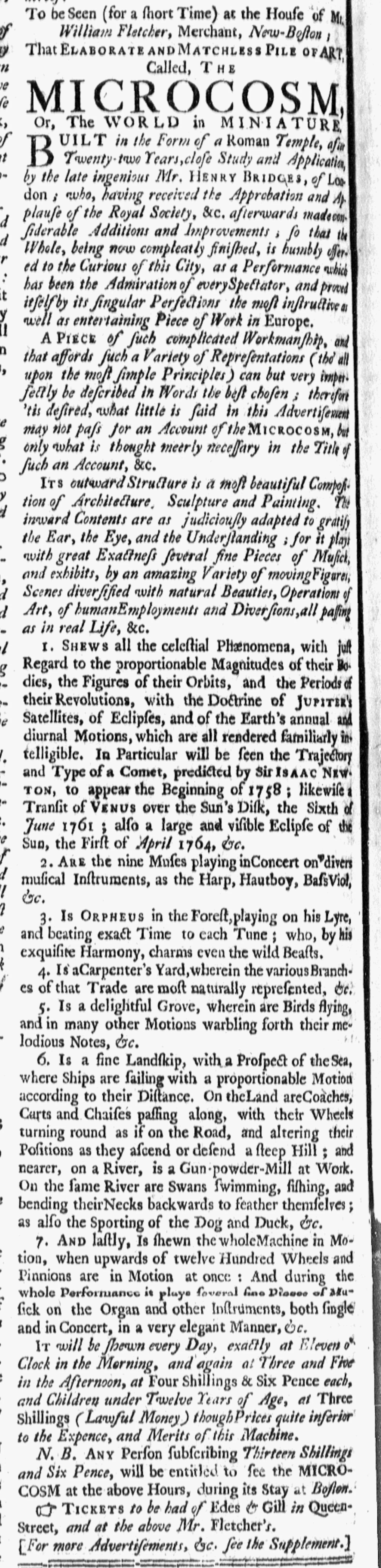
Henry Bridges’ Microcosm may have also been an elaborate form of a raree show or peep show, as advertised in the Boston Gazette (May 15, 1756):
(h/t Selden West for assistance in getting copies of these advertisements)