
Magic Lanterns
in the 18th Century
The Magic Lantern by Paul Sandby. © The Trustees of the British Museum. Shared under a Creative Commons Attribution-NonCommercial-ShareAlike 4.0 International (CC BY-NC-SA 4.0) licence.
At its most basic level, describing what is a magic lantern is a bit like describing an early sort of slide show. Light is projected through a painted glass slide (or, later in the century, through a transparent print) and onto a screen. This spectacle was portable, and could be displayed for paying spectators in public settings, or at a private home.
Jean-Baptiste le Rond d'Alembert provided a good definition of a magic lantern with a diagram showing how it works in his Encyclopédie in 1765; a 1798 Encyclopædia provides an even more thorough description of “this very remarkable machine, which is now known all over the world,” with sections on a Method of Painting the Glaſſes for the Lantern, To repreſent a Tempeſt by the Magic Lantern, The Nebulous Magic Lantern (projecting images onto “a cloud of ſmoke”), To produce the Appearance of a Phantom upon a Pedeſtal placed in the middle of a Table, and The Magic Theatre.
Many depictions of magic lantern shows are intended as satires, setting forth the illusionistic nature of the spectacle as a metaphor for current events. I’ve also gathered some newspaper advertisements featuring references to magic lanterns and descriptions magic lantern shows.
(Later on in the 19th century, the slides were capable of movement to display animation, as demonstrated in a video from the V&A.)
Lanterne Magique.
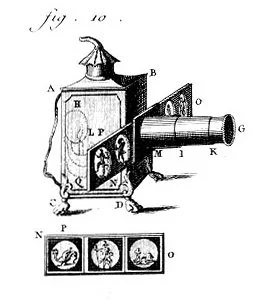
Magic Lantern, machine invented by Father Kircker, Jesuit, that has the property of making small figures painted on thin pieces of glass appear larger on a white wall, and with fully transparent colors.
For this effect, one places a strong light behind the painted glass, on which is placed the representation of the object, and in front, some distance away from the glass, one places two lenticular lenses that have the property of separating the rays that leave the object, of making them diverge, and consequently projecting on the opposite wall a representation of the image that is much larger than the object. Ordinarily, one places these two lenses in a tube, where they are mobile, so that one can move them closer together or farther apart sufficiently to render the image distinctly on the wall.
This tube is attached to the front of a square box within which is the object-holder; and so that the lantern makes an even greater effect, a spherical mirror is placed in the same box, whose light occupies the foyer; and in front of the object-holder, between it and the light, a third lenticular lens is placed. Ordinarily, one slides the object-holder by using a runner operated at M close to the third lenticular lens. N O is the object-holder, on which are painted different figures that we know how to pass successively between the tube and the box, as represented in the figure. On the magic lantern, we can consult the physics essay of Mr. Musschenbroek section 1320 and following, and the Leçons de Physique of the Abbé Nollet, book V near the end. The theory of the magic lantern is founded on a simple proposition; if one places an object a little beyond the foyer of a lens, the image of this object will be found on the other side of the lens, and the size of the image will be the same as the object, more or less as the distance between the image and the lens is the same as that between the object and the lens. Thus, we can make magic lanterns with one lenticular lens; the multiplication of these lenses serves to augment the effect.
— “Magic Lantern,” in The Encyclopedia of Diderot & d'Alembert Collaborative Translation Project; originally published in the Encyclopédie ou Dictionnaire raisonné des sciences, des arts et des métiers, 1765
Magic lanterns & slides from the 18th century
Rijksmuseum BK-NM-3333, a magic lantern
Rijksmuseum BK-NM-8462-Q & BK-NM-8462-R, a two-part transparency with a scene of a fire, c. 1750-1830
Rijksmuseum BK-NM-3334, a set of slides for a magic lantern, c. 1760; Rijksmuseum BK-NM-3334-AD is the box containing the slides
Magic lantern slides at Science Museum Group, c. 1780-1820, including:
1990-5036/11452, with satirical engravings from The Humours of the Lilliputians, including Sir Bandy-leg Platter-face and Dame Dowdy his wife, Monsieur Perukesmore (A French cavalier) and Squire Amorous Great-hat
1990-5036/11453, with satirical engravings from The Humours of the Lilliputians, including Barnaby Bottle-nose, Sir Wangle Fee Simple, Toby Rusty, Jeffrey Jordan-Cap and Joan his wife and Jerry Jug Guzzle
1990-5036/11523, with fantastical beasts and folk monsters
1990-5036/11527, with fantastical beasts and folk monsters, including a portrait of a mole monster in side profile and a figure playing a pipe with its nose
1990-5036/13194, with satirical scenes and caricatures, including a goat being shaved by monkeys
1990-5036/13195, with satirical scenes and caricatures, including two portraits of men in side profile
1990-5036/17002, with two woodland spirits, a woman next to a house, travelling entertainers and destitute figures
1990-5036/17003, with disabled and destitute figures, including a man in a green cape with a small dog
1990-5036/17004, with fantastical beasts and folk monsters, including a figure playing a pipe with its nose
1990-5036/17005, with soldiers marching on figures in Scottish dress, possibly illustrating the Jacobite rising of 1745
Transparent prints published by Rudolph Ackermann, 1799; see also the six-piece set, The Incantation, The Dream (BM 1990,0728.41), The Visit, The Assignation (Yale Folio A 2018 39), The Festival, The Wedding (BM 1990,0728.42)
Transparencies in the British Museum, including:
The Burning of the French Adm.l's Ship L'Orient in the Glorious Battle of the Nile, 1799
A Captive Led to Prison, 1800
A Cavern, 1798
A corridor in a prison (no. 16 in a series), 1799
A Cottage on Fire, 1799
A Cottage on Fire, 1799
Emily attending the Burial of Madame Montoni, 1799
Eruption of a volcano at night, 1799
A family in rustic dress gathered at night in front of a fire, 1799
A Girl Drawing Beer, 1806
Interior of a gothic vault, 1799
A Kiln for Burning Coke near Maidstone Kent, 1799
Macbeth & Witches, 1799
The Mars and the L'Hercule, 1799
Night and Evening, 1799
Outside of a Castle, 1798
A Ruin near Bastia in Corsica, 1798
Sir Bertrand in the Haunted Castle, c. 1794-1799
Smugglers, 1799
The Tomb of Juliet, 1799
Tourists being shown a statue in the crypt of a church, 1799
Transparency with six small scenes, 1799
Transparency with six small scenes, 1799
Turnpike, 1799
View in an arched cavern (plate 1 in a series), 1801
A View on the Rhine near Bingen, 1798
Additional Resources
Encyclopædia; Or, A Dictionary of Arts, Sciences, and Miscellaneous Literature (1798), s.n. Dioptrics: The Magic Lantern
Inſtructions for Painting Tranſparencies (1800)
An Essay on Transparent Prints, and on Transparencies in General (1807)
Virtueel toverlantaarnmuseun 'de Luikerwaal':The Miracle of the Magic Lantern
Edward Orme's Transparent Prints
The history of projecting phantoms, ghosts, and apparitions, part 1 and part 2
L’antico Mondo Novo della nobile famiglia Dolfin
John Bonnin, the New York showman
Elliott & Schlemowitz, Magic Lanternists
Lantern Image: Iconography of the Magic Lantern, 1420-1880
18th Century Material Culture: Magic Lanterns - Cameras Obscura
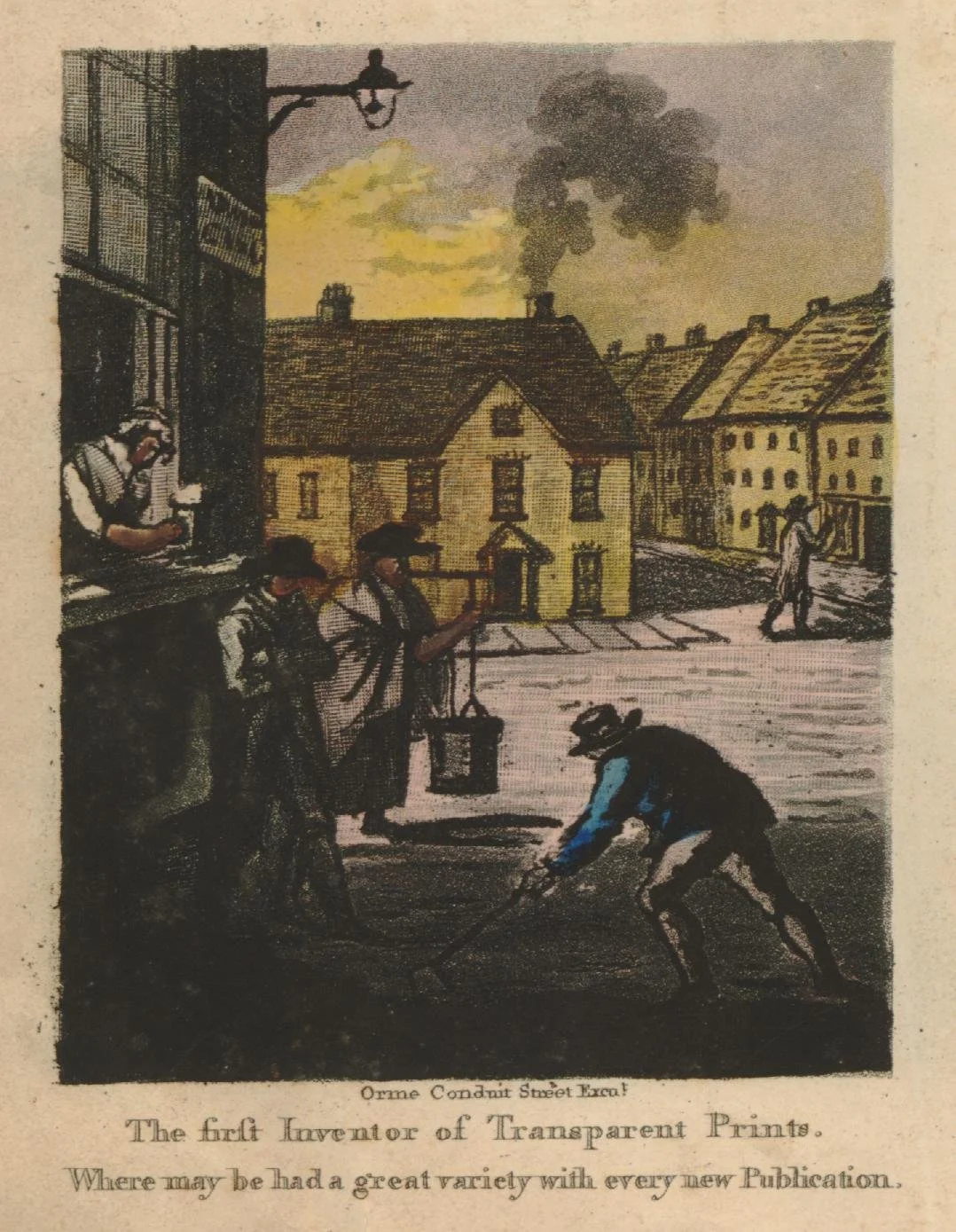
© The Trustees of the British Museum. Shared under a Creative Commons Attribution-NonCommercial-ShareAlike 4.0 International (CC BY-NC-SA 4.0) licence.
18th century artwork and illustrations depicting magic lanterns
Several of these illustrations depict itinerant showmen carrying a large box (probably a peep show or raree show) with a magic lantern mounted on top. Many of them also carry a barrel organ or hand organ to accompany the show; this is also described in a newspaper advertisement (a couple who left behind “a Hand Organ and Magick Lanthorn” at a dwelling-house, The Gloucester Journal, February 23, 1778). See also The Hurdy-Gurdy and the Magic Lantern.
Traveling print seller and a boy with a magic lantern
Edme Bouchardon’s studies from the 1730s of a woman playing a barrel organ while carrying a magic lantern on her back, and a woman inspecting a magic lantern
The magic lantern by Christophe Huet, 1741
Savoiardi colla Lanterna Magica, 1750
La Lanterne Magique, 1755
La Lanterne magique, 1757
The Magic Lantern by Paul Sandby, 1763; see also The Magic Lantern and Paul Sandby
A man carrying a magic lantern (“Charmante Katrinn - Katrina charmant …”) in the Cries of Danzig, c. 1765
Ah! La lanterne magique la pièce curieuse in Cris de Paris, 1774-1775
Vue du camp de manœuvres militaires établi sous le commandement du Prince de Condé près de Saint-Omer du 5 août au 25 septembre 1788 by Jacques François Joseph Schwebach
Family scene, 1796
Satires and caricatures featuring magic lanterns
See also Magic lanterns and raree shows: metaphors of financial speculation during the bubbles of 1720.
De Toverlantaaren (The Magic Lantern), 1701
Actieuse Nacht-Wind-Zanger met zynTover slons (The Night-Singer of Shares, with his Magic-Lantern), c. 1720
Ha die Tover Lantaren Tweede Deel Vertonende Waaltjes maat op deboere Kermis, 1720
Toverkaart of geneesmiddel voor de windbreuken in Het Groote Tafereel der Dwaasheid, 1720
The Burlesquer burlesqued, 1753
The Magic Lantern; Paul before Felix, 1753
The Tea Tax Tempest, or the Anglo-American Revolution, 1778
The Tea-Tax-Tempest, or Old Time with his Magick Lanthern, 1783
Galante Show: Redeunt Spectacula Mane, 1788
The Reception of the Diplomatique & his Suite, at the Court of Pekin, 1792
Experiments at Dover or Master Charley’s Magic Lanthorn, 1806
Perceval’s Magic Lantern, 1808
Advice from the other World — or a peep in the Magic-lanthorn, 1820
The Magic Lantern, 1822
Advertisements for magic lanterns and shows
Several of the wondrous spectacles advertised in 18th century puppet shows may have also been performed with magic lanterns. For example, the entertainments promised by “Signor Gulielmo Pittachio” (The Northern Star, September 14, 1795) include both a magic lantern and a puppet show.
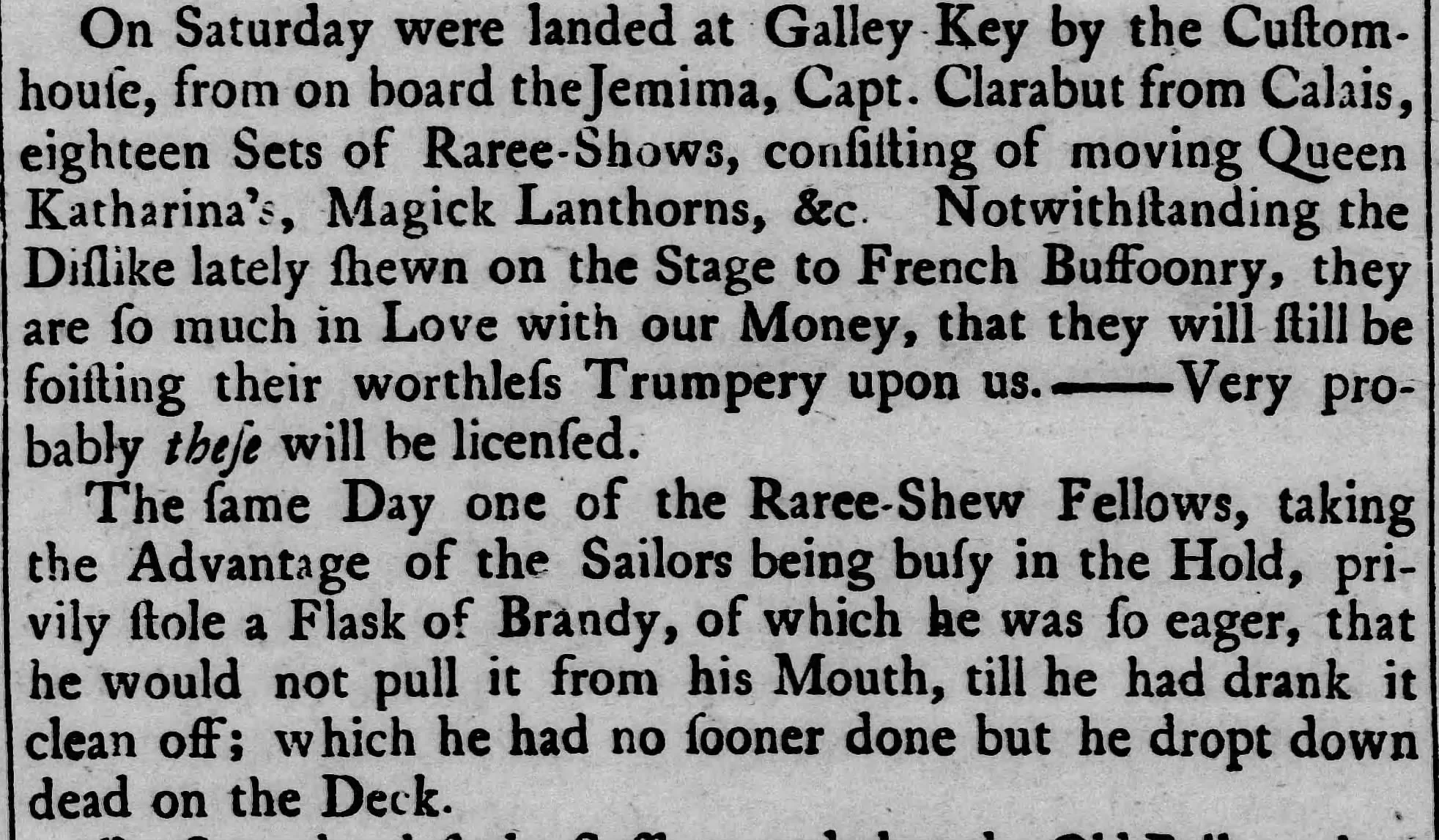
The Gloucester Journal, December 19, 1738
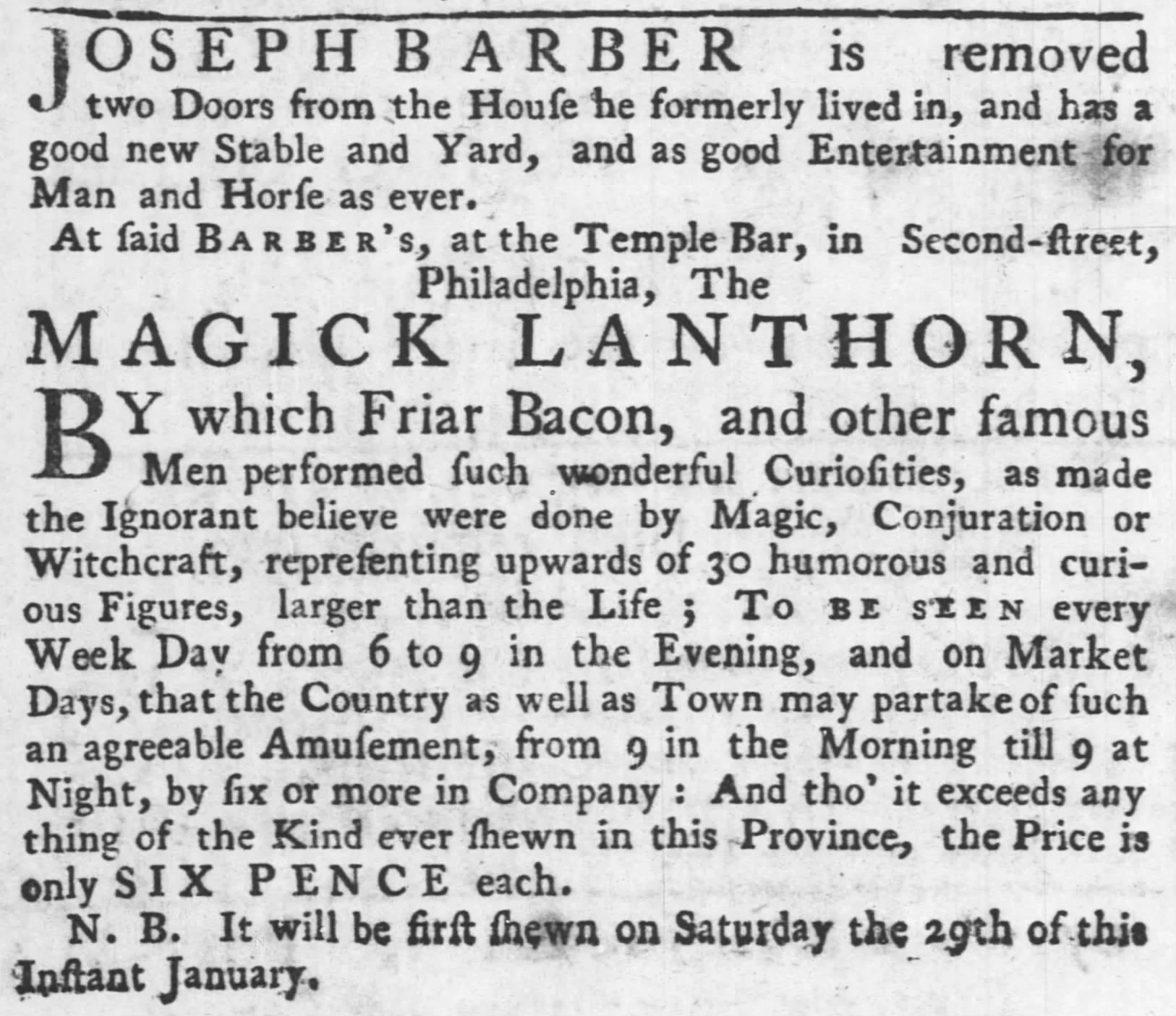
The Pennsylvania Gazette, March 10, 1743
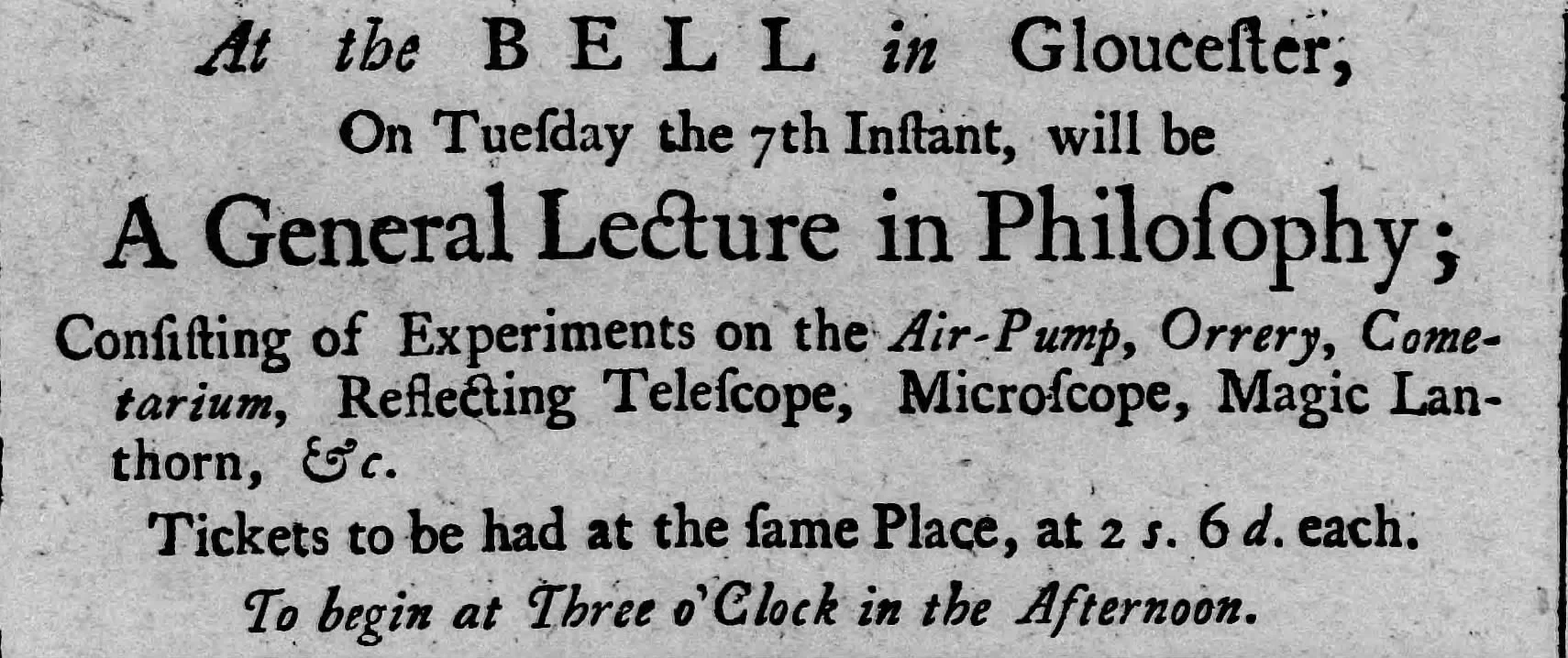
The Gloucester Journal, June 7, 1743
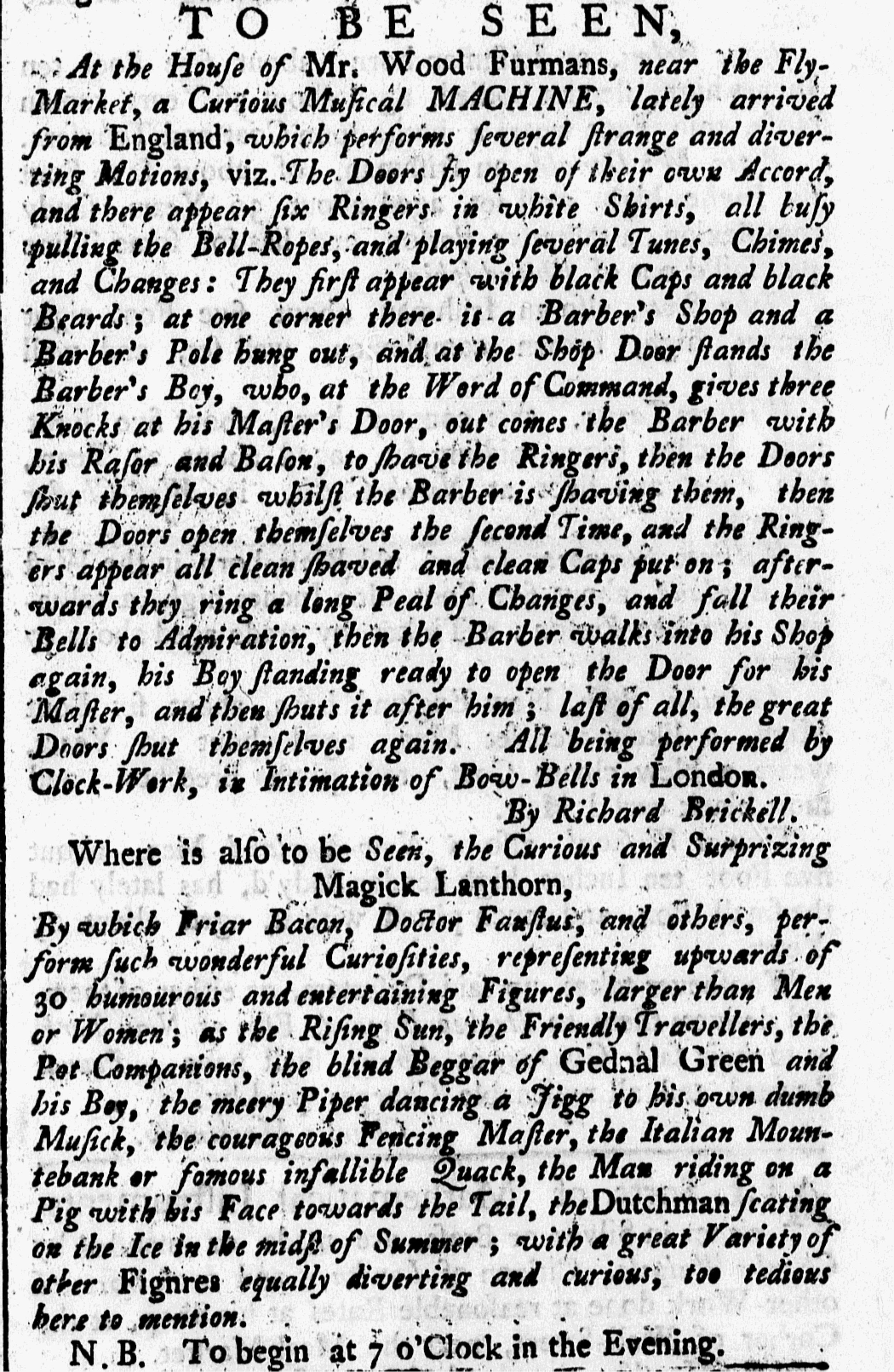
New York Evening Post, September 8, 1746
(h/t Selden West)

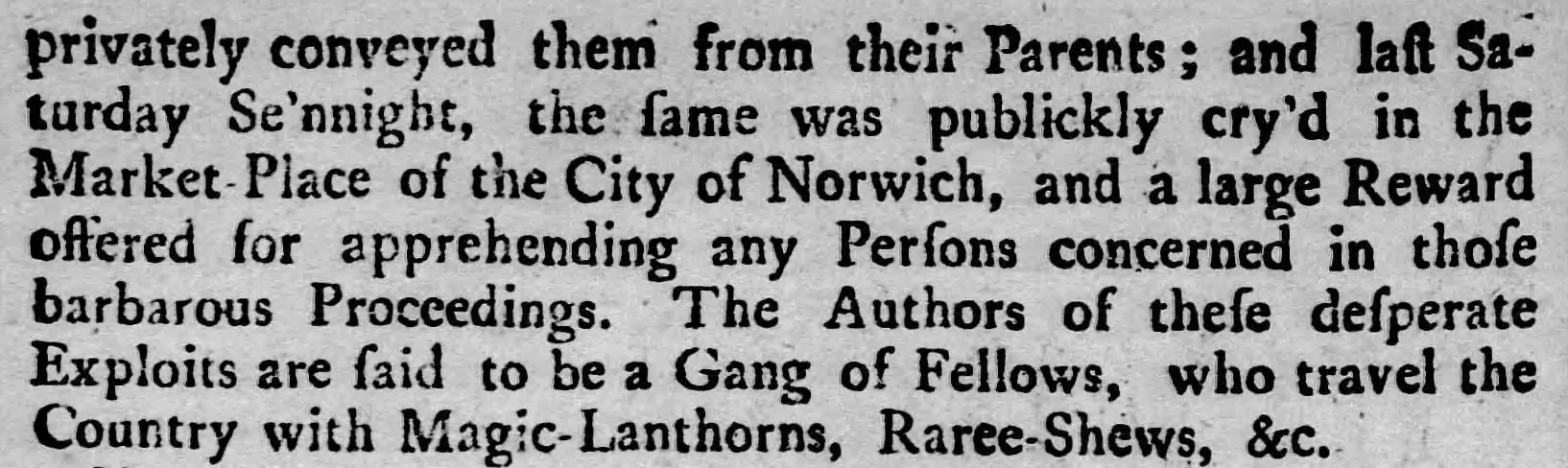
The Gloucester Journal, March 22, 1748

The Pennsylvania Journal, or, Weekly Advertiser, March 25, 1762

The Pennsylvania Journal, or, Weekly Advertiser, December 19, 1765
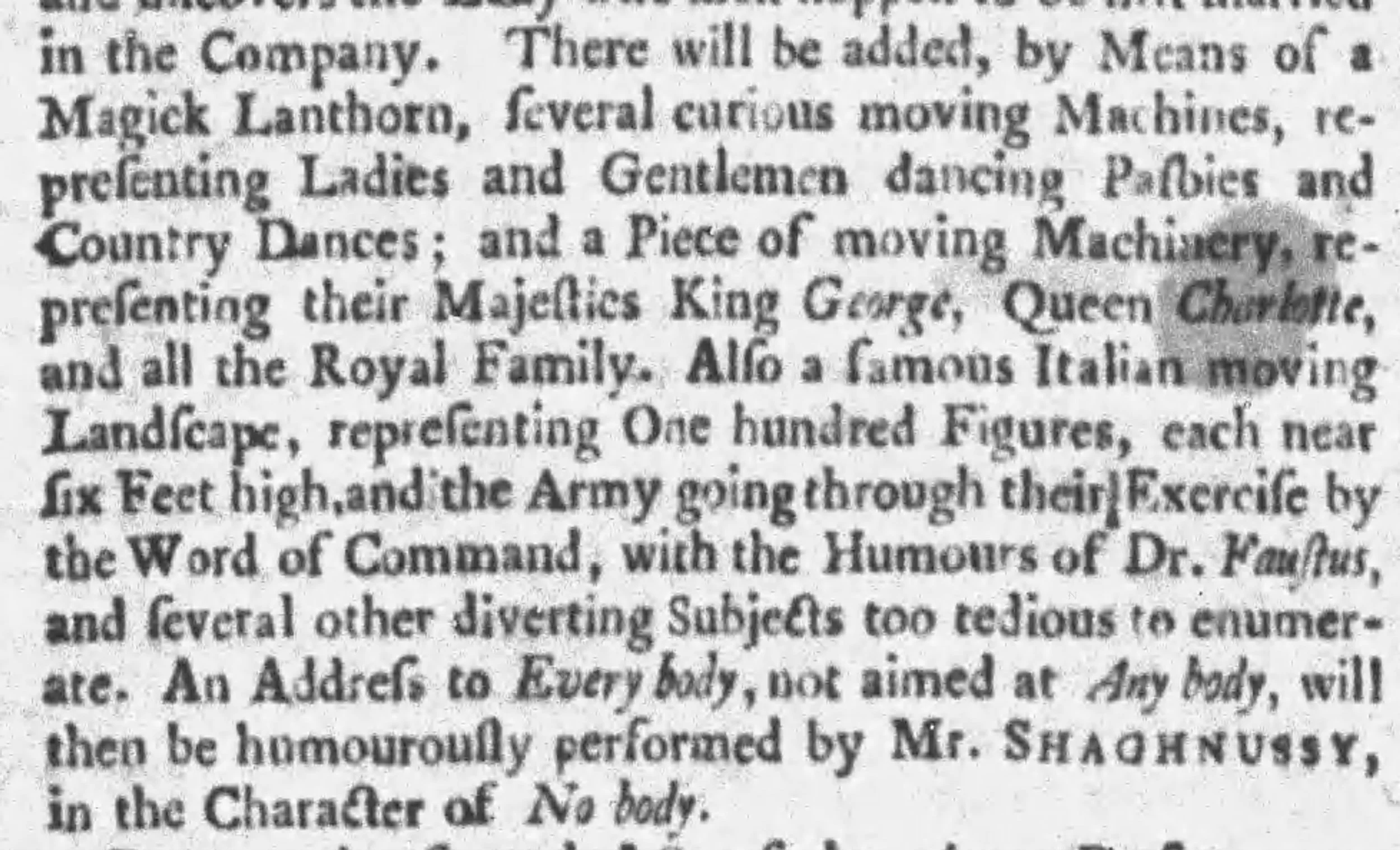
The South-Carolina and American General Gazette, November 27, 1770

The South-Carolina Gazette; and Country Journal, November 10, 1772
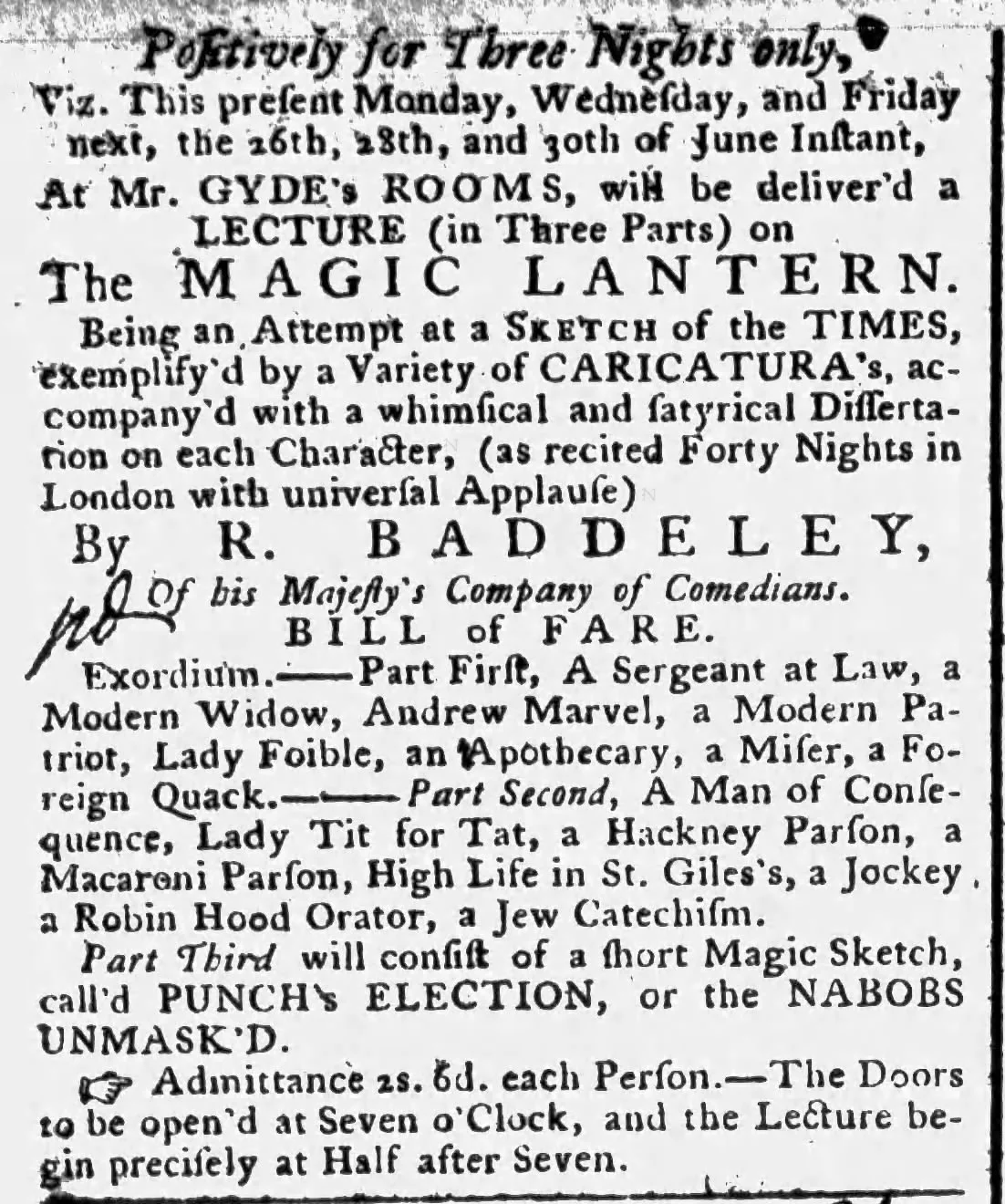
The Bath Journal, June 26, 1775
R. Baddeley (likely Robert Baddeley) advertised a similar program earlier in the month at Marylebone Gardens (The Public Advertiser, June 8, 1775)
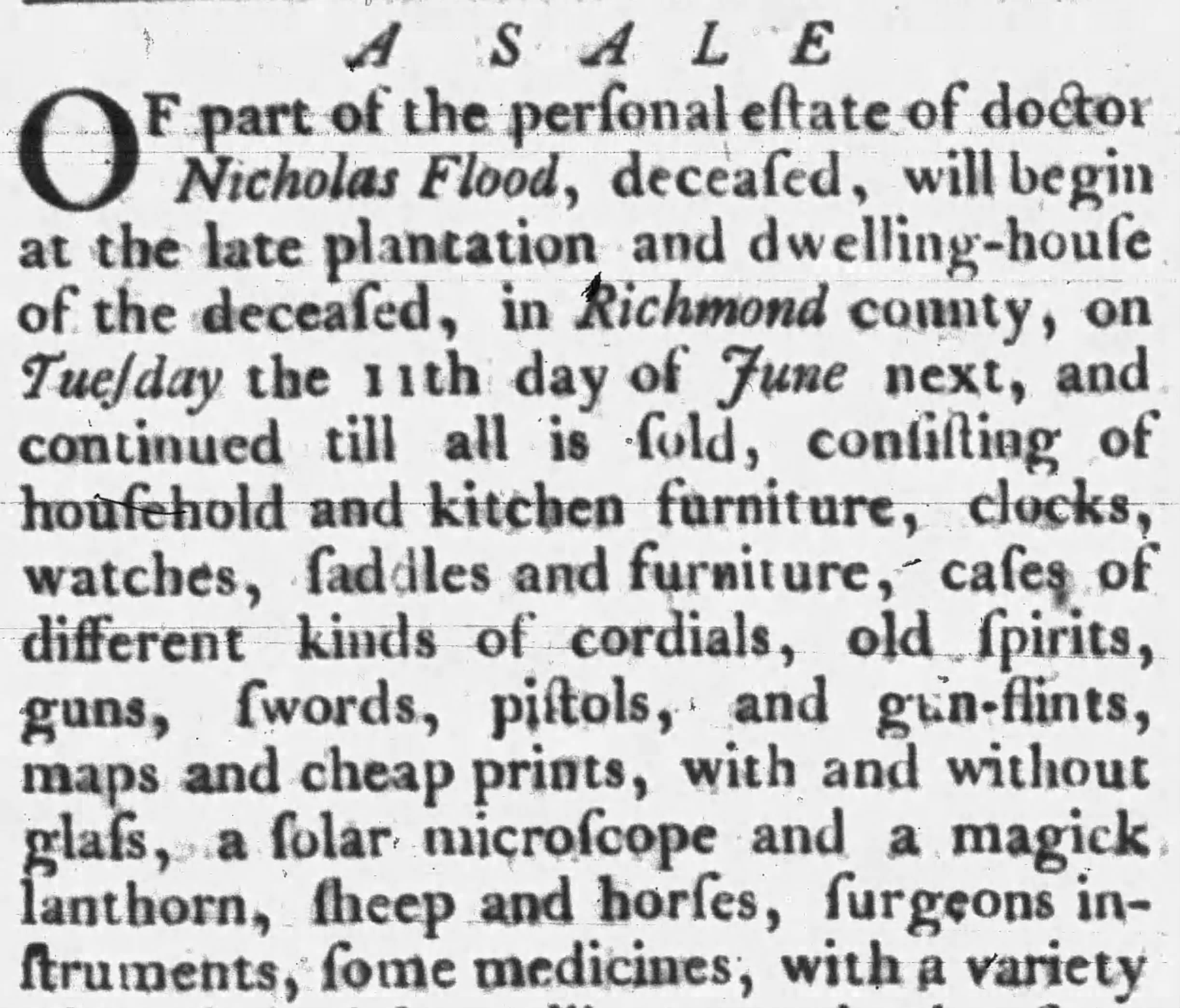
The Virginia Gazette, May 24, 1776
The “magic lanthorn” also appears on Dr. Flood’s probate inventory
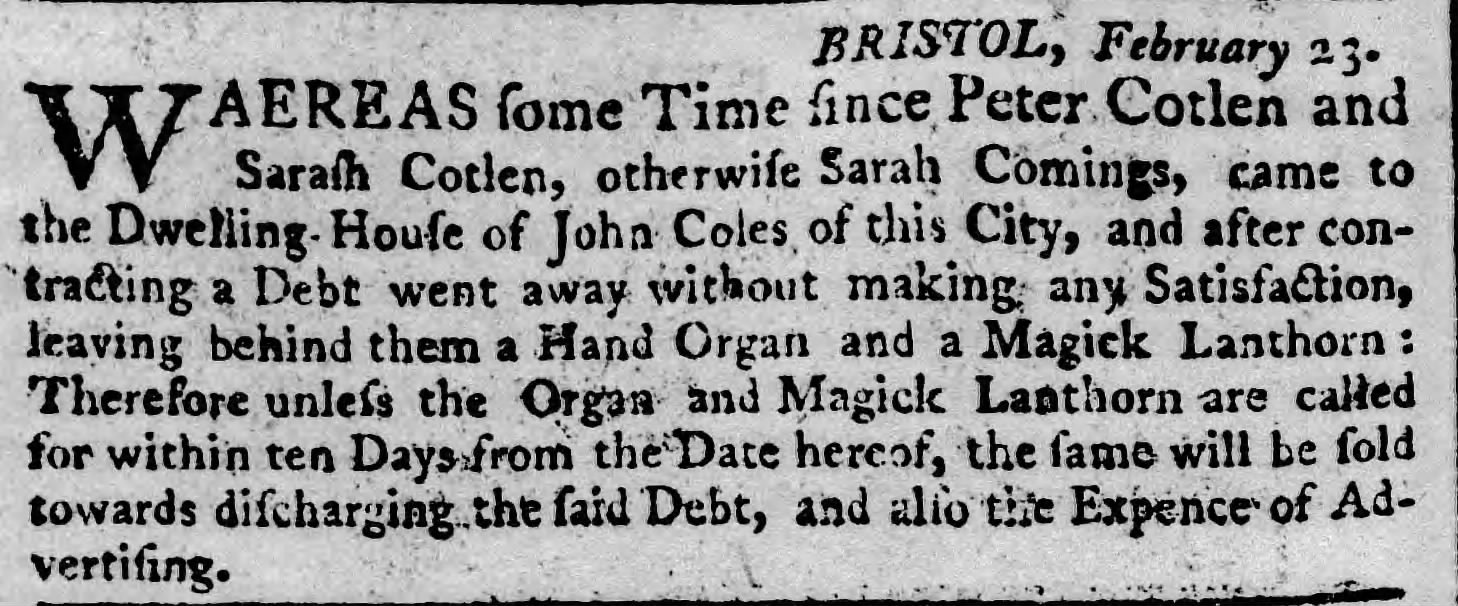
The Gloucester Journal, February 23, 1778
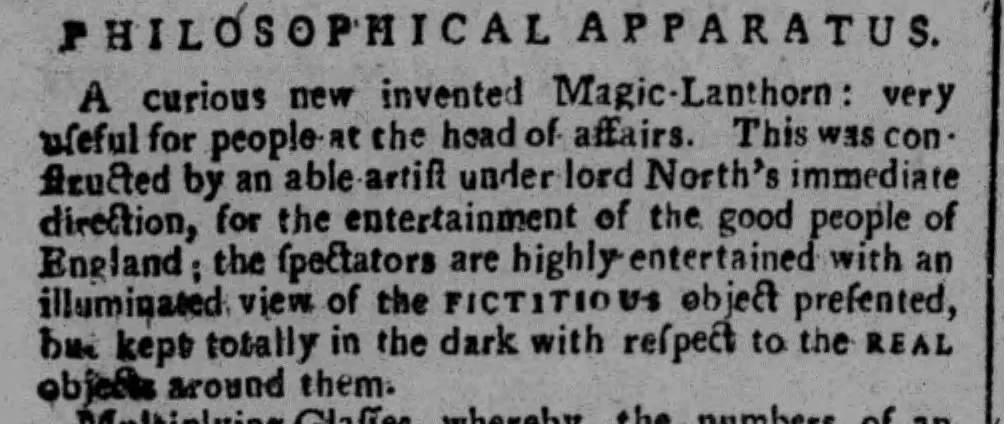
Poulson's American Daily Advertiser, November 10, 1781

The Times, April 1, 1785
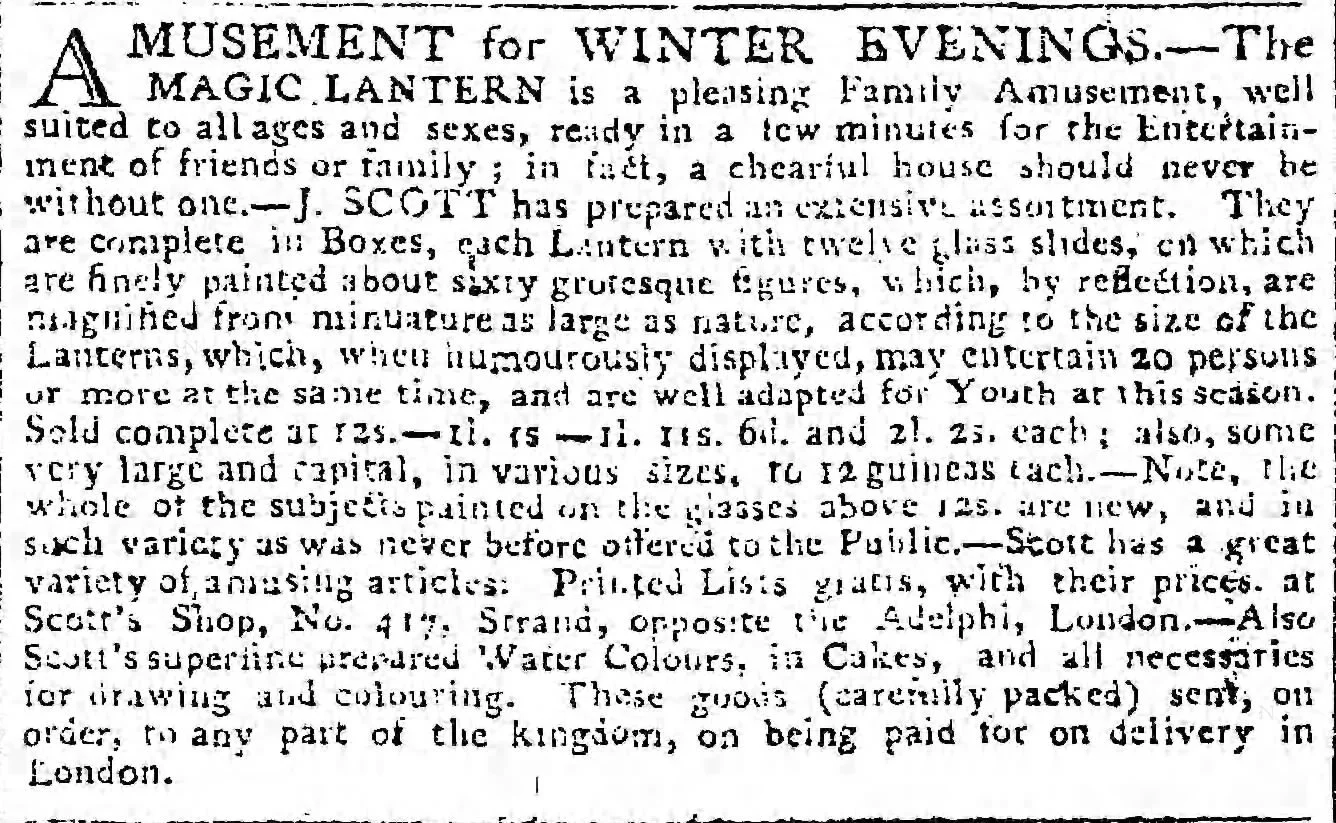
The Observer, January 26, 1800