An index to the plates and figures in the 1789 Instructions for Cutting Out Apparel for the Poor
This page attempts to connect the plates in the back of the Instructions with the relevant text. The plates are not in the same order as the text itself, and the figures are poorly labeled.
I recommend opening the Wellcome Collection edition in one window (to view and zoom in on the plates), and the Google Books edition in another window (to read and search the text).
You can also jump to the relevant plates (more convenient, if you’re working through one of the patterns in the book):
The Preface of the Instructions describes the sorts of schools and institutions for which this work was intended. See also the Sunday school and School of Industry described in the Country News column of the Gloucester Journal (May 14, 1787).
Measurements in The Instructions

The Instructions use a system of linear measurements for cloth that are no longer in common use. Plate IV has a ruler to demonstrate what these measurements mean, but it is not printed to scale in the plate.
Download and print out this reference sheet for conversions for these measurements and a better-scaled ruler.
The table at right (also reprinted on the reference sheet) comes from The British Youth's Instructor: or, A New and Easy Guide to Practical Arithmetic (1777). It also has word problems to help students practice working with these measurements. For additional problems like these — blending a little math lesson into your historical studies — see also:
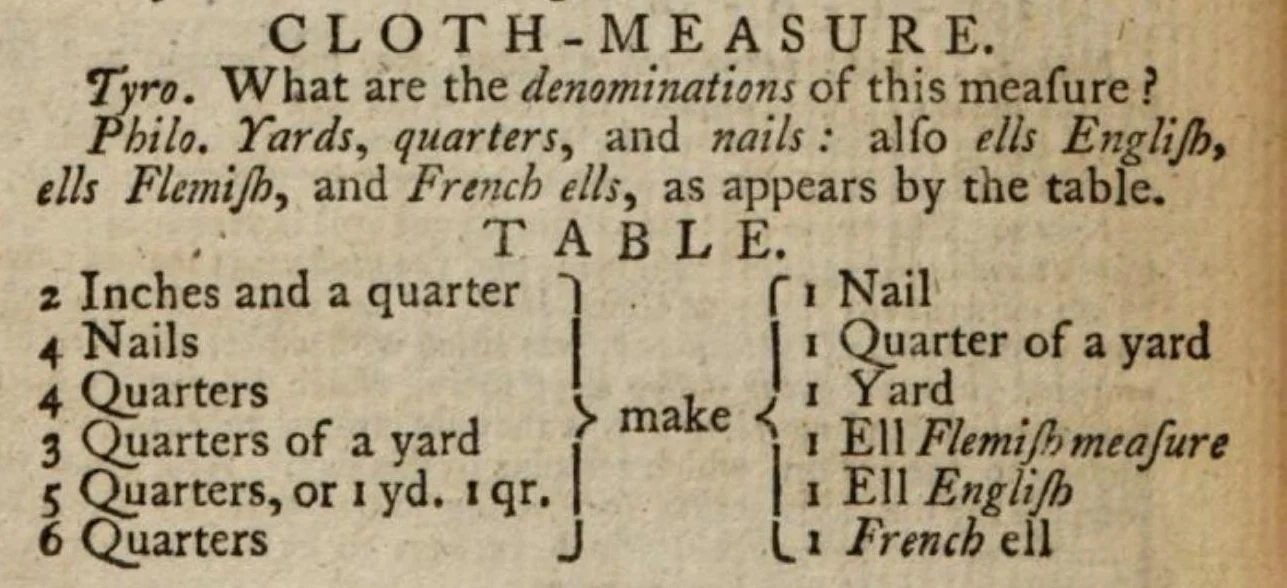
Plate I
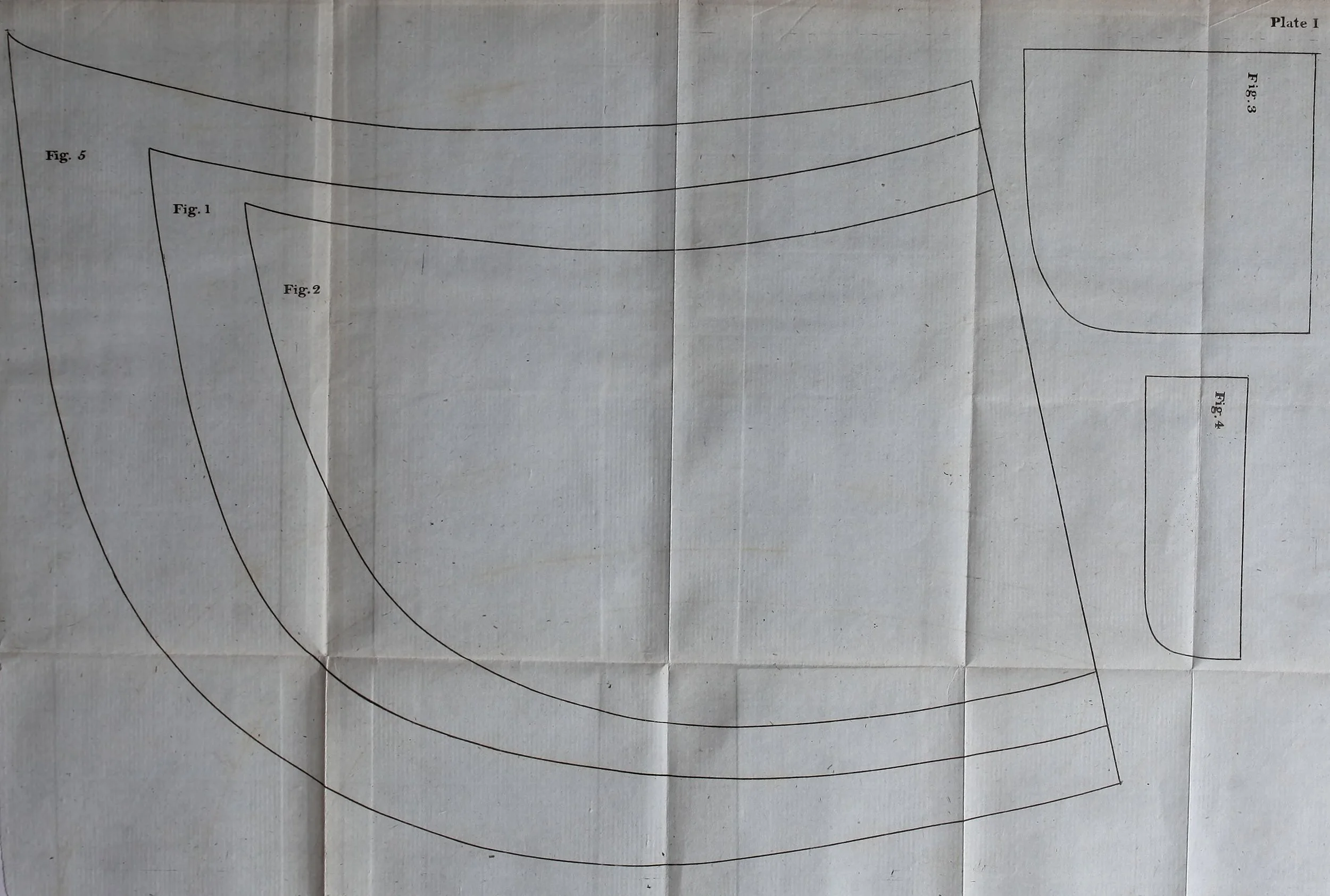
CLOATHING for GIRLS
SHIFT, Nº 4. How cut out.
… The guſſets out of the boſom, Plate I, Fig. 3. The pattern of the back, Plate I, Fig. 4.
BONNET, Nº 1. How cut out.
One yard and a nail make one front and a half, two cauls. The breadth doubled in three, will be the width of the pattern of the front, Plate I, Fig 1 …
BONNET, Nº 2. How cut out.
Three quarters, half a quarter and a nail, make two bonnets. The breadth makes four widths (cut one out of the other) of the Pattern, Plate I, Fig. 2, which compleats two fronts …
Plate II
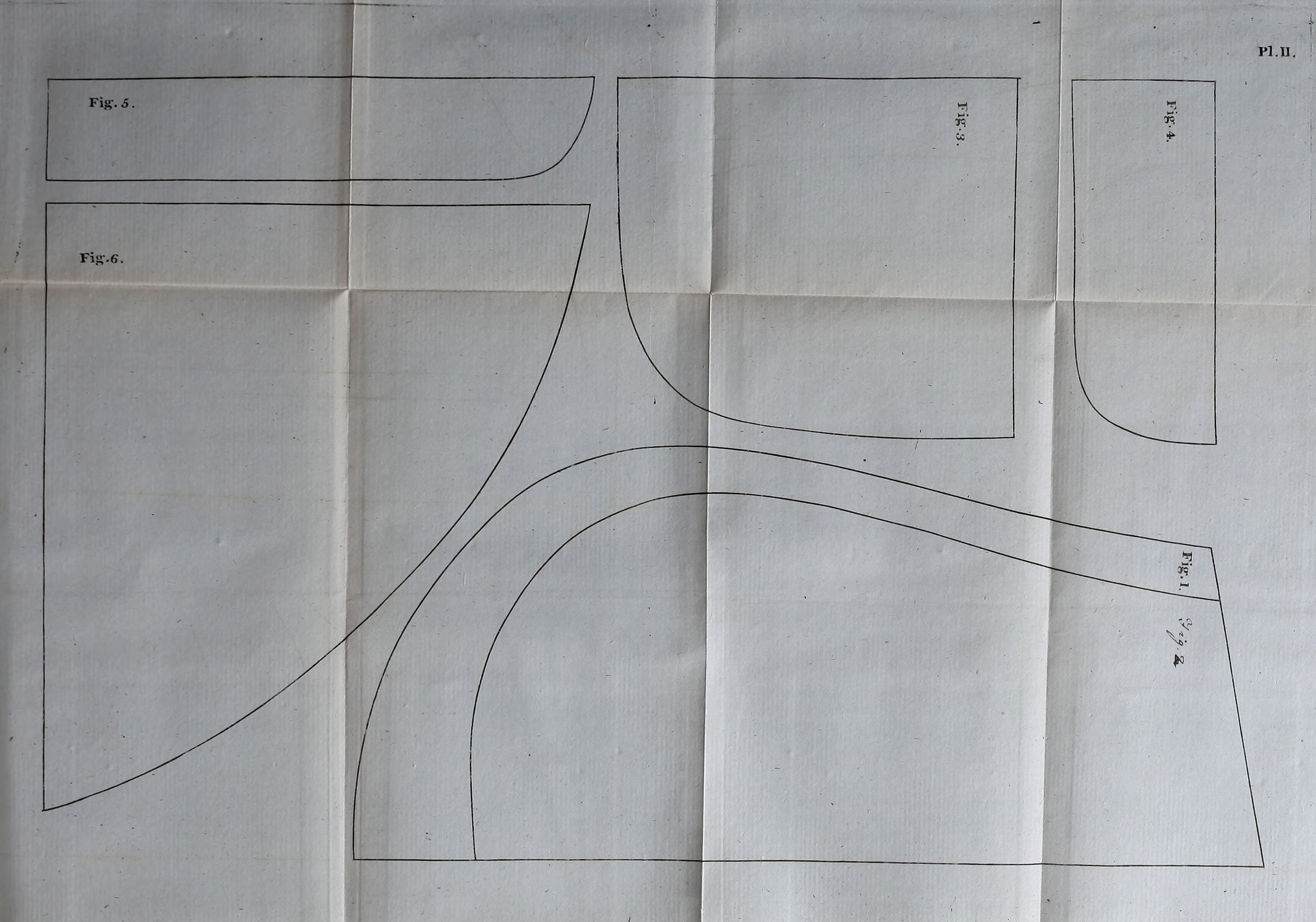
CLOATHING for GIRLS
CAP, Nº 1. How cut out.
… the half head-piece, Pattern Pl. II, Fig 1 …
CAP, Nº 2. How cut out.
… head-pieces, Pattern Pl. II, Fig. 2 …
SHIFT, Nº 2. How cut out.
… The guſſets out of the boſom, Pattern Plate II, Fig. 3; the back, Plate II, Fig. 4.
CLOATHING For POOR WOMEN
SHIFTS. How cut out.
… Pattern of the back, Pl. II, Fig 5; and of the boſom, PL. II, Fig 6. The guſſets out of the boſom.
Plate III
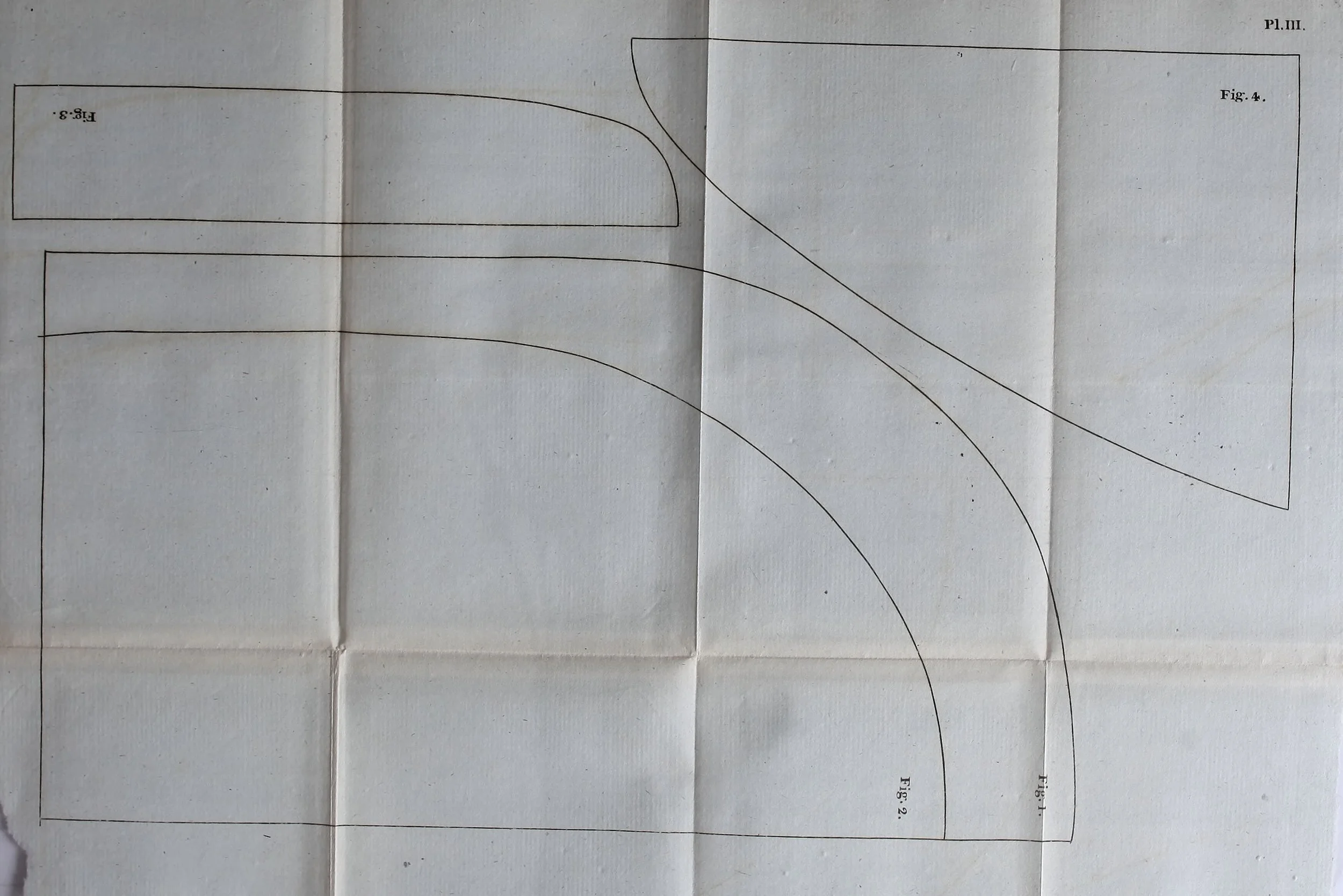
CLOATHING for GIRLS
CAP, Nº 1. How cut out.
… cauls … Pattern Pl. II, Fig 1 …
CAP, Nº 1. How cut out.
… the caul, Pattern Pl. III, Fig 2. …
CHILD-BED LINEN for the Uſe of the POOR.
SHIFTS. How cut out.
… The back, Pattern Pl. III, Fig. 3, and the boſom, Pattern Pl. III, Fig. 4, to be cut out without dividing them from each other, as it will allow the guſſets (which are cut from this piece) to be larger …
Plate IV
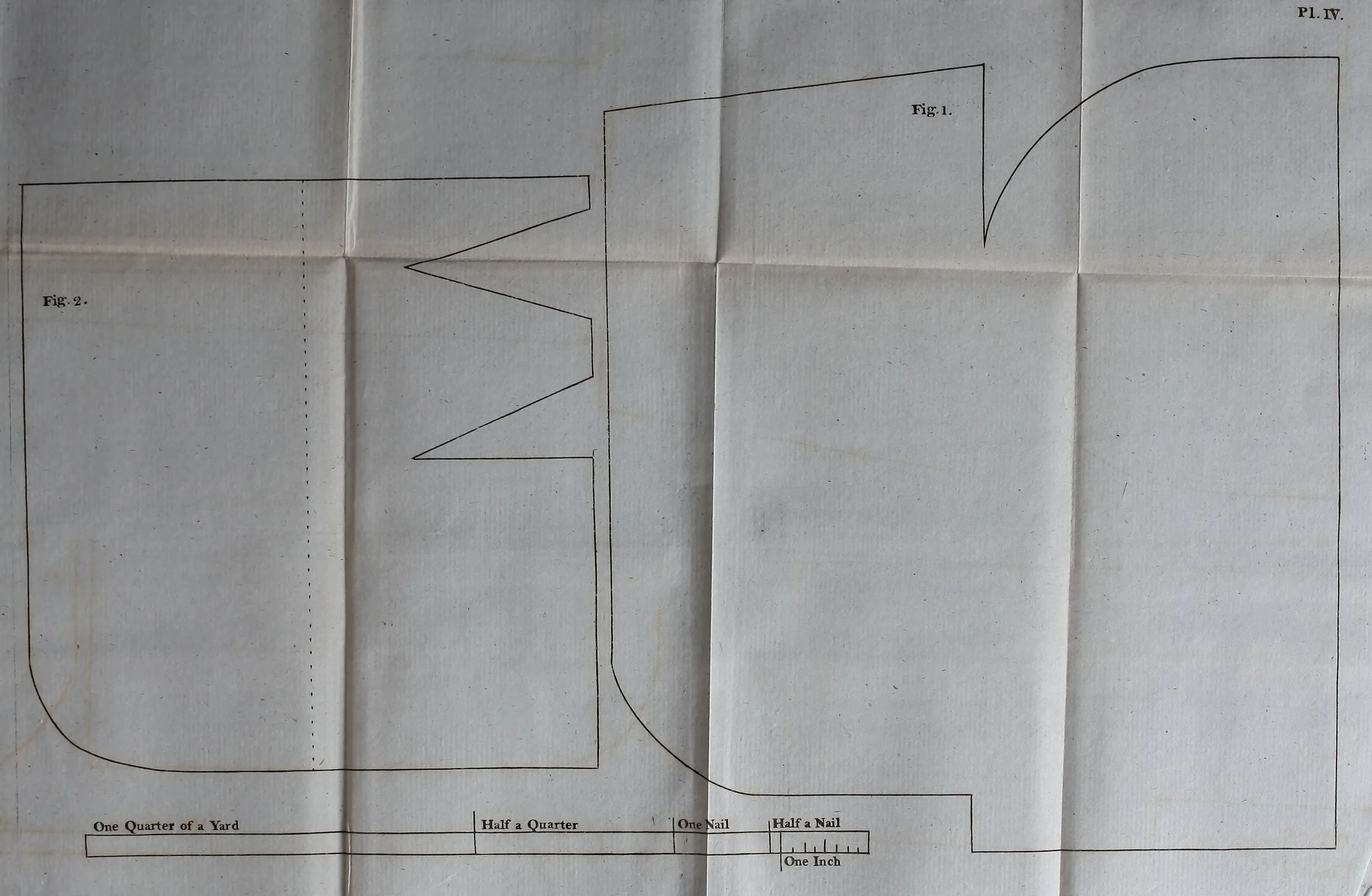
It is eaſy to deſcribe the length or breadth of any thing; but where the different foldings and doublings are required to be expreſſed to make a thing which admits of no pattern, it is very difficult for words to render it intelligible. For the ſake of exactneſs in the admeaſurement, a ſcale has been introduced in Pl. IV, the extent of which is one quarter of a yard, and the ſmaller diviſions of nail, half nail, and inch, are more accurately marked than in common meaſures made uſe of.
CLOATHING for GIRLS
CAP, Nº 3. How cut out.
One quarter of a yard makes two. The width doubled in four, the ſelvage to the face, Pattern Pl. IV, Fig. 1 …
CHILD-BED LINEN For the Uſe of the POOR.
CAPS. How cut out.
Three quarters of a yard make ſix caps; viz. the width divided in three. The width of the thirds will be the depth of the cap with double headpiece; two caps in the length of each third; cut out as follows: double down ſuch a width for the headpiece as the depth of the Pattner Pl. IV, FIg. 2, will allow; then double the length of the cloth in four, which will be the ſize of the pattern), and cut out two caps at once, taking care that it is doubled exactly even, and pinnin the pattern ſteady, on account of the points of the caul. The hadpiece is backſtitched down. The cap joined behind; the two corners backſtitched upon the hind part of the cap, and the middle point upon them, which forms the caul, and makes it ſerve either for boys or girls. A hem for a ſtring to draw behind.
Plate V
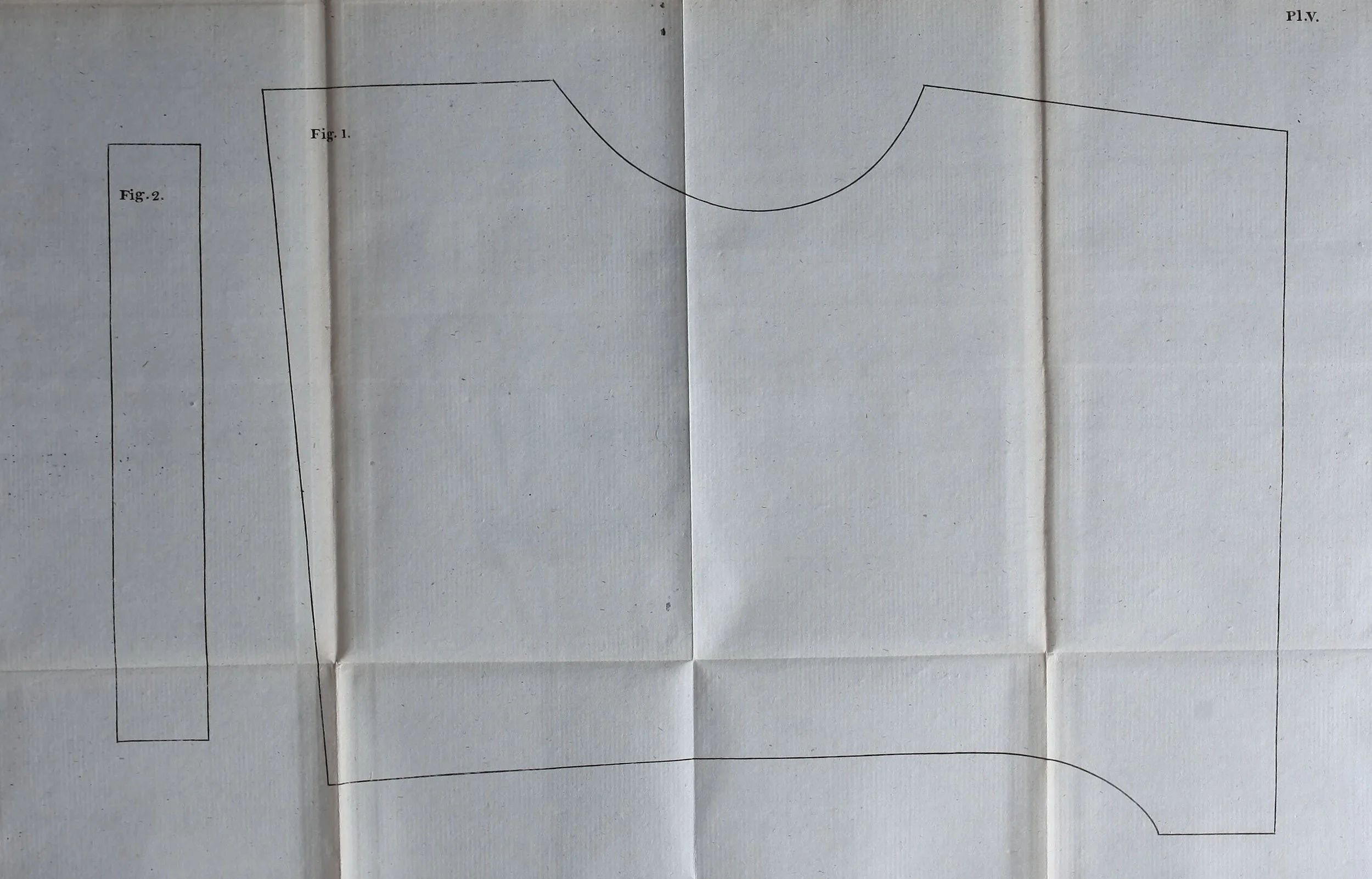
CLOATHING for GIRLS
GOWN, Nº 4. How cut out.
Three yards of ſtuff, half a yard wide, at 7 d. per yard, make the gown. Half a yard and one nail for the body and ſleeves. The breadth doubled down the middle and the half body, Pattern, Plate V, Fig. 1, placed with the ſelvedges at the top. The ſhoulder ſtraps (Plate V, Fig. 2) out of the ſlope at the bottom …
Plate VI
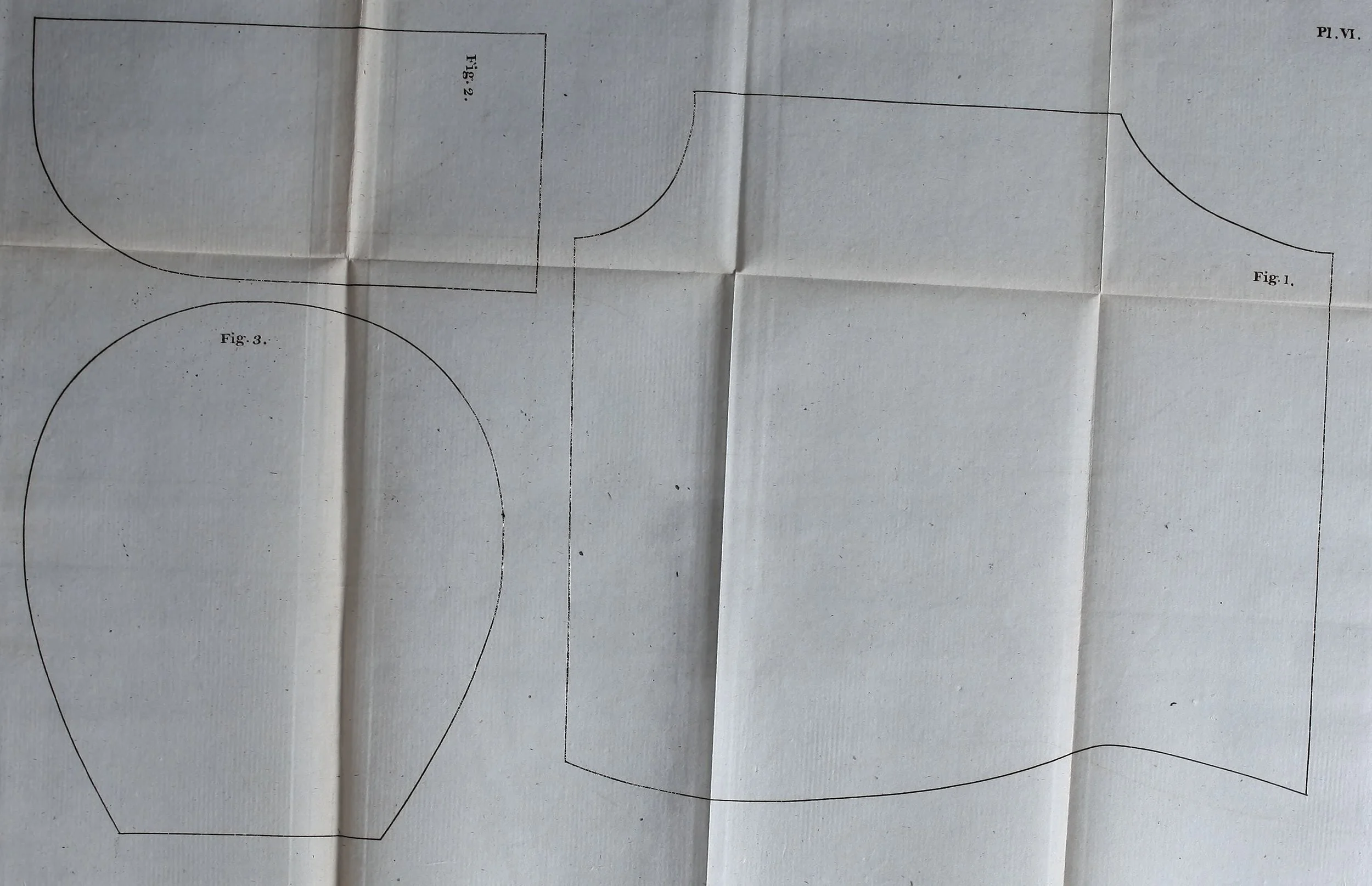
CLOATHING for GIRLS
GOWN, Nº 4. How cut out.
… The reſt of the piece makes the ſleeves, Pattern Plate VI, Fig. 1, the ſelvedge at the top. …
CHILD-BED LINEN For the Uſe of the POOR.
UNDER CAPS. How cut out.
… Divide the width in three, then double each piece down the middle, and twice the length, which will make the it the ſize of the half headpiece, Pattern Pl. VI, Fig. 2. Laying the top of the headpiece to the whole end, and cutting out two at once. For the cauls, double the remaining piece of long lawn, (which will be a quarter, a nail and a half wide), down the middle, lay the pattern of the whole caul, Pl. VI, Fig. 3, open upon it ſlanting with the narrow part as near oppoſite to the corner as the width of the piece of the cloth will allow to take the pattern in …
Plate VII
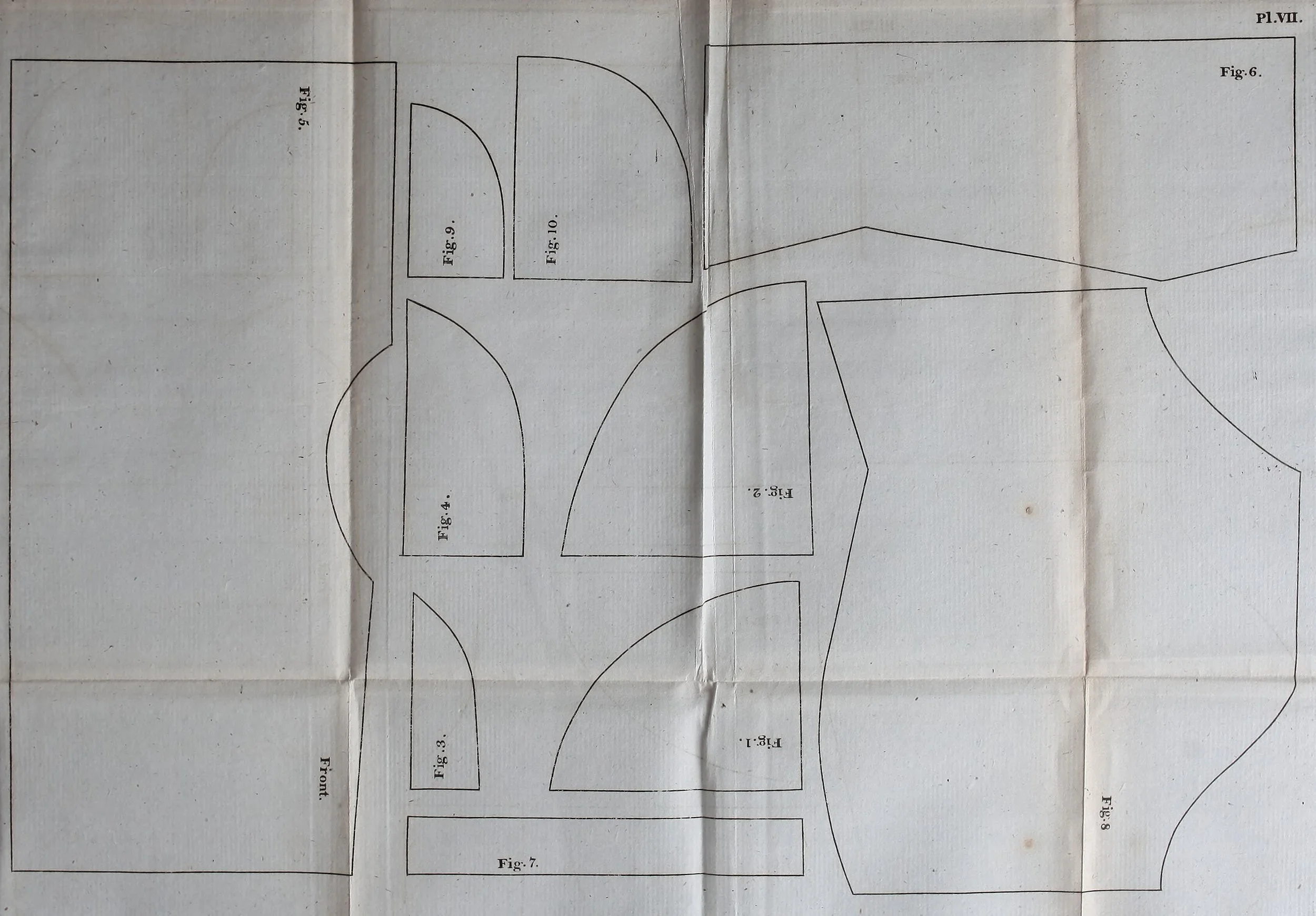
CLOATHING for GIRLS
PIN-CLOTH, Nº 1. How cut out.
One breadth of check, three quarters of a yard, and half a quarter long, open behind. Doubled down the middle, and the back, Pattern Plate VII, Fig. 1, and the boſom, Fig. 2, cut out as for a bed-gown …
CHILD-BED LINEN For the Uſe of the POOR.
BEDGOWNS. How cut out.
… The bedgown doubled down the middle, and the back, Pattern Pl. VII, Fig. 3, and the boſom, Pattern Pl. VII, Fig 4, cut out …
SHIRTS. How cut out.
… The ſhirt doubled down the middle, and the back Pl. VII, Fig. 9, and the boſom, Pl. VII, Fig. 10, cut out. …
FROCKS. How cut out.
Three yards makes two frocks, A quarter and a half and a nail, make the whole of the two bodies as follows: take off one quarter and a half and a nail for the bodies, cuffs, and ſhoulder-ſtraps, meaſure half a yard and half a nail of the width of the cotton, and double that quantity down the middle the ſelvedge way; place the Pattern Pl. VII, Fig. 5, the fore-part of the body to the whole part of the cotton as doubled; when that is cut out, lay it on again before for the ſecond body. The piece left of the width of the cotton is for the cuffs and ſhoulder ſtraps, double it in half the ſelvedte at the end, and lay the Pattern Pl. VII, Fig. 6, lengthways for the cuffs, it will be the width for two, cut one out of the other, which (the cotton being doubled) will make four. The piece ſtill remaining in the width will make the four ſhoulder-ſtraps, Pl. VII, Fig. 7, the width of two in the width, and length of two in the length.
Plate VIII
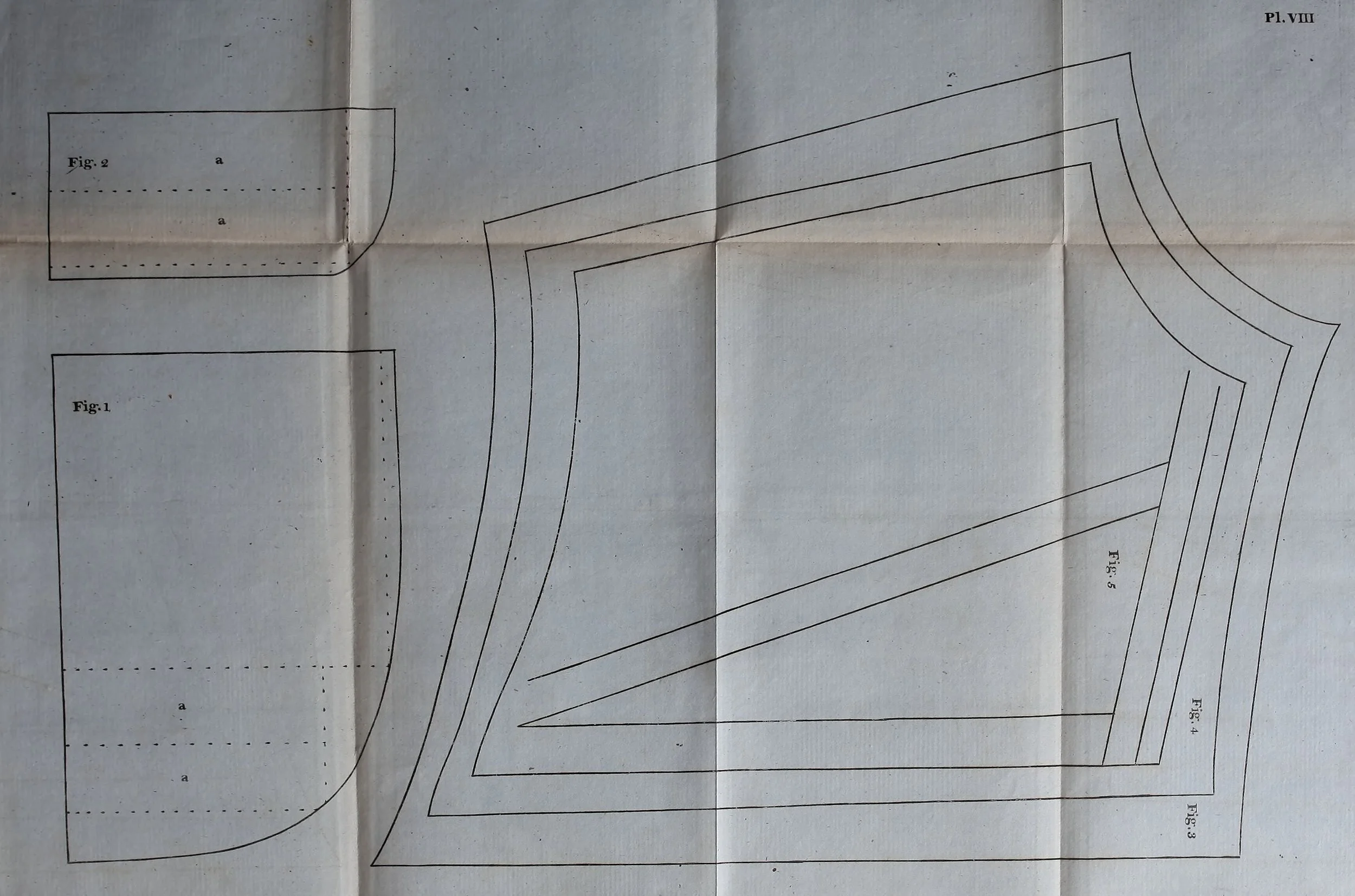
CLOATHING for GIRLS
SHIFT, Nº 1. How cut out.
… Before you move the ſift, cut the boſom, Plate VIII, Fig. 1, and then the back, Plate VIII, Fig. 2, (which will be conveniently done, as the ſhift lays doubled right for each), obſerving to make the gored breadth for the back …
STAYS, Nº 1. How cut out.
… the half front of the ſtays, Pattern Plate VIII, Fig. 3 …
STAYS, Nº 2. How cut out.
… lay the front of Pattern Plate VIII, Fig. 4, to the whole ſide …
STAYS, Nº 3. How cut out.
… a ſingle front, (Pattern Plate VIII, Fig 5) …
Plate IX
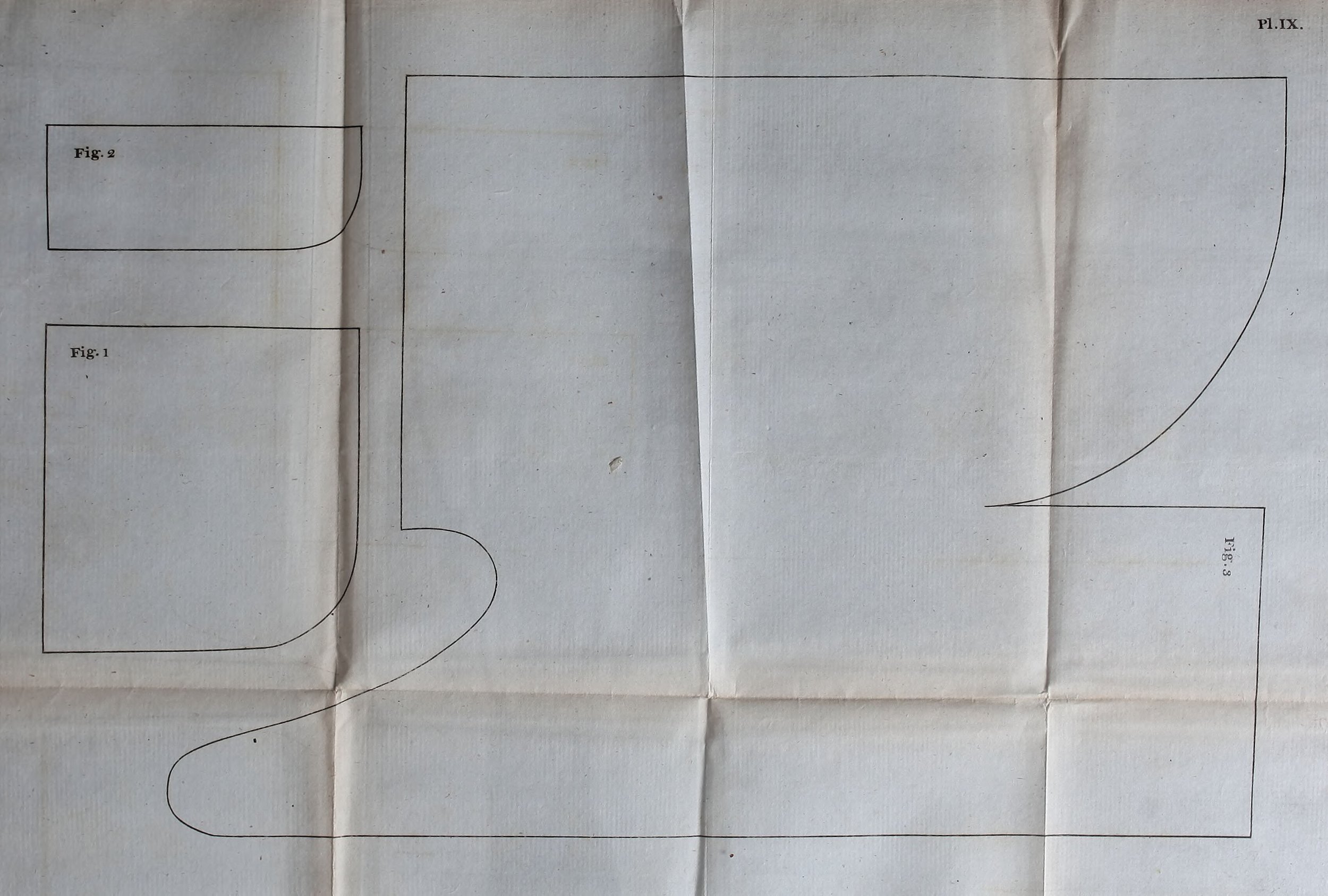
CLOATHING for GIRLS
SHIFT, Nº 3. How cut out.
… The guſſets out of the boſom, Pattern Plate IX, Fig. 1; back, Plate IX, Fig. 2. …
CLOATHING For POOR WOMEN.
CAPS. How cut out.
Half a yard, three nails and a quarter make four caps, which may be cut out all together, thus; when this quantity of cloth is cut off, double hte width in four, and then double the length in half, laying the Pattern Pl. IX, Fig. 3, upon it with the front to the ſide of the cloth where the ſelvedge is, and the top of the headpiece to that end which is whole, where the cloth is doubled. When it is opened, the four caps are to be divided from one another, and a ſmall ſlope cut to the forehead on the top of the headpieces, where they join. A broad hem at the bottom of the caul behind …
Plate X
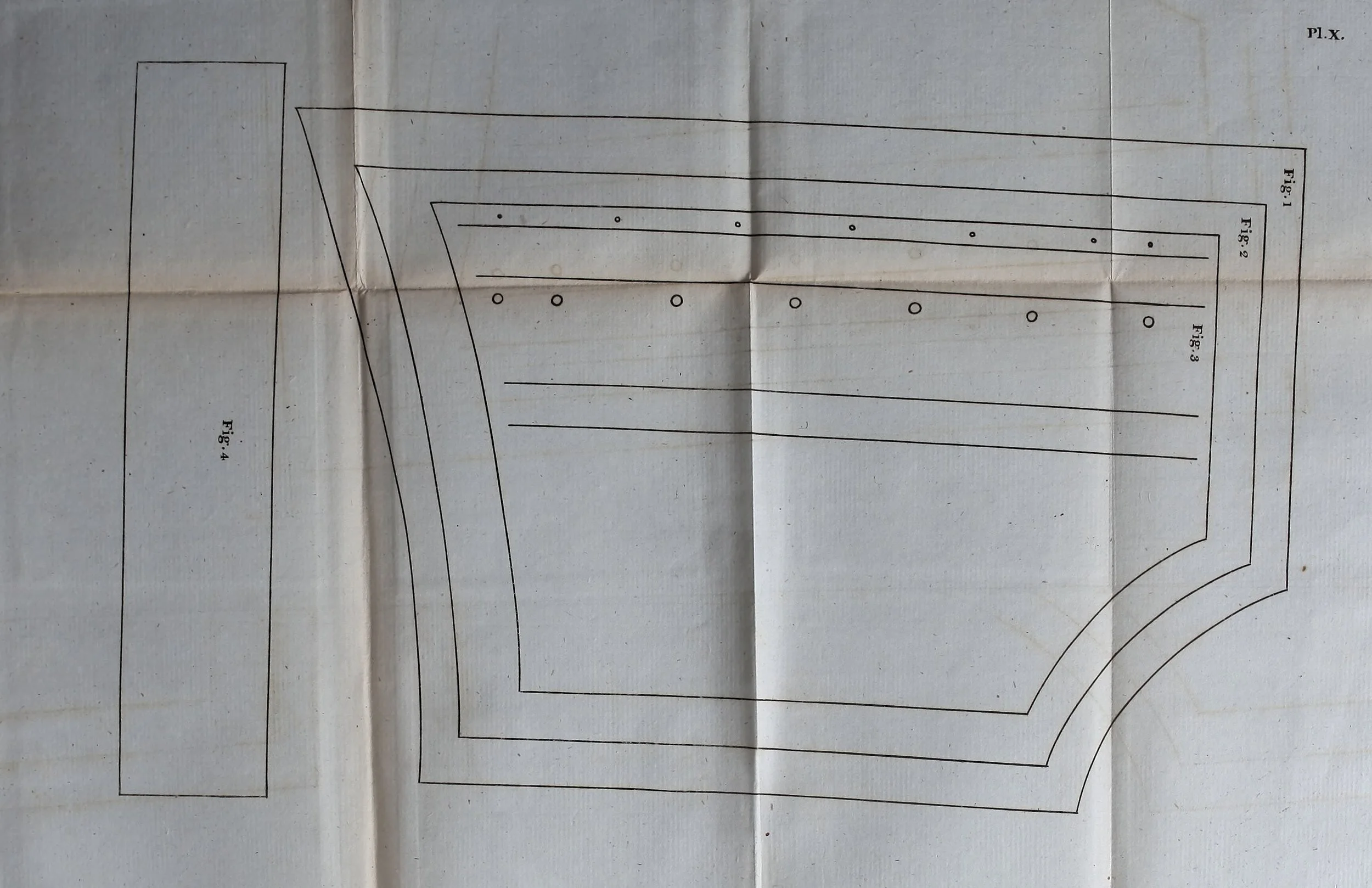
CLOATHING for GIRLS
STAYS, Nº 1. How cut out.
Three quarters, two nails and a half make one pair double, and one half of a back ſingle. There will be a front and one half of a back in the width. When the above quantity is taken from the piece, double down on one ſide to the width of the half front of the stays, Pattern Plate VIII, Fig. 3, and lay the front to the whole ſide where the cloth is doubled, then cut the half back out of the remainder of the width of the cloth, Pattern Plate X, Fig 1. Do this a ſecond time, and then double the remainder of the cloth, the width in three, which will make three half backs ſingle and a piece for the ſhoulder-ſtraps, Pattern Plate X, Fig 4, quarter and a nail long, and three quarters of a nail wide, doubled. Caſes muſt be backſtitched down the ſtays the width of the cane, dour in the back, two in the front, two ſlanting as a ſtomacher, and one piece round the breaſt; for which, and lſo for the proper diſtances of the lace-holes, ſee the patterns of the ſmalleſt ſize; the lace-holes for the oppoſite ſide are marked by dots on the edge of the pattern, and the diſtances of thoſe in the larger ſized ſtays may be proportioned accordingly. Two yards a quarter and half of ſplit cane.
STAYS, Nº 2. How cut out.
Half a yard, one nail and a half, make one pair double, and there will be a front and two half backs in the width. Double the breadth down the middle, and lay the front of Pattern Plate VIII, Fig. 4, to the whole ſide, and the back part, Pattern Plate X, Fig. 2, to the ſelvedge. N. B. By laying the patterns on again with the bottoms oppoſite to thoſe already cut out, a ſlope will come out, which will make the two ſhoulder ſraps a quarter long. Tow yards, two nails and half of ſplit cane.
STAYS, Nº 3. How cut out.
Three quarters of a yard will make one pair of ſtays and a half. Divide the width of the cloth in three, and each part will make a ſingle front, (Pattern Plate VIII, Fig. 5), and two half backs, (Pattern Plate X, Fig. 3,) thus: Double the two ends together, and lay the front of the pattern to the whole end where doubled, by which the fronts will be cut whole before, and the remainder makes the backs. The ſhoulder ſtraps cut from the ſlopings at the bottom about a quarter long each. Two yards of ſplit cane.
Plate XI
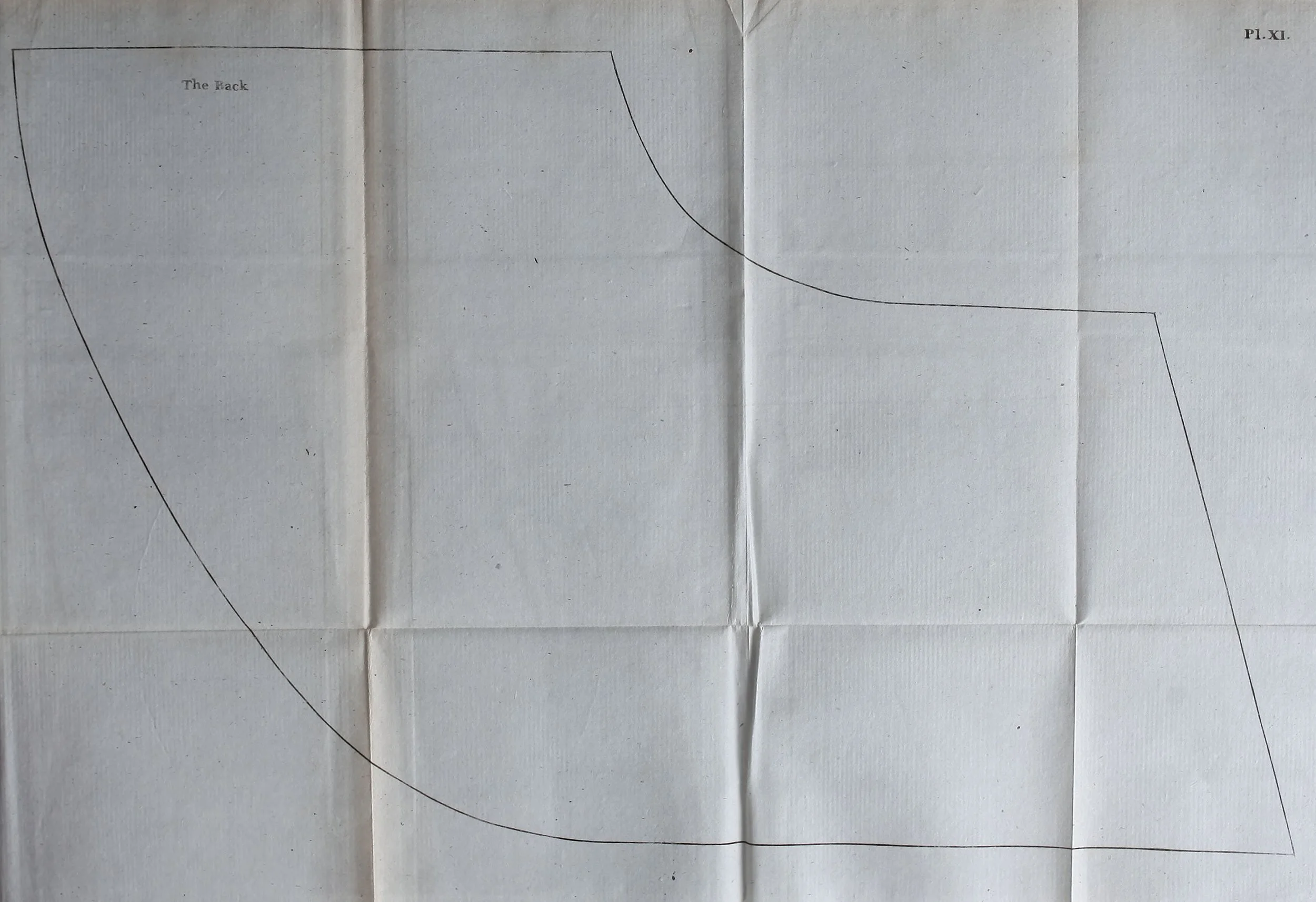
CLOATHING for GIRLS
TIPPET, Nº 1. How cut out.
Half a yard and a nail make two. Double the breadth in the middle, and then double down the end as deep as the width of the Pattern Plate XI, placing the back to the whole ſide of the breadth where doubled, which when cut out will make two at once. Three quarters and a half of tape, the neck ſewed upon it, and ſome gathers on each ſide.
Plate XII
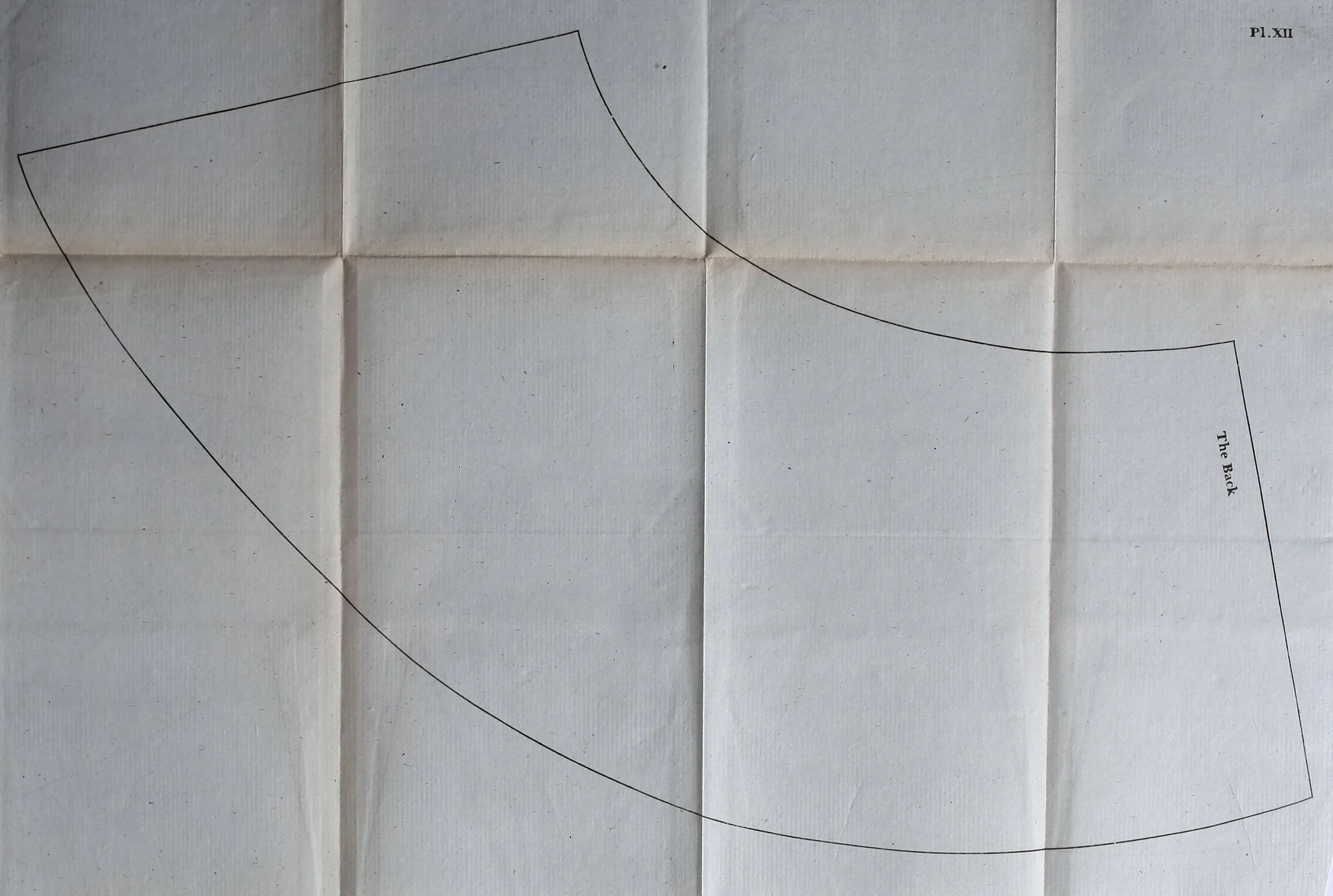
CLOATHING for GIRLS
TIPPET, Nº 2. How cut out.
Three quarters and a half make four. The breadth doubled down the middle, and the Pattern Plate XII, laid acroſs, cutting out one below the other. The neck ſewed upon a tape (the ſame as Nº 1), three quarters and a half long, rather more gathers on each ſide than are neceſſary for the pattern of the largeſt ſize.
N. B. It is better to make them of any kind of cheap printed Linen or ſtriped Holland.
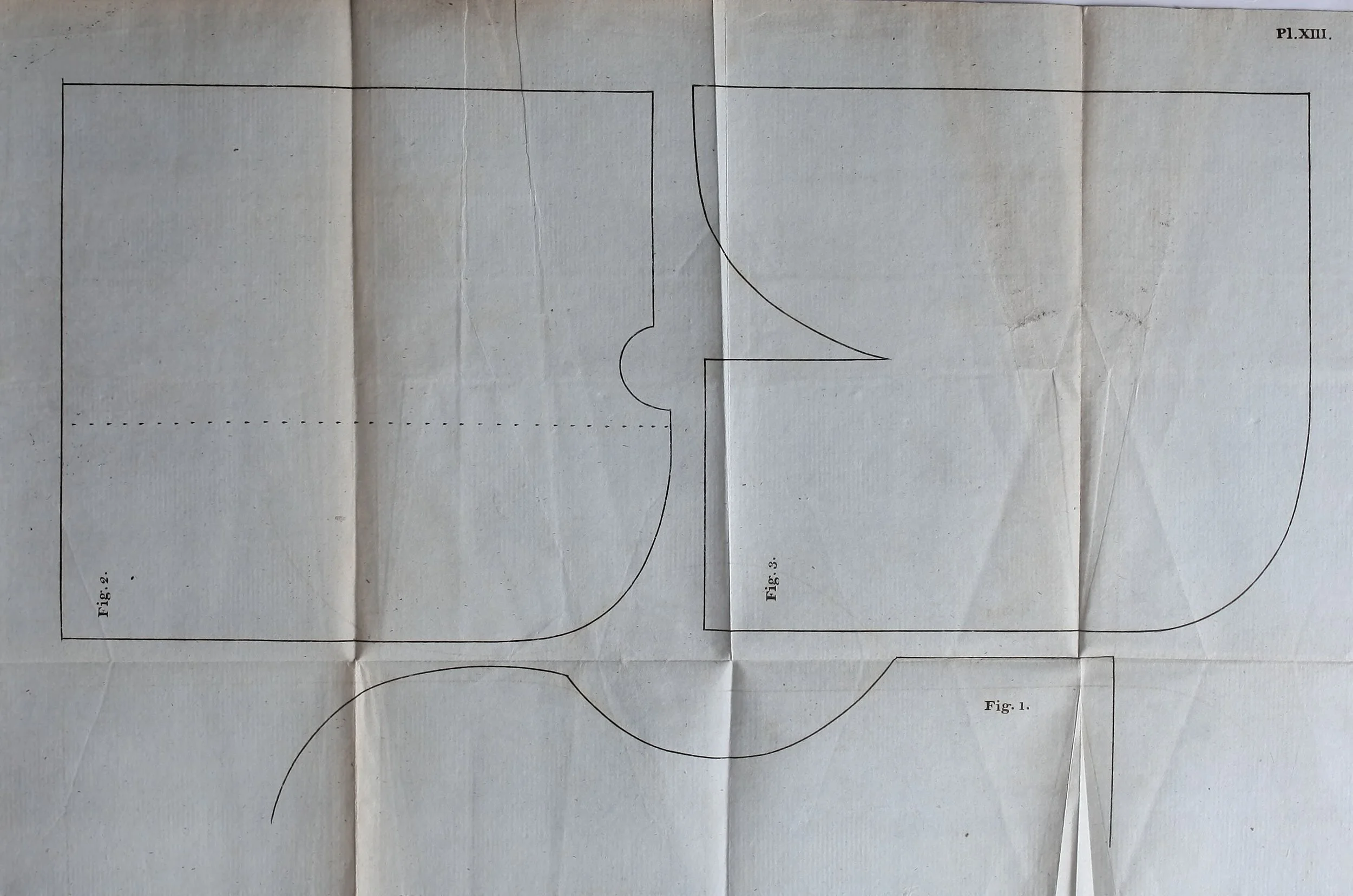
Plate XIII
PREFACE.
… there will be found a pattern of a night cap or boy’s cap in Pl. XIII, Fig. 2, and of a girl’s cap FIg. 3, which require leſs work …
CHILD-BED LINEN For the Uſe of the POOR.
TIPPET, Nº 2. How cut out.
Three quarters of a yard and a nail of flannel make one blanket; doubled in half down the middle. Gores cut from the ſelvedge ſides, a quarter and a half a nail wide at the top, and half a quarter, and half a nail wide at the bottom. The ſloped ſides of the gores joined to the blanket. A ſtrait piece cut out of the back (as it is doubled) a nail deep, and two nails and a quarter long, which will form a plait in the back of the ſkirt, alſo the ſlope in the body cut ſtrait, tow nails and a quarter under the armhole, which will form ſmall plaits at the hips, and make the waiſt fit better, the armhole cut out, and the corners rounded in front, Pattern Pl. XIII, Fig. 1, (which allows for the joining under the arm in the width of the armhole). The blanket to be bound all round with three yards and a half of Galloon, run on the edge of the inſide, and turned back nad ſewed down upon the outſide of the blanket.