Punch in the 18th Century
Both men and women drank punch in a variety of social settings, including punch houses as well as coffeehouses, public houses, and taverns. In 1774, Edward Topham describes a social gathering in Edinburgh:
This shrine of festivity is nothing more than an oyster-cellar, and its votaries the first people in Edinburgh. A few evenings ago I had the pleasure of being asked to one of these entertainments, by a Lady. At that time I was not acquainted with this scene of 'high life below stairs,' and therefore, when she mentioned the word Oyster Cellar, I imagined I must have mistaken the place of invitation: she repeated it it, however, and I found it was not my business to make objections; so agreed immediately. You will not think it very odd, that I should expect, from the place where the appointment was made, to have had a partie tête-à-tête …
The large table, round which they were seated, was covered with dishes full of oysters, and pots of porter. For a long time, I could not suppose that this was the only entertainment we were to have, and I sat waiting in expectation of a repast that was never to make its appearance. This I soon verified, as the table was cleared, and glasses introduced. The ladies were now asked whether they would choose brandy or rum punch? I thought this question an odd one, but I was soon informed by the gentleman who sat next to me that no wine was sold here; but that punch was quite 'the thing.' The ladies, who always love what is best, fixed upon brandy punch, and a large bowl was immediately introduced. The conversation had hitherto been insipid, and at intervals; it now became general and lively.
Pehr Kalm recalled a conversation on the good and harm of punch, in his Account of His Visit to England (1748):
I asked Mr. Catesby and Dr. Mitchel whether they thought that Punch was a useful or a baneful drink? They answered that their opinion was that it is beneficial or baneful according as it is prepared. Mr. Catesby said that his experience in Virginia and Carolina had been as follows. They drank at one time Punch which was made of strong Brandywine or rum and water with much sugar in it, but only a little lemon-juice was added. The effect, which they gradually found, of this was, that after some time they got a kind of Paralysis, which was such that they could not hold anything with the fingers; for they had almost no strength in them, but were obliged to place everything they wished to take hold of between the two hands. For example, they could not hold the glass which they wished to raise to the mouth with the fingers, which they could not press together, but between the wrists.
Afterwards they began to diminish the quantity of Brandywine and sugar but to put more lemon-juice in it, after which they did not get such troublesome paralysis, although commonly the sad future consequence was that he who drank Punch generally became very palsied in his old age.
Additional Resources
This site contains affiliate links for which I may be compensated
Drinking punch in the eighteenth century
Punch vs. Tea in the 18th Century
With Glasses Raised: All About Punch and Punch Love
Mixed Company: Colonial American Taverns’ Connections to the Atlantic World, 1620-1775
Punch: The Delights (and Dangers) of the Flowing Bowl
Barbarity in a Teacup? Punch, Domesticity and Gender in the Eighteenth Century
Find reproduction and original 18th century punchbowls on eBay
Re-creations of historical century punch recipes include Berkshire Rum Punch, Philadelphia Fish House Punch, and Martha Washington’s Rum Punch
Boy, bring a Bowl of China here,
Fill it with Water cool and clear:
Decanter with Jamaica right,
And Spoon of Silver clean and bright,
Sugar twice-fin’d, in pieces cut,
Knife, Sieve and Glass, in order put,
Bring forth the fragrant Fruit, and then
We’re happy till the Clock strikes Ten.
— Ben Franklin, Poor Richard’s Almanack, 1737
18th century recipes for punch
To make Punch from The queen-like closet by Hannah Woolley, c. 1670 (and Punch’s version)
A pleaſant and grateful ſort of Punch from Pharmacopœia Bateana, or Bate’s Diſpenſatory, 1720
A somewhat rambling discussion of the medicinal benefits of various ingredients in punch: Having had frequent Occaſion to mention Drams, Punch, Cyder, &c. in the foregoing Rules for the Uſe of our Waters, I have here given the Advantages and Diſadvantages, Uſe and Abuſe of those Liquors, as explanatory Notes, from The Natural, Experimental, and Medicinal History of the Mineral Waters …, 1734
Benjamin Franklin’s milk punch recipe, 1763 (and Food Republic’s version)
A Remarkable Bowl of Punch, The Historical Magazine, 1792; “On the 25th of October 1694, a bowl of punch was made at the right honourable Edward Ruſſel’s houſe” (and 12 Bottle Bar’s version)
© The Trustees of the British Museum. Shared under a Creative Commons Attribution-NonCommercial-ShareAlike 4.0 International (CC BY-NC-SA 4.0) licence.
Illustrations of punchbowls and/or punch drinking
The happy Clubb, A new Song, c. 1712-1783
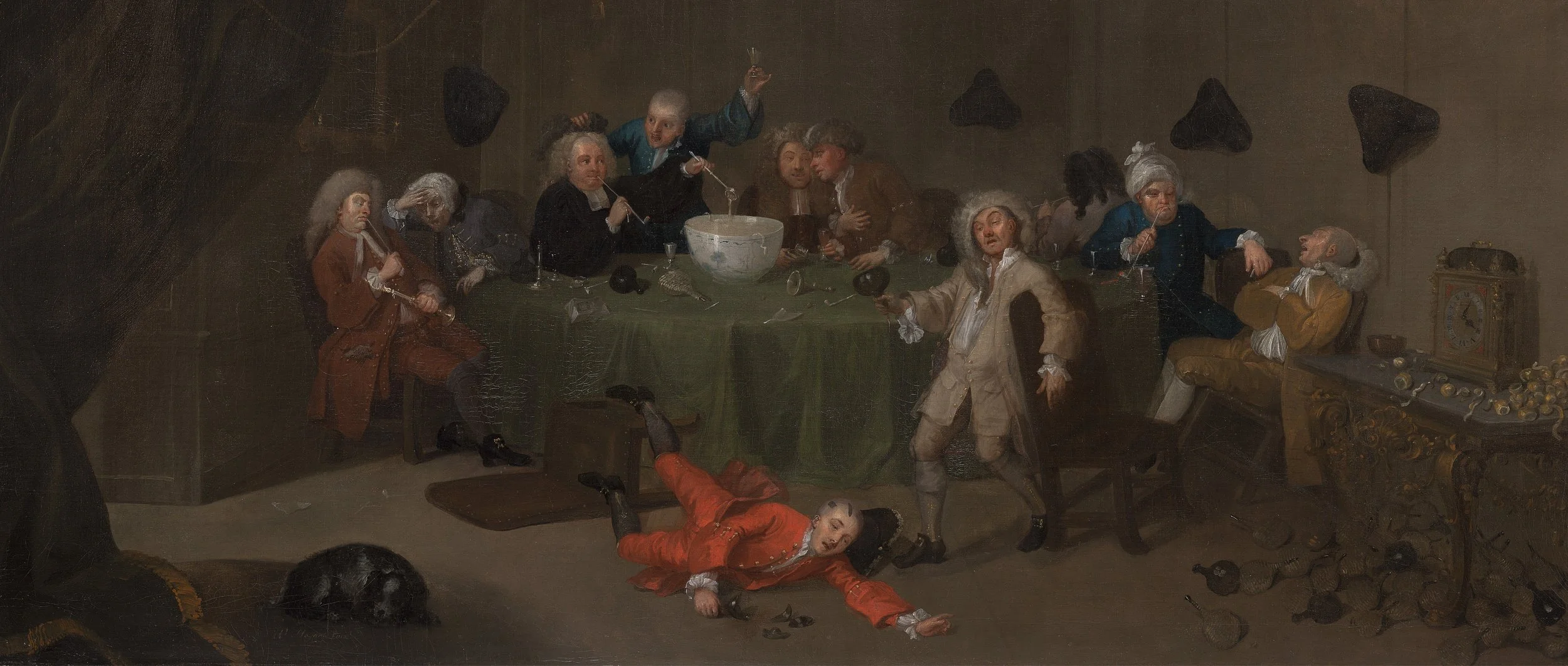
A Midnight Modern Conversation by William Hogarth, 1732 (see also A Midnight Modern Conversation after William Hogarth)
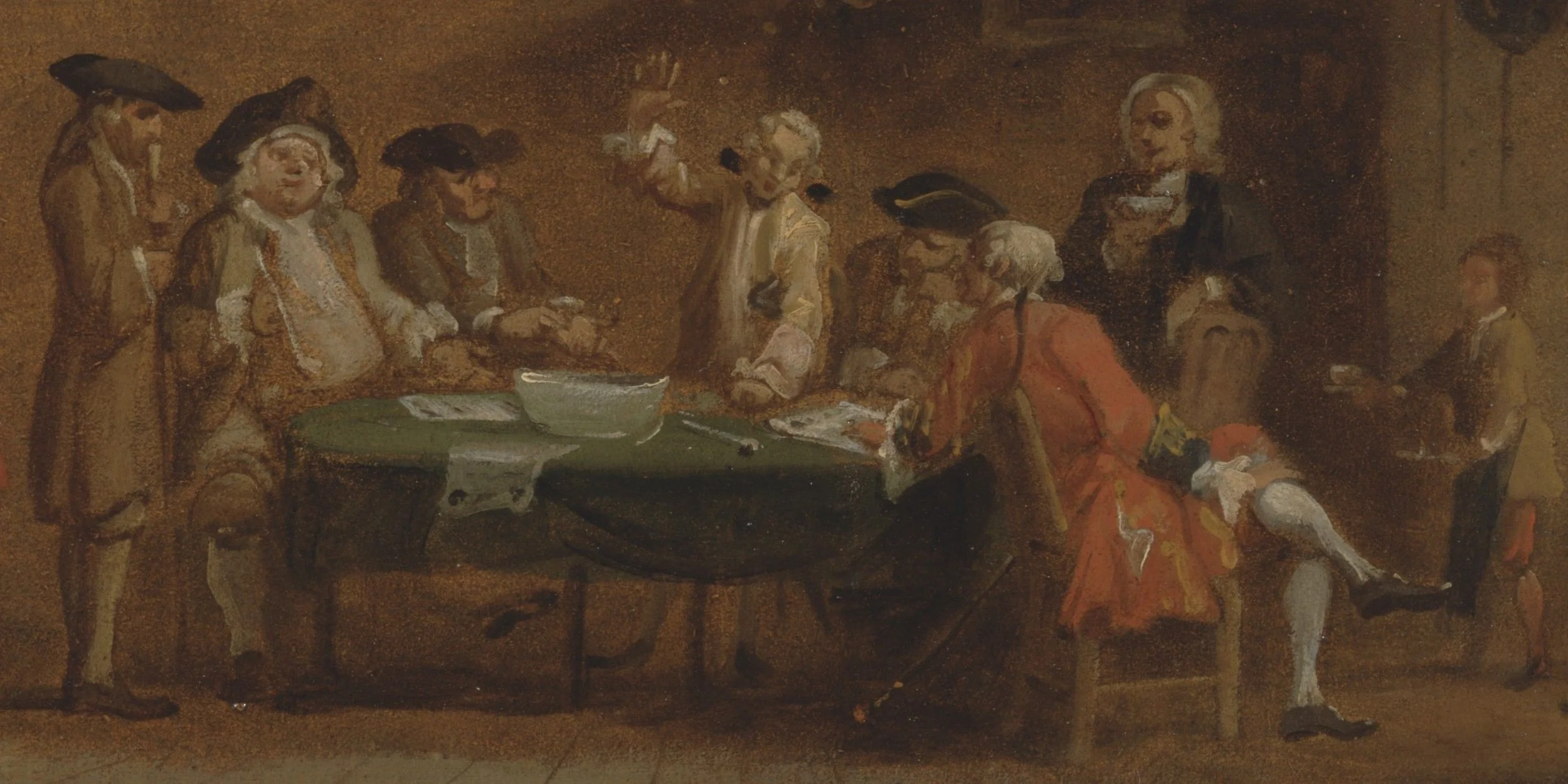
Figures in a tavern or coffee house, c. 1725 or after 1750
A Harlot’s Progress by William Hogarth, 1731
On Mr Groves, 1734
A Rake’s Progress III by William Hogarth, 1734
Headpiece illustration to The Musical Entertainer, 1737-1738
The Spendthrift, 1740-1767
The Humours of a Wapping Landlady, c. 1743
The Naval Nurse, or Modern Commander, 1750
Sea captains carousing in Surinam by John Greenwood, c. 1752-1758
A Punch Party in Florence by Thomas Patch, 1760
The Catch Singers, Real Characters, 1764
Mirth and Friendship, 1768-1772
Ha! ha! hah!, 1770-1780
The City Junto or the Min_st_l Aldermen of Gotham in Consultation, 1772
Human Passions Delineated, 1773
The Refusal, 1774
A Society of Patriotic Ladies at Edenton in North Carolina, 1775
The Pretty Bar Maid, 1778
A Bagnio Scene, 1778
Miss Tipapin Going For All Nine, 1779
Hyde Park, 1780
The Hireling-Constable, 1780
Two sailors carousing, c. 1780s
A man sits at a table with a punchbowl, representing the letter D (for “drunkard”), by Thomas Bewick, 1781
Sir Samuel House, 1781
Lofty Riding, or Miss Folly’s Head Exalted, 1781
Deceitful Kisses, or the Pretty Plunderers, 1781
Wine is a Mocker, 1782
Old What Sheaf in the Trap of Venus and Bacchus, 1782
A Rich Privateer brought into Port, by Two First Rates, 1782
The Contrast, 1783
Glee singers executing a Catch by Robert Dighton, c. 1785-1786
Smithfield Sharpers by Thomas Rowlandson, 1787
O Tempora, O Mores!, 1787
The Country Club, 1788
Symptoms of Drunkenneſs: Quite finished?, 1790
Three ladies drinking punch by Thomas Rowlandson
The Sailor’s Pleasure, 1790-1800
Ecclesiastic Opinions Concerning the Devil!!, 1791
St James’s St Giles’s by Thomas Rowlandson, 1792
New Cloathed Poets!!, 1792
A Cock and Bull Story, 1793
The Smoaking Club, 1793
Jack’s Return After Lord Howe’s Glorious Victory, 1794
British Soldiers Drowning Care, 1794
Let Us All Be Unhappy Together, 1794
A Relish, 1794
A Magisterial Visit, 1795
The Pretty Barr Maid by Thomas Rowlandson, 1795
Settling a Political Debate, 1795
Swearing at Highgate, 1796
The Celebrated Mr Jno Cussans, 1798
And the 'Tisick, the Colic, Punch cures the Gout by James Gillray, 1799
Checkmate by Thomas Rowlandson
Naval officers and a bowl of punch by Thomas Rowlandson
Illustration from Sir Launcelot Greaves, 1800
Two gentlemen seated in an interior, smoking
The Prodigal Son in Excess, early 19th century
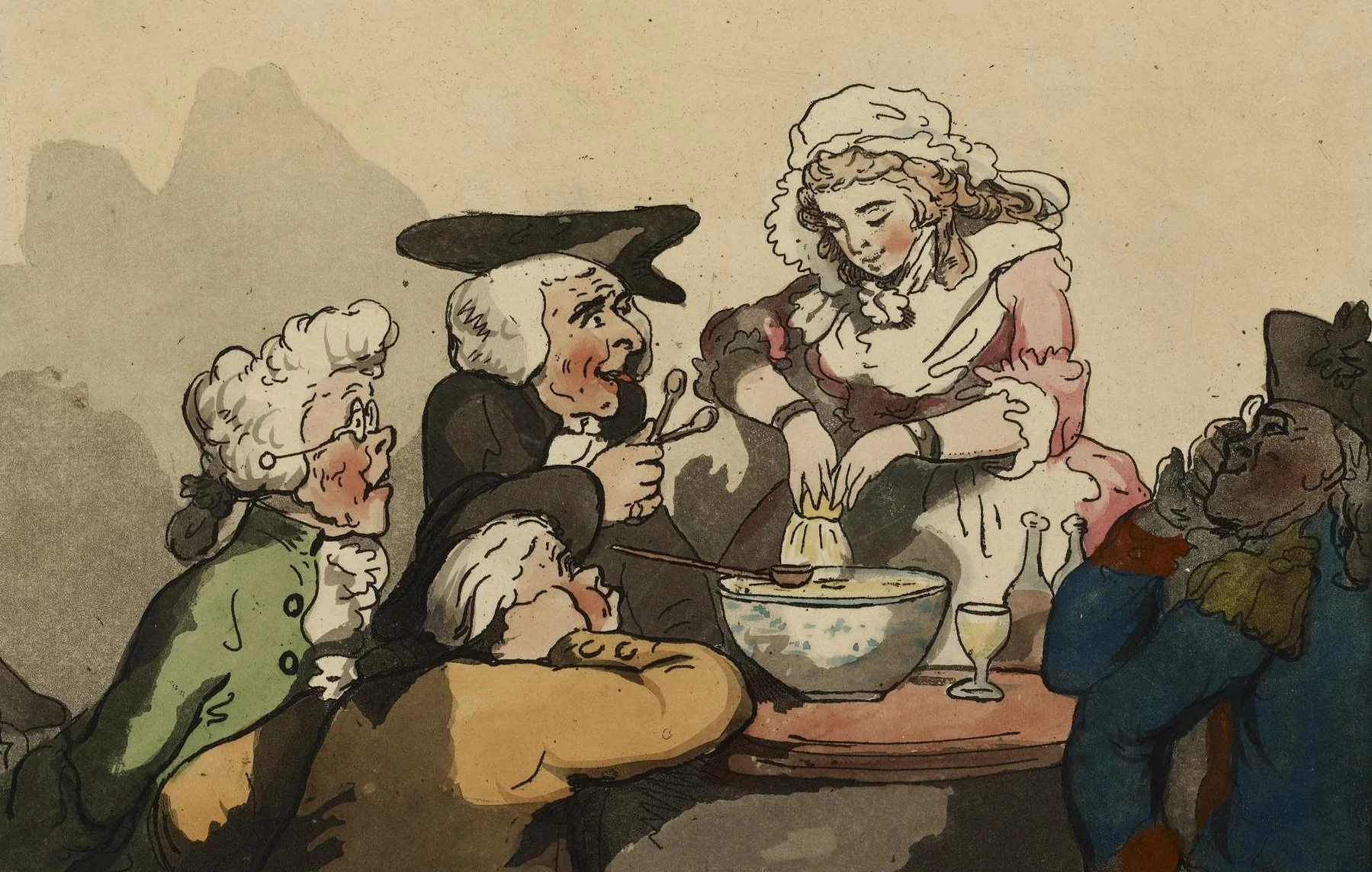
Serving Punch by Thomas Rowlandson, between 1815 and 1820
18th century punch bowls
National Trust 581702, Chinese porcelain punchbowl with cobalt blue underglaze and a floral design with rockwork and peonies, c. 1695-1715
Colonial Williamsburg 1991-183, a tin-glazed earthenware punchbowl made in London or Europe with Chinese-inspired decorations, c. 1700
National Trust 1250634, tin-glazed earthenware punchbowl made in Lambeth in 1707 with a fox-hunting scene and armorial interior, and inscribed ‘MANETE : BIBILE : ITERUMQUE : REPLETE :' (Stay, oh drinker, and fill it up again)
National Trust 582024, a punchbowl with a floral design, made in Bristol c. 1710
Colonial Williamsburg 1991-197, a tin-glazed earthenware punchbowl probably made in Bristol c. 1720
Colonial Williamsburg 1968-48, a tin-glazed earthenware punchbowl made in London c. 1720 with a design of pagodas in circles, c. 1720
National Trust 1276615, famille verte punchbowl made c. 1720
MFA 51.773, a Chinese punchbowl with a European hunting scene, c. 1722-1735
Winterthur 2003.0022.073, faience punchbowl made in London with a spouting whale on the interior, 1725-1735
Colonial Williamsburg 1954-586, footed silver punchbowl with engraved armorial decoration, made in London c. 1726-1727
Winterthur 2016.0034.024, made in England; inscribed “Drink Fair Dont Swar”
British Museum 1887,0210.134 made in England; inscribed “Drink Faire Dont Sware 1728”
Winterthur 2003.0022.028, speckled punchbowl with fish on the outside and floral decorations on the inside, made in London or Bristol c. 1730-1740
Winterthur 2003.0022.031, punchbowl with cupids and speckled design on exterior, Bristol, c. 1730-1740
Winterthur 1964.1216, made in Liverpool or London c. 1730-1760
National Trust 285013, Chinese Imari porcelain punchbowl with peonies, rockwork, and trellises, c. 1730-1770
National Trust 477136, tin-glazed earthenware punchbowl with Chinoiserie decoration, c. 1730-1770
Winterthur 2016.0034.008, faience punchbowl made in England; inscribed “Drink Fair Dont Swear 1737”
Mount Vernon W-2100, an enamelled porcelain punchbowl in the famille rose palette, “likely brought to Mount Vernon by Martha Washington from her first marriage,” c. 1735-1757
Colonial Williamsburg 1981-79, a Chinese porcelain punchbowl made c. 1740 and owned by the Spotswood family of Virginia in the 18th century
National Trust 771311, Chinese porcelain bowl made c. 1740 with a hunt scene in famille rose
National Trust 581641, Chinese porcelain bowl made in the 1740s in famille rose, “interior with a female figure sitting on a throne, behind her is a child, there is long altar table, another round tall table, all ornamented with precious antiquities or antiques, and numerous large jars on the ground, the rim with an elaborate baroque-style border with confronting archaic dragons and ruyi head devices above foliate swags, the exterior with a continuous scene of courtiers, beneath a narrow scrolled band in iron-red and gold, the rim with gold line band.”
British Museum 1887,0307,H.41, made by Enoch Booth (?) in Tunstall, 1743
Colonial Williamsburg 1956-150, white slip cast salt-glazed punch bowl made in Staffordshire c. 1745
Met 40.133.1a, b, a covered punchbowl made in China for the Swedish market, 1745-1755
British Museum E.159, made in Liverpool, 1746; a bust crowned with laurel and inscribed “Confusion to the Pretender 1746”
Colonial Williamsburg 1973-329, made in London or Liverpool, 1746; the interior featuring a cartoon bust of a Roman wearing a laurel wreath bracketed by the inscription 'Long Livee The King'
British Museum 1890,1210.1, made in Liverpool or London, 1749; Prince Charles Edward Stuart in highland dress, crown and shield
Mount Vernon M-4536/A, a Chinese export porcelain punch bowl originally owned by Sarah Bradlee Fulton, c. 1750
National Trust 592444, a Chinese porcelain bowl with peony decorations in famille rose, c. 1750
Mount Vernon W-2405, a Chinese porcelain punch bowl made c. 1750 and used as a christening bowl in the Dandridge family
Colonial Williamsburg 1995-28, tin-glazed earthenware punchbowl made in Liverpool c. 1750, with a rural landscape and Hogarth’s Midnight Modern Conversation
Colonial Williamsburg 1975-75, a Chinese porcelain punchbowl with Imari decoration, made c. 1750
National Trust 1552545, a Chinese porcelain bowl “decorated in the Famille rose palette, with two large panels of decoration; the first with a family group looking at a holy man, riding a mule and accompanied by an aide, the second with two horseback figures, servants and a falconer”
Colonial Williamsburg 1955-258, a silver punchbowl with a flat-chased border and engraving, made in London c. 1750-1751
British Museum 1887,0307,E.117, made in England, mid-18th century; inscribed “One more and then”
V&A C.23-1951, a Chinese porcelain punchbowl for the export market with a scene from Hogarth’s Gate of Calais, c. 1750-1755
British Museum 1887,0307,E.82, made in London, c. 1750-1760; arms and supporters of Gardeners’ Company and inscribed “WILLIAM GOODENOUGH GARDENER AT BARNS IN SURRY”
National Trust 641469, tin-glazed earthenware punch bowl made in Liverpool c. 1750-1760 with stylized flowers and tendrils on the outside, inscribed on the interior ‘fill Every man his Glass’
Colonial Williamsburg 1996-870, Chinese porcelain punchbowl made c. 1750-1765 with “undecorated, shaped cartouches surrounded by an overall ground pattern of underglaze cobalt-blue circles and dots interspersed with stylized flowers and foliage”
Mount Vernon H-37, a china punchbowl possibly owned by Charles Carroll of Carrollton, Maryland, c. 1750-1775
Colonial Williamsburg 1994-8, Chinese porcelain punchbowl with floral designs and scenes possibly from Booth’s Sailor’s Farewell & Sailor’s Return
British Museum 1960,0702.1, made in Dublin in 1753
British Museum 1887,0210.136, made in Liverpool, c. 1754; pastoral landscape and inscribed “Richard Wyatt Appelsham Prosperety to the Flock May th30 : 1754”
London delft punch bowl circa 1755, “Painted on the exterior with Chinese landscapes in blue and manganese inscribed 'One Bowl More And Then' with a floral bianco-sopra-bianco band below the rim”
National Trust 452268.3, a punchbowl from an armorial dinner service, c. 1755
ENGLISH DELFT BLUE AND WHITE PUNCH BOWL, PROBABLY LIVERPOOL, 1750-60 English Delft blue and white punch bowl, probably Liverpool, 1750-1760
Colonial Williamsburg 1964-487, Staffordshire salt-glazed stoneware punchbowl with enamelled floral decorations, c. 1755
British Museum 1887,0307,V.34, a Chinese-style punchbowl made in Worcester c. 1756-1780
Met 51.86.413, a porcelain punchbowl made in China for the British market, c. 1760
Levy 5500, English Delft punch bowl decorated in “Fazackerly” colors, Liverpool, c. 1760
National Trust 592430, Chinese porcelain punch bowl with floral decoration painted in famille rose enamels, c. 1760
National Trust 118668, Chinese famille rose porcelain punch bowl “enamelled around the exterior with scenes depicting European figures riding horses amidst pack of hounds in hilly landscape with buildings in the background,” c. 1760
Colonial Williamsburg 1972-433, tin-glazed earthenware punchbowl made in London, “gnarled chinoiserie root incorporating the cracked-ice motif and exterior and interior of the rim. On the interior bottom, a Chinese landscape with a house and the inscription '17 IGA 60.'”
National Trust 921639, Dutch Delft blue and white punch bowl, 1760
Historic Deerfield 16-A, English delft punch bowl decorated with floral sprays in Fazackerly colors, c. 1760
Colonial Williamsburg 1972-235, English tin-glazed earthenware punchbowl probably made in Liverpool with a Chinese dragon on the exterior and interior of the bowl, c. 1760-1780; Winterthur 1983.0031 has a similar design, possibly made by the Worcester Porcelain Factory c. 1758-1780 in lead-glazed porcelain
Creamware cherry and flower punchbowl excavated from the cellar of the Washington family home at Ferry Farm, probably made in the 1760s or early 1770s
Winterthur 2003.0022.030, made in London c. 1760-1770; floral decoration on the outside, interior inscribed “My wife drinks Tea / And I’le drink punch”
Museum of the American Revolution 2015.02.0001, made in Liverpool c. 1760-1770, with a ship and the inscription “Success to the Triphena”
Colonial Williamsburg 2000-92, Chinese porcelain punch bowl embellished en grisaille with symbols of support for American rights and the figures from The Queen’s Arms, A Night’s Amusement, made c. 1765 (which also appears on this c. 1765 Chinese punchbowl)
V&A C.346-1940, porcelain punchbowl made in Worcester and decorated with purple transfer print, c. 1765
Colonial Williamsburg 1959-40, tin-glazed earthenware punchbowl made in Liverpool in 1765 with an English landscape and a Masonic design
Winterthur 2003.0022.029, speckled punchbowl made in London, c. 1765-1770; inscribed on interior, “Rouse up Bold Buttons fam’d of Old / your powerfull Arms advance / Now let the Shamefull tale be told / you Subjecks were to France”
Winterthur 2003.0022.019 and 2003.0022.023, made in Bristol c. 1765-1775; speckled exterior, interior with swimming fish
Historic Deerfield 2014.3, blackware decorated in gold and silver with Jacobite motifs, c. 1766
Winterthur 2003.0022.026, punchbowl with floral decorations, made in London 1765-1775
Colonial Williamsburg 1976-76, a tin-glazed earthenware punchbowl with Chinese-inspired flowers and trees, made in London c. 1770
National Trust 1448585, a punch bowl with transfer-printed hunting scenes, Worcester, c. 1700
V&A C.20-1951 and Museum of the American Revolution 2012.00.0001, Chinese porcelain punchbowl made for the English market with the legend “Wilkes & Liberty” and portraits of John Wilkes and William Murray, Earl of Mansfield, 1770-1775
Historic Deerfield 2120, a Chinese export porcelain punch bowl decorated in the Mandarin palette with hunting scenes, c. 1770-1780
Colonial Williamsburg 2001-50, a Chinese porcelain punchbowl with neoclassical floral decorations, c. 1770-1790
Winterthur 1959.2691, Wedgwood punchbowl commissioned by the Paris Mining Company, c. 1774-1784
Historic Deerfield 1999.27.3, Chinese export porcelain punch bowl c. 1775
National Trust 1220297, a large Chinese export porcelain punch bowl with floral decorations in famille rose, c. 1775
British Museum 1887,0210.135, made in London, c. 1775-1780; inscribed “Succeſs to Trade.” (See also English Delft punch bowl inscribed “Succeſs to Trade,” with a “the exterior painted with a chinoiserie landscape scene,” probably Liverpool, third quarter of the 18th century.)
National Trust 413507, a porcelain punch bowl with black transfer prints of hunt scenes, c. 1775-1780
British Museum Franks.1403, made in China c. 1779; English harvest scenes and inscribed “Felden Farm” / “Harvest Home” / “J C” / “1779”
National Trust 849121, punch bowl from an armorial dinner service, 1779
Historic Deerfield 1130.1, a Wedgwood creamware bowl with black transfer prints and personalized with an inscription, "JOHN JANSTON" c. 1780
Historic Deerfield 1998.6.2, an English pearlware punchbowl with a fish and the words "Drink Round" c. 1780
National Trust 725441, a Chinese famille rose punchbowl with floral decorations and figures on terraces, c. 1780
Mount Vernon W-658, a Chinese porcelain punchbowl used for celebrations at Mount Vernon, made c. 1780-1785
Winterthur 1960-1158, 1960.1159, 1960.1160, 1960.1161, 1960.1162, and 1962.0583, a group of similar Chinese punchbowls made in China c. 1780-1790
Colonial Williamsburg 1993-433, pearlware punchbowl with black transfer printing and polychrome enamels, made in Staffordshire c. 1780-1795
Historic Deerfield 2000.35, small English pearlware punch bowl inscribed "Paſs it Round" c. 1785-1795
National Trust 630367, a Chinese porcelain bowl in famille rose palette enamels, c. 1785-1795
National Trust 959642, a Chinese hong bowl, c. 1786-1788
Historic Deerfield 2772, a Chinese export porcelain (hong) punch bowl decorated with scenes of the Canton waterfront, 1788-1789
Historic Deerfield 2110, a Chinese export porcelain punch bowl in the famille rose palette, c. 1790
Colonial Williamsburg 1978-32, a very shallow tin-glazed earthenware punchbowl made in London c. 1790
MFA 51.770, made in China for export to the American market, design featuring a warship and an eagle, c. 1795
Additional Resources
Drinking punch in the eighteenth century
“One More Bowl and Then?” A Material Culture Analysis of Punch Bowls
A punchbowl identified at Augustine Creek South and related artifacts in Ordinary and Poor People in 18th-Century Delaware
Punch strainers
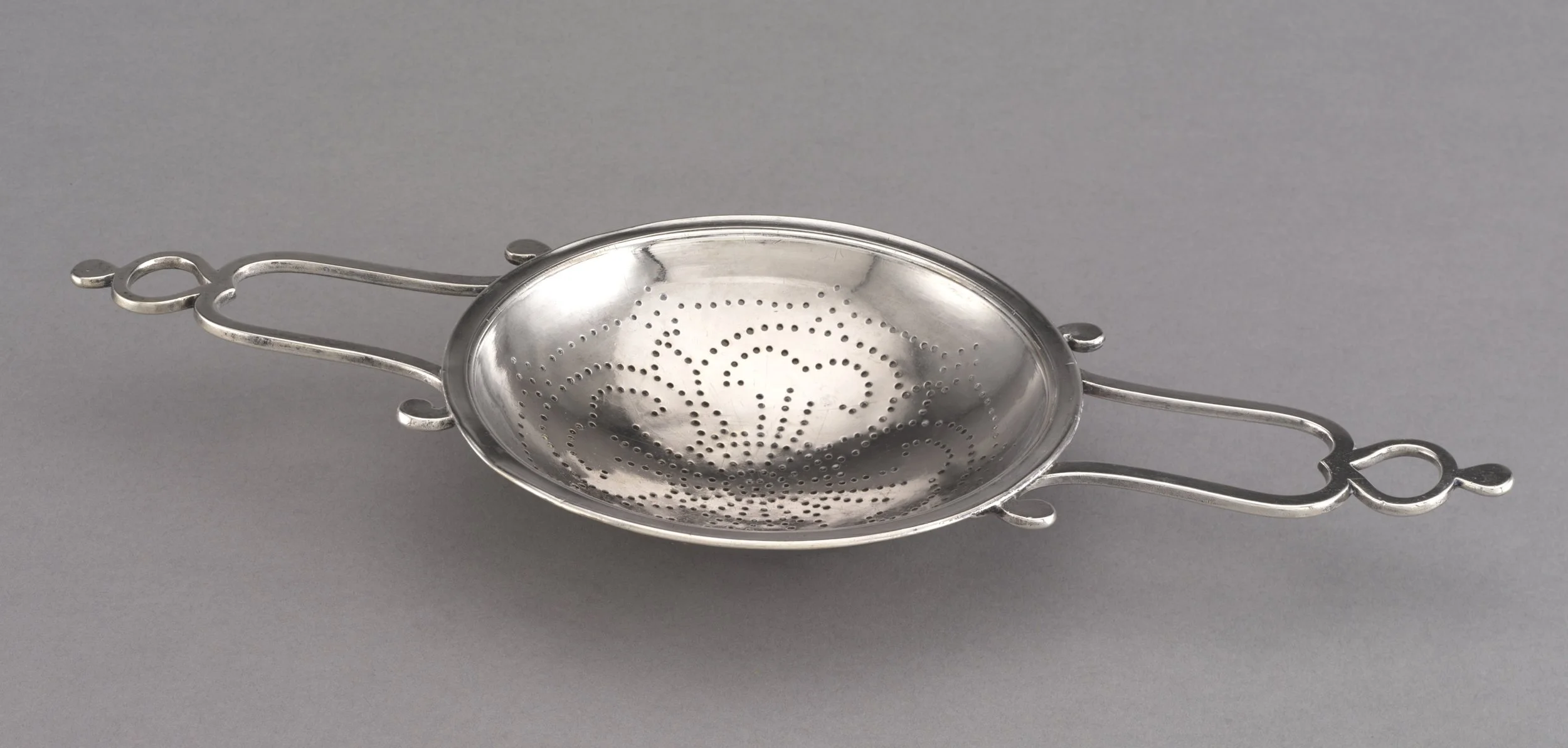
The handles on a punch strainer could straddle the bowl, catching seeds and pulp from citrus fruits juiced into the mixture. The strainers themselves are often shaped like shallow bowls, often with a decorative design to the perforations. You can sometimes find 18th century punch strainers on eBay.
Winterthur 2001.0002.010, made in Boston by Jacob Hurd, c. 1720-1758
Winterthur 1976.0022, made by Bartholomew Le Roux II in New York, c. 1739-1763
Massachusetts Historical Society 02.001, made in Boston by William Breed from silver captured by John Vryling during the Siege of Cartagena, 1741; see also Spoils of War: John Vryling’s Silver Punch Strainer
Art Institute of Chicago 1943.799, made in Boston by William Simkins, c. 1743-1760
MFA 1991.1011, made in Boston by Paul Revere, Sr., c. 1745-1750
Mount Vernon W-2688 made in London c. 1750-1751 and probably “part of the Custis plate brought by Martha Washington Mount Vernon from her first marriage”
Cleveland Museum of Art 1940.249 made by Paul Revere II in Boston c. 1760
Yale University Art Gallery 1930.1001, a punch strainer made in Rhode Island by Jonathan Clarke, 1765
Mount Vernon W-2527, made c. 1773-1774 in England, formery owned by John Parke Custis and his wife Eleanor
Massachusetts Historical Society, a punch strainer belonging to John Hancock, made in England in the 18th century
Punch ladles
Unless otherwise noted, most 18th century punch ladles are silver. (You can also find 18th century punch ladles on eBay.)
V&A 1193-1902, an English punch ladle with a wooden bowl
MFA RES.35.39, a ladle with a horn stem and a bowl with a Queen Anne shilling set into the center
National Trust 1151598, 1728
MFA 18.31, made by Samuel Meriton in London, 1747-1748
Winterthur 1996.0004.072, made by Benjamin Hurd in Boston, c. 1760-1781
MFA 12.1157, marked by John Nicholson, made in Ireland c. 1780
Met 39.91, made in Philadelphia c. 1780-1800
Met 24.109.43, made by Joseph Anthony Jr. in Philadelphia c. 1783-1800
National Trust 852192, punch ladle with lipped bowl and turned wooden handle, 1798