18th Century Spangles
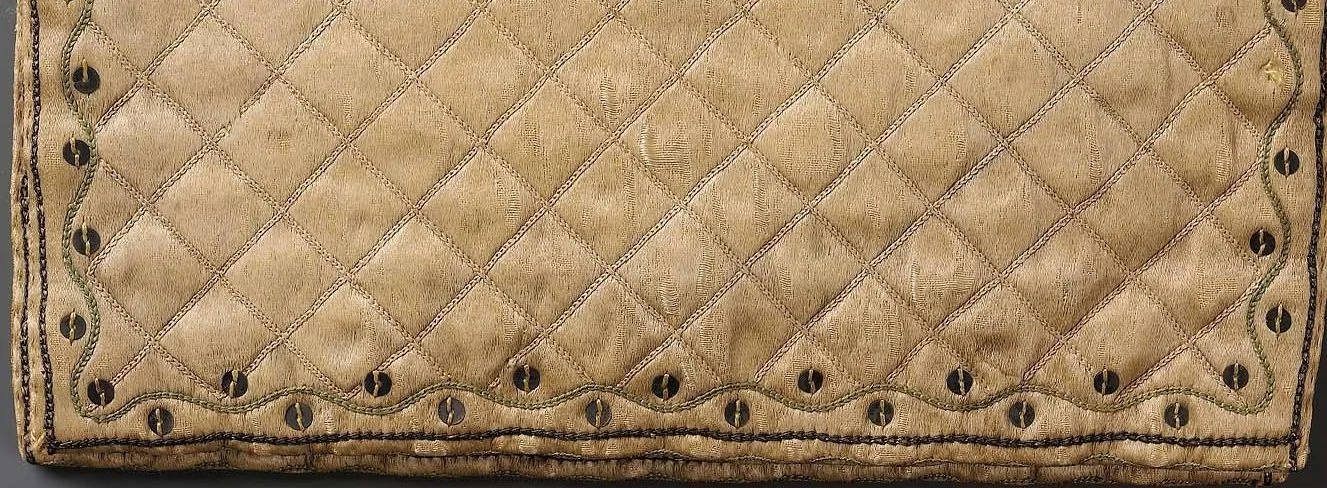
18th century French pocketbook at the Museum of Fine Arts, Boston
Spangles were used to decorate a wide variety of garments and accessories for men and women. Often made of silver, these flat sequins add accents that sparkle in candlelight – making them ideal for wearing at court and formal evening occasions. Many spangles were likely cut from clothing as the styles went out of fashion, falling victim to drizzling and parfilage.
The list of extant spangle-decorated clothing and accessories is grouped by type of garment or accessory, rather than being in chronological order.
(The closest reproductions I’ve found are Benton & Johnson’s silver spangles, which are available in several sizes from specialty embroidery shops.)
Additional Resources
This site contains affiliate links for which I may be compensated
Spangles, Sequins, and Spangs, Oe My!
The Spangles and Plate Figures in Embroidery are made of Gold or Silver Wire, firſt twiſted round a Stick of the Bigneſs they want the Spangles, &c. to be made of; then they are cut off in Rings and flatted upon an Anvil, with a Punch and the Stroke of a heavy Hammer. The Anvil is made of Iron, fixed in a large Block of Wood bound round with Iron Hoops; the Face of it is caſe-hardened Steel, nicely poliſhed and perfectly flat; the Punch is nine Inches long, and about an Inch over in the Face, which is likewiſe of caſe-hardened Steel, flat and curiouſly poliſhed; a Frame of Iron is raiſed from the Block over the Anvil, which ſupports the Punch: When the Workman is to make Spangles, Rings for Buttons, or other Plate Figures, he places the Rings above deſcribed, upon the Anvil under the Punch, then, with both Hands, gives a ſmart and ſudden Blow with the Hammer, which flats the Wire Rings into the Shape of Spangles, &c. If the Anvil or Punch is not hardened to an equal Temper, either of them gives way to the Metal and the work is ſpoiled; or if they are not truly poliſhed, the Spangles want their proper Gloſs, in which their chief Beauty conſiſts. Note, When we ſpeak of Gold Wire in all theſe Branches, we mean only Silver double gilt, and drawn after the Manner deſcribed in the ſection of Wire-Drawers.
— The London Tradesman, 1747
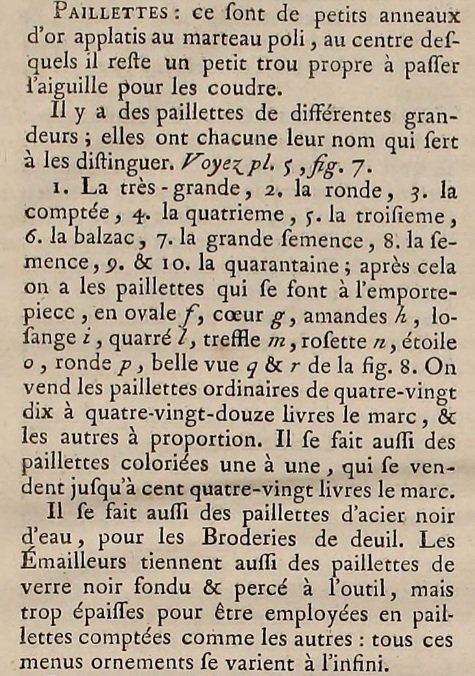
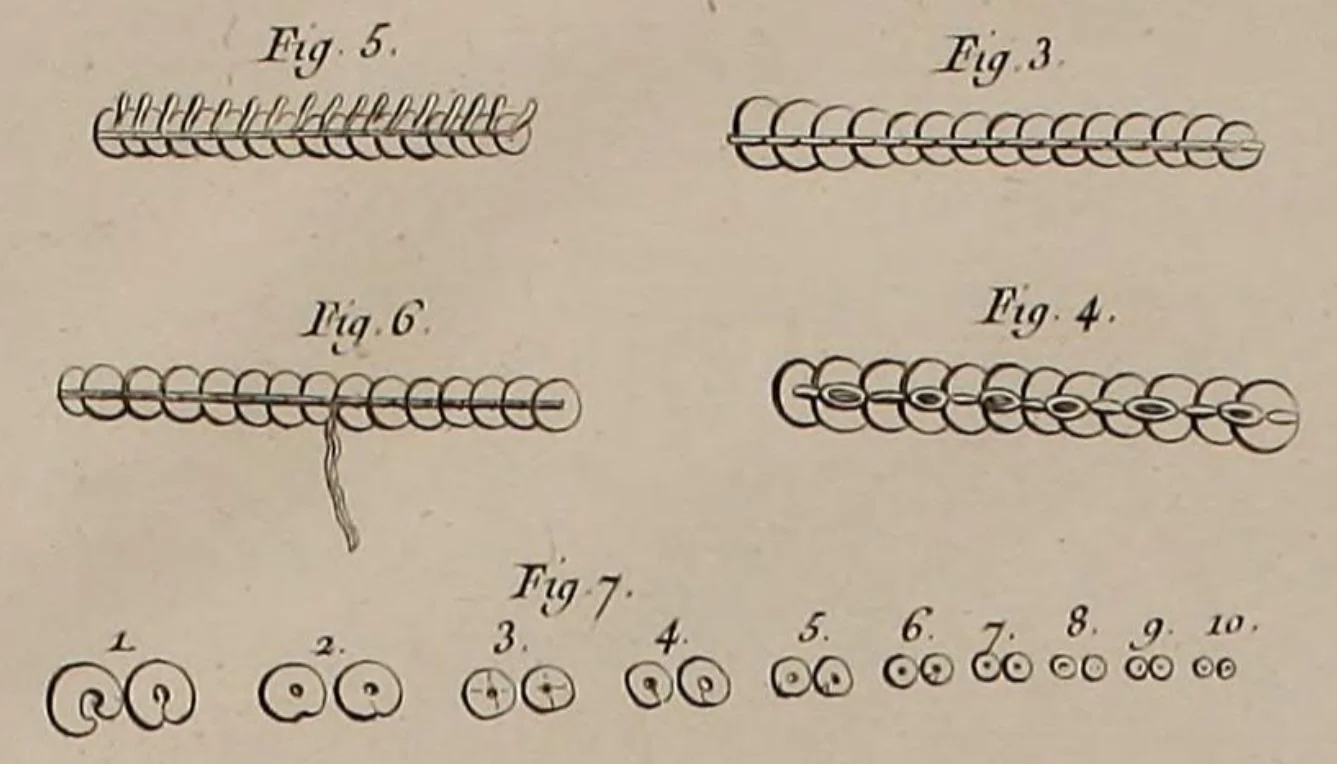
In L’Art du brodeur (1770), Charles Germain de Saint-Aubin describes spangles, and provides diagrams of different sizes & styles. There is an additional chapter on embroidering with spangles (De la Broderie en Paillettes).

Eighteenth-century ladies’ magazines published several embroidery patterns with spangles, including these patterns for a gentleman's ruffle (July 1771) and a waistcoat (March 1775).

Banyans
National Trust 1349100, 1770-1800
Coats
FIT 2013.3.3, Scotland, c. 1745
Met 33.124.2a, b, 1750-1775
National Trust 1348777, 1760-1770
National Trust 1349414.1, 1760-1770
National Trust 1348791, 1770
V&A T.214:1, 2-1992, possibly France or Netherlands, c. 1770
National Trust 1348783.1, 1770-1779
V&A T.365:1, 2-1995, made in Great Britain, 1770-1779
National Trust 1348762.1, 1770-1780
Manchester 1954.1098, 1770-1790
National Trust 1349102, 1770-1800
National Trust 1349760, 1770-1800
National Trust 292106, 1770-1800
National Trust 1348785, 1780
Musé de l’Armée 09405, uniform of the aide-de-camp of the governor of the army of the Elector of Saxony
V&A 106-1891, 1780s
National Trust 1348760, 1780-1790
V&A T.9-1972, Italian, c. 1790
Fans
Met 42.150.31, French
Met 48.58.22, French, mid-18th century
National Trust 980549.1, 1750
Rueil-Malmaison, châteaux de Malmaison et Bois-Préau, MM.51.2.48, 1750
Met 48.58.1, Italian or French, third quarter of the 18th century
National Trust 1363170, 1760
V&A 2186-1876, English, 1765-1775
Met 24.80.2, French, c. 1774-1793
Met 48.58.5, French, c. 1775
Manchester 1953.267, 1775-1780
Kunstmuseum Den Haag 0390810, c. 1775-1799
Versailles V5845.227, 1776-1800
Met 90.2.34, possibly German, c. 1780-1785
Versailles V5845.223, 1780-1790
Rijksmuseum BK-KOG-2469-A, c. 1783-1784
Rijksmuseum BK-1992-14, c. 1784
Manchester 1953.269, 1790-1810
Museum Rotterdam 63383-1, 1799
Gowns
V&A 114&A-1873, a sack and petticoat, English, embroidered 1735-1740 and sewn 1750-1759
Manchester 1953.213, a bodice, 1740-1760
Galerie des Modes, 11e Cahier, 6e Figure, 1778: “Ball dress. The bodice and petticoat are of the same stuff and color. This petticoat is pulled up with tassels on the sides, a little in back, and on the front unevenly through the pockets: it allows, as it were, the discovery of a second petticoat of a different color, trimmed with a volant of striped gauze, headed with a flower garland, with barrieres of flowers and sequins. Little apron of gauze matching the volant, trimmed around the edges. The body has a top-rounded bib, showing graceful contours. Sleeves with large gauze sabot cuffs, trimmed in poufs, with pearls, flowers, and sequins.”
Galerie des Modes, 21e Cahier, 2e Figure, 1779: “New Gown, called à la Longchamps, pulled up with love-knots and tassels, trimmed with sequins … Skirt of the Gown open in front, pulled up in garlands with tassels equipped with cordelieres in love-locks; the edges trimmed with embroidery in sequins of many colors.”
Galerie des Modes, 1er Cahier de Grandes Robes d'Etiquette, 6e Figure: “The trimming of a trimmed gown dressed with blue crêpe, the parement of a garland of sequins edged with cornflowers, the petals in blue and green sequins, the leaves in green sequins, and the bases and hearts in stones, a large satin and pinked crêpe chicory positioned behind … The petticoat of white taffeta covered with crêpe edged with blue sequins, a volant of a large garland edged with blue and green sequins; cornflowers in stones and sequins edged on the bottom with a very high blonde lace, a tulle ground with a border, held up with a large garland of roses positioned on a pleated frill of the same blonde.”
Galerie des Modes, 2e Cahier de Grandes Robes d'Etiquette, 2e Figure: “The furnishing and trimming of a grand presentation dress of black fleuret, the petticoat covered with an embroidered, spangled, bronzed crêpe with very rich sequins, the petticoat bordered with a fringe of tassels in branched-work and sequins, the head of black sequins in festoons, a drapery on the right and on the left of sequined crêpe, edged with the same fringe as on the bottom of the petticoat, ended with beautiful, shining black tassels and attached with sequins, the bottom of the gown of black-spangled crêpe, trimmed with a stomacher en barrière of black sequins and black stone buttons, the veins and epaulettes matching”
Met 1998.314a,b, a robe à la polonaise, British, c. 1780
Galerie des Modes, 3e Cahier de Grandes Robes d'Etiquette, 4e Figure, January 2, 1785: “The trimming and the bodice of a gown of white crêpe, spangled with silver in faux vermicelli patterns, the parement trimmed with a beautiful garland of two fringes in silver lamé, and a third row of gold in the middle, pinched bouillon-style at the ends, each bouillon held with a flower of blue spangles and green leaves. The manchettes edged with a fine silver fringe and frivolité, and a fine petit pied of blonde. The petticoat of white taffeta covered with white crêpe, striped at the edges with white sequins, edged with oval stones or scattered very thickly in a pattern of faux sequins. The bottom of the petticoat edged with a pleated ruffle of crêpe striped in two rows of fine silver fringe and a third row of fine gold. A pleated, pulled-up volant of white crêpe edged with silver sequins at the end, edged at the bottom by a ribbon edged in rich stones and a fine silver fringe held with a garland matching that of the parement in gold and fine silver.”
Galerie des Modes, 2e Cahier de Grandes Robes d'Etiquette, 3e Figure, January 20, 1788: “The furnishing of a full gown, the petticoat of white taffeta, covered with a crêpe spotted with silver sequins, forming a fabric with contrary pleats, the foot of the petticoat trimmed with a large band of green sequins striped with white sequins, bordered at the bottom with a high gold fringe and tatting; three festoons forming shells bordered with a very high fringe of gold and silver tassels, a very beautiful garland in branch-work of green and pearl spangles mixed with gold spangles, with large flowers of blue spangles, the top of the petticoat striped in columns of garlands of green spangles, all a branch-work mixed with pearl: the bottom of the gown of blue satin trimmed with a fringe of gold and silver tassels; a band spotted with spangles, a flat gold fringe with tatting at the top; the grand corps of blue satin trimmed with a stomacher of black velvet embroidered with stones, the edging and shoulder straps matching. Four gold and fine silver gown tassels.”
Costume Parisien: Fichu - Turban semé de Pailettes …
Pocketbooks & Purses
Kunstmuseum Den Haag 0211801, a silk work bag
National Trust 1349538, a silk netted long purse, 1750-1760
MFA 56.1143, a quilted silk pocketbook, French, mid to late 18th century
National Trust 1152452, a silk work bag, c. 1803
Shoes
Kunstmuseum Den Haag 0210269, a pair of mules
National Trust 1348821.1/1348821.2, 1770-1780
National Trust 1362001, 1775-1780
Galerie des Modes, 11e Cahier, 6e Figure, 1778: “Shoes with low heels, the coup-de-pied free, embroidered with sequins. Round rosettes, with a large sequin in the center.
Galerie des Modes, 29e Cahier, 4e Figure, 1780: “We will only observe here, the long and pointed slippers … gold, silver, sequins, large sequins soon made shoes look like real jewels. Women having ceased to put diamonds on their heads, began to ornament their feet with them, and the shoe became an object of splendor and magnificence.”
Centraal Museum 4416/001-002, 1780-1789
Manchester 1947.923, 1785-1800
Stomachers
Manchester 1953.325, 1700-1720
Manchester 1955.175, 1700-1720
Manchester 1947.857, 1730-1750
V&A T68-1947, possibly French or Italian, c. 1750
MFA 03.1351, American, probably mid-18th century
Waistcoats
National Trust 1361221, 1700
National Trust 1355480.1/1355480.2, 1720
Massachusetts Historical Society 1113, waistcoat made in England or France c. 1720-1730 and owned by Massachusetts Lt. Gov. William Tailer; more details at SilkDamask and philippe_on_fleek
V&A 252-1906, France, c. 1730-1739
National Trust 1402224, c. 1730-1740 (with matching breeches 1402225)
FIT 2013.3.3, Scotland, c. 1745
National Trust 1359453, 1750
National Trust 1349004, 1750-1755
National Trust 1348939, 1750-1799
National Trust 709706, 1759-1761
Met 1981.14.6a, b, 1760s
National Trust 1349414.2, 1760-1770
National Trust 1359455, 1770
National Trust 1348783.2, 1770-1779
National Trust 1349010, 1770-1780
National Trust 657387, 1770-1799
National Trust 292107, 1770-1800
National Trust 1349314, 1770-1848
National Trust 1349023, 1775-1780
National Trust 1349012, 1775-1785
National Trust 1349024, 1775-1785
Centraal Museum 4373, 1775-1800
Galerie des Modes, 23e Cahier, 1ere Figure, 1779: “a vest of cloth of gold, relieved with gold embroidery and sequins of diverse colors.”
Met C.I.66.59.2a, b, probably French, c. 1780
Museum Rotterdam 65853, 1780-1785
National Trust 1349021, 1780-1790
National Trust 1349013, 1780-1790
National Trust 1349015, 1780-1790
National Trust 1348936, 1780-1799
Met 23.202, an uncut waistcoat panel, French
Museum Rotterdam 65852, 1780-1800
Rijksmuseum BK-NM-12171, c. 1789-1814
Centraal Museum 7325, c. 1790
NPS SAMA 938, a waistcoat owned by Elias Hasket Derby, c. 1790-1795
National Trust 658045, 1790-1819
Rijksmuseum BK-1978-810, c. 1805-1810