“Thoſe for Ornament are principally deſigns from the antique, elegantly enriched and adapted for the decoration of chimney-pieces”
This page covers ornaments from and inspired by the ancient world — largely Greece and Rome, occasionally Egypt — as they appeared on 18th century chimney-pieces. I’m less interested in the architecture of the space — the chimney-pieces made of marble sculpted to resemble an ancient tomb or Roman temple — and more on the smaller movable pieces, such as busts, statuettes, and obelisks.
As elements of garnitures, these tend to be arranged symmetrically — often in odd numbers, with the largest or most visually interesting piece in the middle. In some cases, the sculptures are intermixed with vases and urns. Some garniture vases and urns were in classical forms or designs, which complemented and enhanced the display’s sense of antiquity.
Additional Resources
This site contains affiliate links for which I may be compensated
A complete body of architecture by Isaac Ware (1768)
Talking Heads: Classical portrait busts in the country house, 1715-1832
Bronze statuettes by Giacomo and Giovanni Zoffoli, with a catalogue of works Giovanni Zoffoli offered for sale c. 1795
Classical Sculpture and the Culture of Collecting in Britain Since 1760
The bronze reductions of ancient statues and busts displayed on 18th century chimney-pieces as garnitures were often souvenirs of the Grand Tour. Charles Heathcote Tatham bought several of these bronzes while studying architecture in Europe, comparing those produced in France and Italy in a 1795 letter to Henry Holland:
As to the difference between the Prices of the French bronzes and the Roman, no one here is I find at a loss to account for it; the following information I have been able to collect upon the subject. The materials used by the French are in the first place very inferior to those used by the Romans, being for the most part of very indifferent metal; their figures in general ill attended as to nature (the ornament only being sometimes good) instead of gilding it in solid gold, they are accustomed to use a kind of varnish mixt with gold dust, which the fancy and invention of a Frenchman contrived to answer the purpose, this composition when used as often turns black, and looses its lustre after a certain time--the bronzes thesleves were also frequently covered with another mixture of varnish, the which cannot be more perceptible, than in the partial lucid parts general marked upon the extremities, the rest being for the most part jet black, which is but a faithless representation of a good bronze, added to the rapidity with which they executed them, in consequence of a great demand, enabled them to sell them cheap. The bronze used by the Italians is of the best metal, with what they call a patina, meaning the outward colour, of a good nature, their gilding is always (unless ordered to the contrary) of real sicane gold, the most valuable of the kind for colour weight and substance, and above all their execution is superlatively good, having artists employed who study the antique with Attention and model with great ingenuity and taste. This is the comparison I am able to make from the best information. The works in question must be left to speak for themselves hereafter, when under the inspection of those of better judgement.
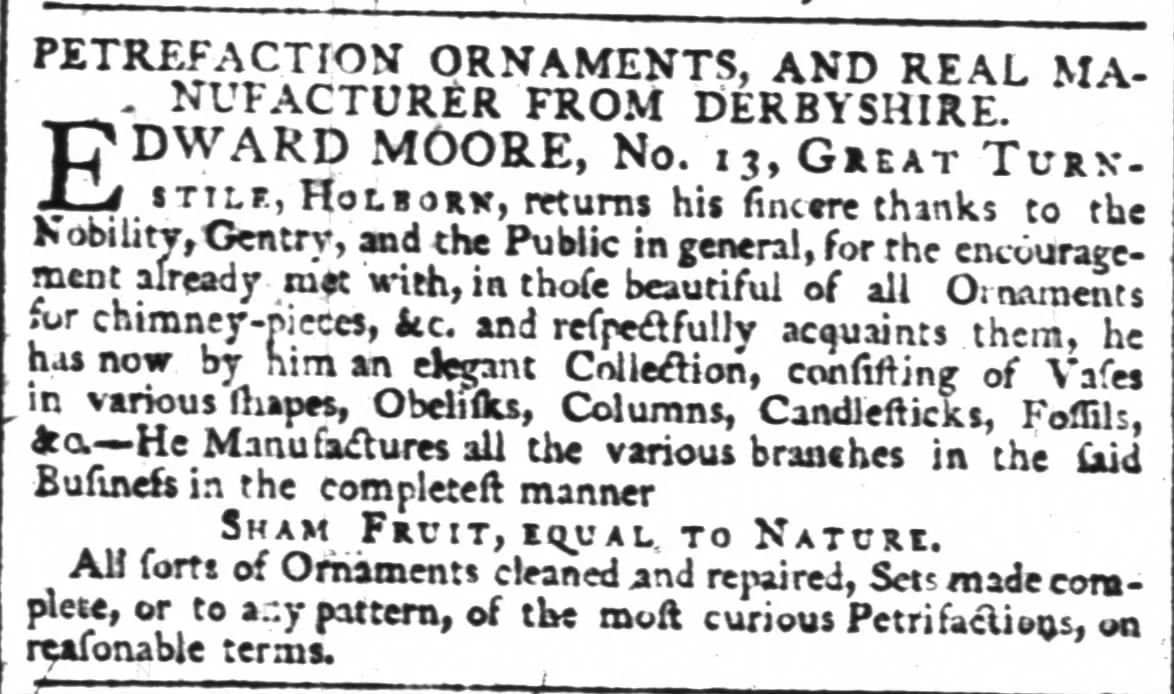
Advertising Antiquity:
Selling neoclassical décor
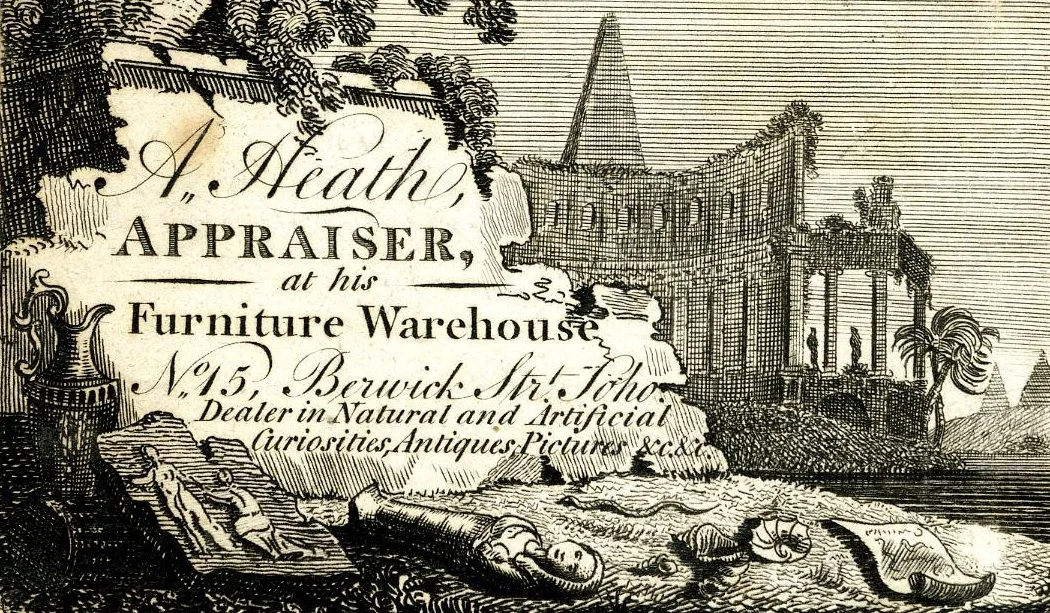
© The Trustees of the British Museum. Shared under a Creative Commons Attribution-NonCommercial-ShareAlike 4.0 International (CC BY-NC-SA 4.0) licence.
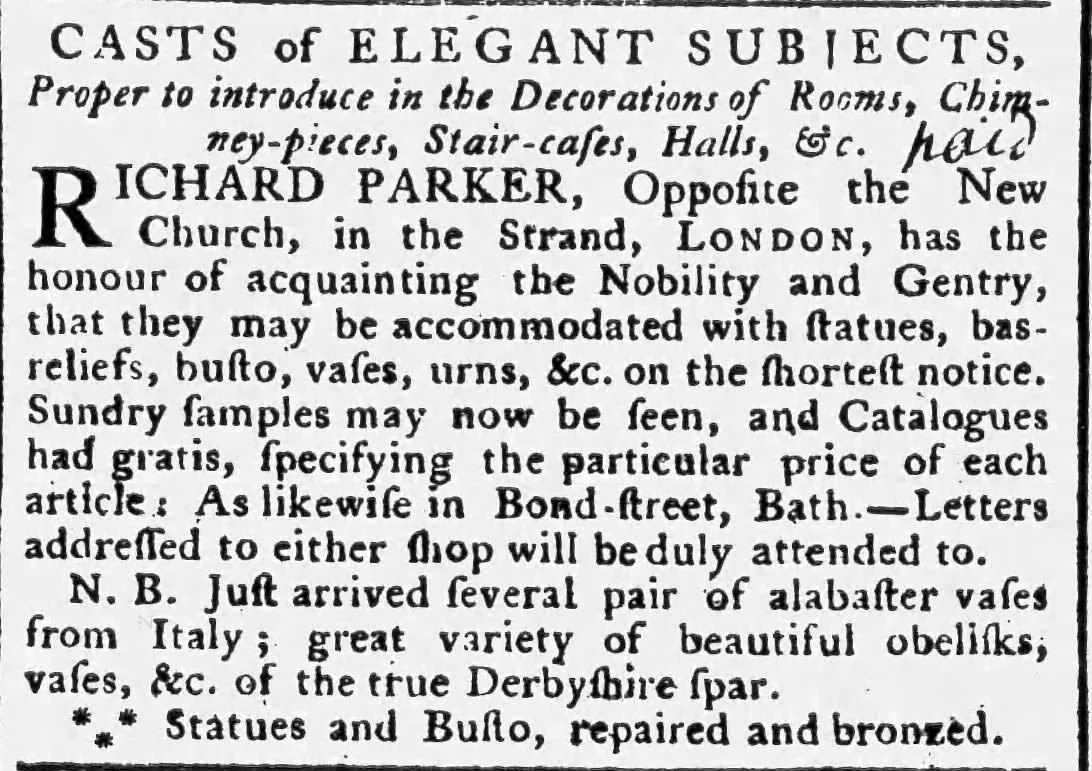
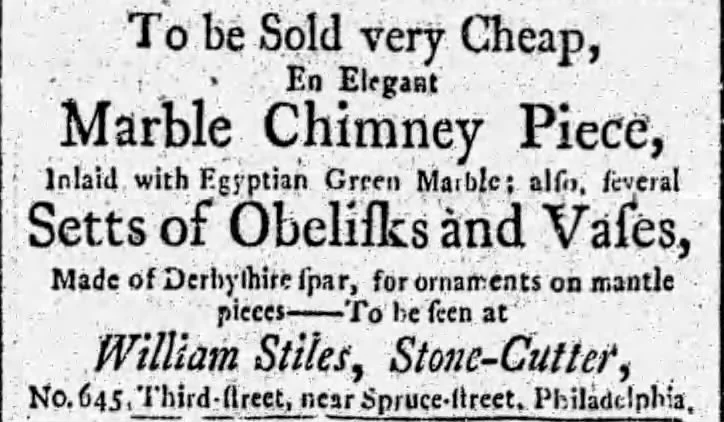
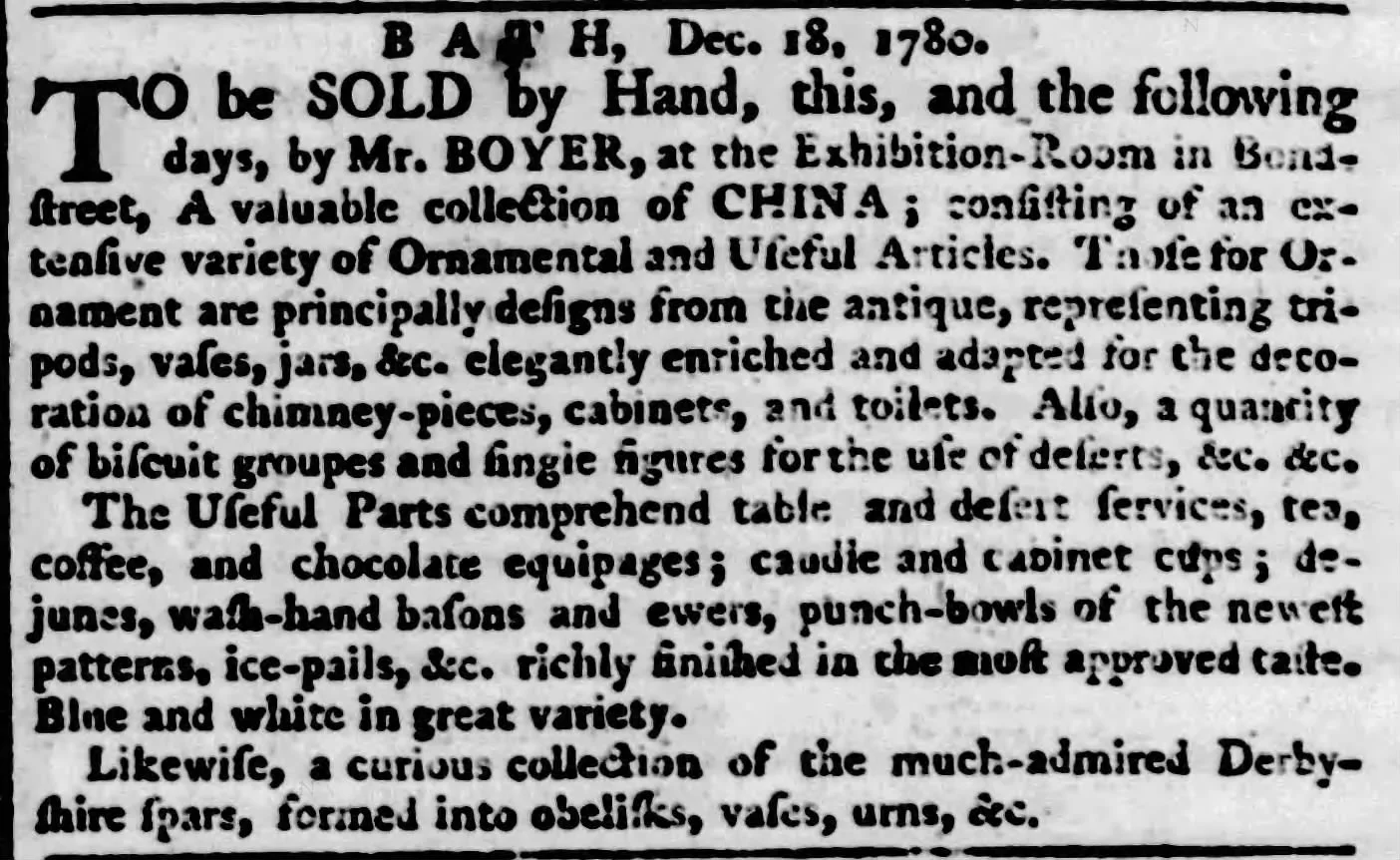
These is the best Ornaments I coud possibly make for the Chimney Piece
The manner of placing them on the Chimney piece shd be thus:
A Groupe of Flora — Vase — Æneas — Vase — Groupe of Bacchus
In 1759, George Washington sent a letter to Robert Cary & Company ordering (among many other things):
8 Busts, according to the Inclosd directin and Measure …
Directions for the Busts
4—one of Alexr the Great—another of Julius Cæsar—anr of Chs 12 Sweeden & a 4th of the King Prussia.
N.B.—these are not to exceed 15 Inchs in hight nor 10 in width for brokn Pedimt.
2 other Busts of Prince Eugene & the Duke Of Marlborh—somewht smallr.
2 Wild Beasts—not to exceed 12 Inch in highth nor 18 in length.
Sundry Small Ornaments for Chim[ne]y piece.
The following year, his order arrived. The busts he requested were not available; instead, he received:
A Groupe of Æneas carrying his Father out of Troy with 4 Statues viz.—his Father Anchises, his wife Creusa, himself and his Son Ascanius, neatly finisht and bronzd with Copper £3. 3.
Two Groupes, with two Statues each of Bacchus & Flora, finisht Neat, & bronzd wt. Copper £2. 2. each £4. 4.
Two Ornamented Vases with Faces & Festoons of Grapes & Vine Leaves &ca finishd Neat & bronzd w. Coppr £2. 2.
The above for the Chimney Piece
Two Lyons after the Antique Lyon’s in Italy finisht Neat & bronzd with Copper £1. 5. each £2. 10 …
These is the best Ornaments I coud possibly make for the Chimney Piece—And of all the wild Beasts as coud be made there is none thought better than the Lyons—
The manner of placing them on the Chimney piece shd be thus
A Groupe of Flora — Vase — Æneas — Vase — Groupe of Bacchus
There is no Busts of Alexander the Great (none at all of Charles 12th of Sweeden) Julius Cæsar, King of Prussia, Prince Eugene nor Duke of Marlborough of the Size desird; and to make Models woud be very Expensive—at least 4 Guineas each. but I can make Busts exactly to the Size wrote for (15 inches) and very good ones at the rate of 16/ Each of—Homer, Virgil, Horace, Cicero, Plato, Aristotle, Seneca, Galens, Vestall Virgin[,] Faustina[,] Chaucer, Spencer, Johnson, Shakespear, Beaumont[,] Fletcher, Milton, Prior, Pope, Congreve, Swift, Addison, Dryden, Locke, Newton
National Trust 1149421 (Mars) and 1149422 (Venus & Cupid)
William Wollaston and his family in a grand interior by William Hogarth, 1730
The bust on the mantlepiece is a portrait of William Wollaston himself, according to this article
The Montagu family and an unknown attendant by William Hogarth, c. 1730-1735
A single bust on the chimney-piece
The children’s theater in the house of John Conduitt by William Hogarth, c. 1731-1732
A key plate identifies the bust on the chimney-piece as Sir Isaac Newton, who was Conduitt’s wife’s half-uncle and Conduitt’s predecessor as Master of the Mint
Seven plaster busts and urns in the Hall at Lydiard House, c. 1743; see Art UK
Marriage A-la-Mode: The Tête à Tête by William Hogarth, c. 1743
“The unmistakable message of the whole scene is that the Squanderfields have bad taste – the battered antique bust on the mantelpiece is placed among a collection of fashionable but bogus Chinese figures.”
The Conversation Piece points out that Arthur Devis reused the same artwork — often including a pair of busts on wall brackets and a row of vases — in several of his family portraits, “intended to indicate appropriate, decorous homes, showing widely approved and popular items and décor – presenting a ‘mean of good taste’. They thus give us an invaluable insight into contemporary standards, into the ideas and ideals in the minds of such consumers when they were thinking about which goods to buy, and when they were looking at (and judging) the homes of their neighbors.”
This group of portraits includes Mr. and Mrs. Richard Bull (1747) and a later portrait of Mr. and Mrs. Richard Bull and family. A smaller bust appears on top of a bookcase in a portrait of John Thomlinson and his family (1745).
National Trust 515054, a bronze reduction of an antique statue of a faun with a goat, excavated at Hadrian’s Villa in 1736; this bronze produced by Giacomo or Giovanni Zoffoli c. 1760-1780
A Conversation (The Artist's Brothers Peter and James Romney) by George Romney, 1766
“James … points to a classical bust to assert the primacy of artistic precedent.” A bust (perhaps of Homer) and a statuette (resembling a putto) appear on the mantel.
Sir Lawrence Dundas and his grandson by Johann Zoffany, c. 1775
A group of seven bronze statuettes are arranged across the chimney-piece. Craske notes: “Zoffany was careful to produce a precise representation of a particular chimneypiece that had an established significance to his patron … Zoffany’s care to make this painting a faithful witness of Dundas’s taste, as well as the terms of his dynastic succession, was also displayed in the care taken to adorn the mantel with an assortment of bronzes that Dundas is known to have possessed.”
The Historians, 1777
The chimney-piece features a bust of “Alfred Rex” in classical style
Conversation piece, attributed to Benjamin Wilson
A classical statuette is at the center of the chimney-piece; the objects at the sides appear to be hieracosphinx candleholders
The fashionable shoe-maker trying on an Italian slipper, 1784
An urn at the center of the mantelpiece, probably with smaller obelisks in the same material on the sides
A l'Anglaise or the English Fireside, 1787
An urn at the center of the mantelpiece with larger obelisks displayed on the sides
The family of Mégret de Sérilly by Jacques Thouron, 1787
A contemporary portrait bust on the mantelpiece
Bandelures, 1791
The visible part of the mantlepiece has a bust of “CLAUDIUS ROM : IMP” and a small statue of an infant Bacchus astride a winebarrel
National Trust 871621, a garniture of bronzes by Giacomo & Giovanni Zoffoli at Saltram Park, Devon, with bronze reductions “consisting of a central equestrian figure of Marcus Aurelius (signed 'G. Zoffoli F. Rome 1793'), two seated figures of Agrippina and Menander, the Capitoline Flora and the Farnese Flora, and the Borghese and Medici Vases,” acquired by Lord Boringdon in Rome in 1793
Diligence and Dissipation: The Modest Girl rejects the Illicit Addresses of her Master, 1797
The statues on the mantelpiece are related to the action in the foreground, a way for the artist to provide additional commentary on the action through symbolism
A gentleman’s art gallery by Thomas Rowlandson
A group of seven statuettes of similar size are arranged across the chimney-piece.
Thomas Jefferson collected busts and displayed them at Monticello — “the memorials of those worthies whose remembrance I feel a pride & comfort in consecrating there,” as he described in an 1805 letter. While they reflected the Enlightenment taste for neoclassicism, most were of notable men of the 18th and 19th centuries — many by Jean-Antoine Houdon, who Jefferson deemed to be “without rivalship the first statuary of this age” in a 1785 letter to the Virginia delegates in Congress regarding a statue of George Washington.
Jefferson’s collection included a set of “American worthies,” in terra-cotta patinated plaster, displayed on wall brackets in the Tea Room at Monticello: George Washington, John Paul Jones, Benjamin Franklin, and the Marquis de Lafayette.