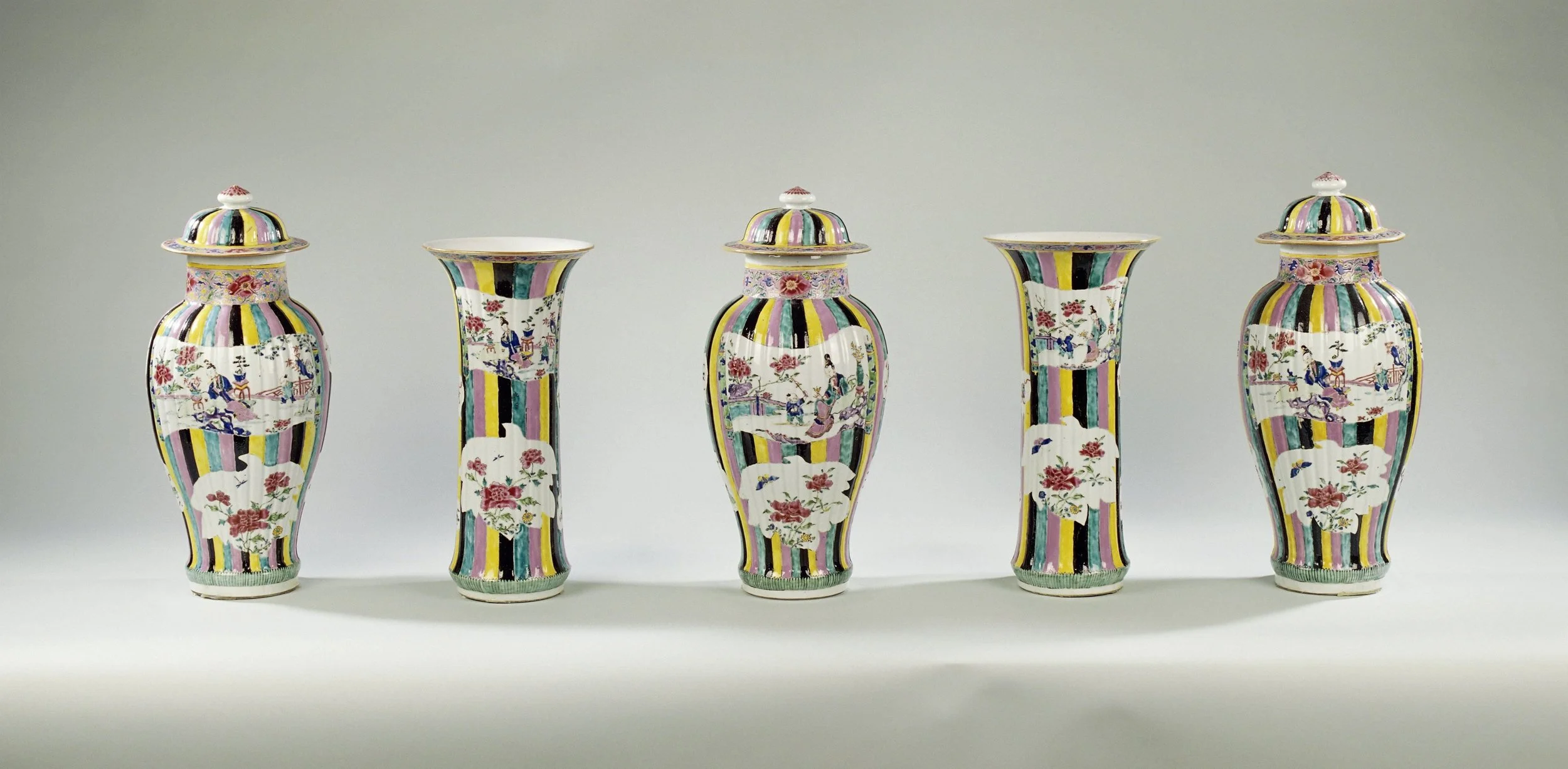
Garnitures in the 18th Century
Garnitures are symmetrical arrangements of vessels, usually a combination of vases and urns, often on the mantelpiece or on top of a cabinet. This modern term comes from a French word meaning an embellishment. The English referred to these vessels as “jars” and “beakers” — the jars being generally baluster-shaped (and often lidded), while the beakers tend to be columnar or trumpet-shaped. (The Dutch term for a garniture is kaststel, deriving from the word kast, the sort of high cupboard on which these might be displayed in a home.)
This sort of display sometimes incorporated ornaments such as candelabra, clocks, busts, obelisks, and Chinese nodders & figurines. Many of the earlier 17th century Dutch garnitures were assembled from Chinese imported ceramics, but in the 18th century, different styles of vases and urns for this sort of display were produced in Europe that coordinated with contemporary tastes and styles for interior decorating, including delftware, rococo floral Sèvres porcelain, neoclassical designs in jasperware or alabaster, as well as chinoiserie-inspired designs.
An exhaustive list of all extant garnitures would be far too lengthy. I’ve included several here to get started, but I’m more interested in looking at images showing how they were displayed in 18th century interiors. (Chimney-pieces in working-class interiors are more likely to display an assortment of household objects, such as chambersticks, cooking equipment, irons, etc.)
Additional Resources
This site contains affiliate links for which I may be compensated
Vase madness: the craze for garnitures
Garnitures: Discovering the Joy of Sets!
The History of Garnitures and its Influence on Interior Design
Garnitures: Vase Sets From National Trust Houses
Eighteenth-Century Ceramics: Products for a Civilised Society
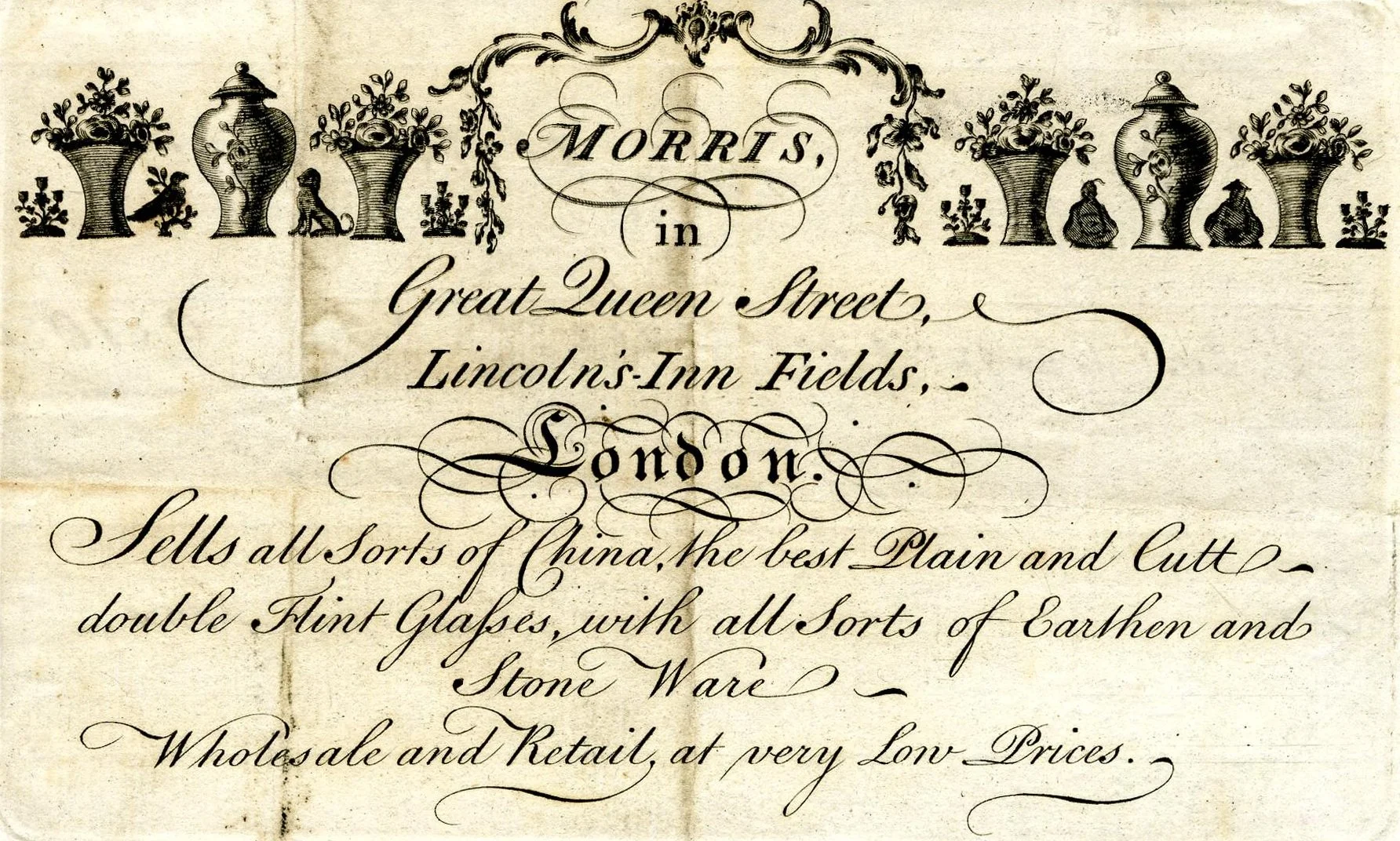
© The Trustees of the British Museum. Shared under a Creative Commons Attribution-NonCommercial-ShareAlike 4.0 International (CC BY-NC-SA 4.0) licence.
The ornaments at the top of John Morris’s c. 1760 trade card include the sort of alternating pattern of trumpet-shaped beaker vases and baluster-shaped covered urns typical in surviving 18th century garniture sets.
The other ornaments resemble items that could have been displayed on a tastefully decorated chimney-piece in the 18th century — small floral displays or candelabras, sculptures of a bird and a lion (which reminds me of the "Two Lyons after the Antique Lyon’s in Italy” that George Washington received in 1760), and a pair of Chinese figures not unlike the joss in the center of the garniture in the Bull family portraits below.
Garnitures displayed in 18th century artwork and illustrations
Chimney-piece decorated with numerous vases and vessels, in Nouvelles cheminée faittes en plusieurs endroits de la Hollande et autres Provinces, c. 1686-1703
Chimney-piece with Chinese vases of various shapes and sizes, in Nouveaux lieure de cheminées à la Hollandoise, c. 1690-1712
Design for chimney-piece, with clock and Chinese vases on the mantel shelf, in Nouvelle cheminées à Panneaux de glace à la manière de France, c. 1690-1712
Mr. and Mrs. Atherton by Arthur Devis, c. 1743
Mr. and Mrs. Richard Bull by Arthur Devis, 1747
Mr. and Mrs. Richard Bull and family by Arthur Devis
Lady Juliana Penn by Arthur Devis, 1752
John Orde, his wife Anne, his eldest son William, and an unnamed servant by Arthur Devis, c. 1754-1756
Lucy Watson, Mrs Thornton by Arthur Devis, 1755
Family group by a follower of Arthur Devis, 1756
Interior with figures at an open hearth, 1765
Sr Archie & Sr Callighan, in Love a la Mode, c. 1770-1800
Four o’Clock in Town, 1790
The Baron de Besenval in his Salon by Henri-Pierre Danloux, c. 1791
The Chinese celadon vases (c. 1720-1750), with French ormolu decoration (c. 1760), are the subject of a “selling exhibition” at Christie’s, Les Passions du Baron de Besenval - A Salon Reimagined
John Holt, 1800
The Second Drawing Room, Buckingham House by James Stephanoff, 1818
Domestic interior by Michiel Versteeg
A room in a Florentine palace, 1824
A garniture on display at the Peyton Randolph house (not original to the house, but possibly referenced in his 1775 estate inventory)
Extant garnitures from the 18th century
(As mentioned above — there are a lot of 18th century garnitures in museum collections and private collections. This isn’t an exhaustive list, but they provide details to consider in terms of shapes, materials, and decorations.)
Rijksmuseum AK-RBK-16290, a five-piece Chinese porcelain garniture with women and flowers in panels, c. 1680-1720
Rijksmuseum BK-NM-11467, a five-piece Delftware garniture of ribbed octagonal form, c. 1695-1715
National Trust 1181037.1 / 1181037.2 / 1181037.3 / 1181037.4 / 1181037.5, a five-piece Imari garniture with three lidded baluster vases and two trumpet-shaped beaker vases, made in Japan in the 18th century
Rijkmuseum AK-RBK-16284, a five-piece garniture with landscapes in panels, Chinese porcelain made c. 1700
National Trust 1145564.1 / 1145564.2 / 1145564.3 / 1145564.4 , four pieces of a Delftware garniture made by the Metal Pot factory decorated in an oriental pattern with chrysanthemums called “Cashmire,” c. 1700-1710
National Trust 1205593.1 / 1205593.2 / 1205593.3 / 1205593.4 / 1205593.5 / 1205593.6 / 1205593.7 / 1205593.8, a garniture of eight maiolica albarelli, c. 1700-1730
Seattle Art Museum 54.81.1 / 54.81.2 / 54.81.3 / 54.81.4 / 54.81.5, a garniture of five Delftware vases made by the Metal Pot Factory c. 1710; “the concept for these impressive vases was inspired by Chinese Ming altar vases collected by the Dutch. They are an exotic blend of forms and decoration-their shapes come from Chinese vases and jars, but the overall dense textural patterns evoke another Asian decorative style and rare commodity: the famous shawls of Kashmir”
Rijksmuseum AK-RBK-15921, five-piece garniture with figures, flower sprays and auspicious symbols, Chinese porcelain made c. 1725-1740
Walters 49.2111 / 49.2112 / 49.2113 / 49.2241 / 49.275, a mid-18th century garniture of trumpet-shaped vases and lidded baluster-shaped vases made of Chinese porcelain with famille rose enamels, mid-18th century
British Museum Franks 820 / 820.1 / 820.2 / 820.3 / 820.4, a set of oviform lidded jars and trumpet vases with English heraldry in the famille rose palette, made in Jingdezhen c. 1750-1770
National Trust 592454.1 / 592454.2, a pair of vases from a five-piece garniture in Chinese porcelain, painted in grisaille (fine black), iron red enamel and gold with reserved panels of roosters and gold fish, c. 1750-1770
Met 64.142.32–.34, three soft-paste porcelain vases with polychrome enamel decorations, made in Worcester c. 1751-1753
National Trust 730504 / 730587, a pair of trumpet beaker vases and a pair of lidded baluster jars in Delftware with chinoiserie decorations featuring women in landscapes with trellises, c. 1761-1772
Huntington 27.27 / 27.28 / 27.29, pear-shaped lidded vases produced at the Sèvres Porcelain Manufactory c. 1762 with pastoral scenes; “The neck and lid are pierced to allow the scent of potpourri to escape from the vase.”
MFAH B.59.115.1-.5, five-piece delftware garniture set with two vases and three lidded urns, c. 1765-1775
Mount Vernon W-972/A / W-972/B / W-2260, made by the Worcester Porcelain Manufactory c. 1768-1770; “In 1785, [English merchant Samuel Vaughan] shipped a costly Italian marble mantelpiece from his own country estate in England to be installed in Mount Vernon's New Room. One year later, these striking, baluster-shaped garniture vases arrived. Their opulent dark blue grounds - a color perfected at Worcester in the late 1760s - marvelously frame the exotic landscapes with animals contained in the reserves.” Washington’s letter to Vaughan thanks him for his generosity: “The picture of a battle in Germany, & the Jarrs came very safe. The first is fine: the latter is also fine and exceedingly handsome—they shall occupy the place you have named for them.“ Martha Washington’s will bequeathed “the fine old china jars which usually stand on the chimney piece in the new room” to her grandson George Washington Parke Custis.
Met 64.101.788a, b / 64.101.788a, b / 64.101.787a, b, vases with figures in landscapes made in Worcester c. 1770
National Trust 1205654.1 / 1205654.2, part of a garniture of three Delftware lidded vases with a landscape with a man standing in front of a river in a landscape, c. 1770-1800
Versailles V2012.22.1-3, 58.75.72, 58.75.73, a set of Sèvres porcelain vases, 1772
National Trust 959583, “a garniture of three Qianlong famille rose two-handled rectangular section baluster vases, each with domed cover, seated Buddhistic lion finial, gilt and iron red pierced scrolling handles, the panelled sides in colours with sprays of flowers among precious utensils on white pounced fields,” c. 1775-1780
Mount Vernon W-4349, part of a set of five Chinese porcelain vases c. 1775-1800; “All five vases (three baluster-shaped and two trumpet-shaped) feature a popular river landscape design known as Two Birds … It is not known when the Washingtons acquired this garniture, nor can it be proven if it is the ‘5 China Jarrs’ in the ‘Front [West] Parlor’ or the ‘5 blue & White Jars’ in the ‘Sweet Meat Closset’ listed in Mrs. Washington's inventory.”
Mount Vernon M-4294 / M-4295 / M-4296, two trumpet-shaped vases and a baluster-shaped lidded vase in Chinese porcelain, c. 1775-1814
Huntington 27.34 / 27.35 / 27.36, jewelled enamel lidded vases produced at the Sèvres Porcelain Manufactory in 1781 with landscapes and scenes adapted from paintings, the set thought to have been owned by Queen Marie-Antoinette
Getty 84.DE.718 / Walters 48.566 & 48.567, 1781; “Beginning in 1778, the Sèvres Porcelain Manufactory produced garnitures of five vases to a design called the vases des âges (vases of the ages). These ornamental vases were made in three sizes: a large central vase with handles in the shape of bearded male heads, a pair of smaller vases with heads of young women, and a pair of still smaller vases with heads of boys. In 1781 Louis XVI bought one of these garnitures for his library at the palace of Versailles. The scenes painted on the fronts of these vases show episodes from The Adventures of Telemachus, one of the king's favorite books … These vases are among the largest pieces of jeweled porcelain made at Sèvres. Jeweling was an elaborate form of decoration in which the ground color was covered with stamped gold foils. Small drops of colored enamel were then applied to the foils, imitating jewels, pearls, and moss agates. This type of ornament was extremely fragile and was therefore used only on objects created for display rather than for use.”
National Trust 1449299.1 / 1449299.2 / 1449299.3, a three-piece classical garniture in marble, alabaster, and Derbyshire feldspar, 1790
Mount Vernon W-2101/A-B, a baluster-shaped lidded vase with a castle in a landscape in Chinese porcelain, probably part of a three-piece or five-piece garniture, made c. 1790-1800