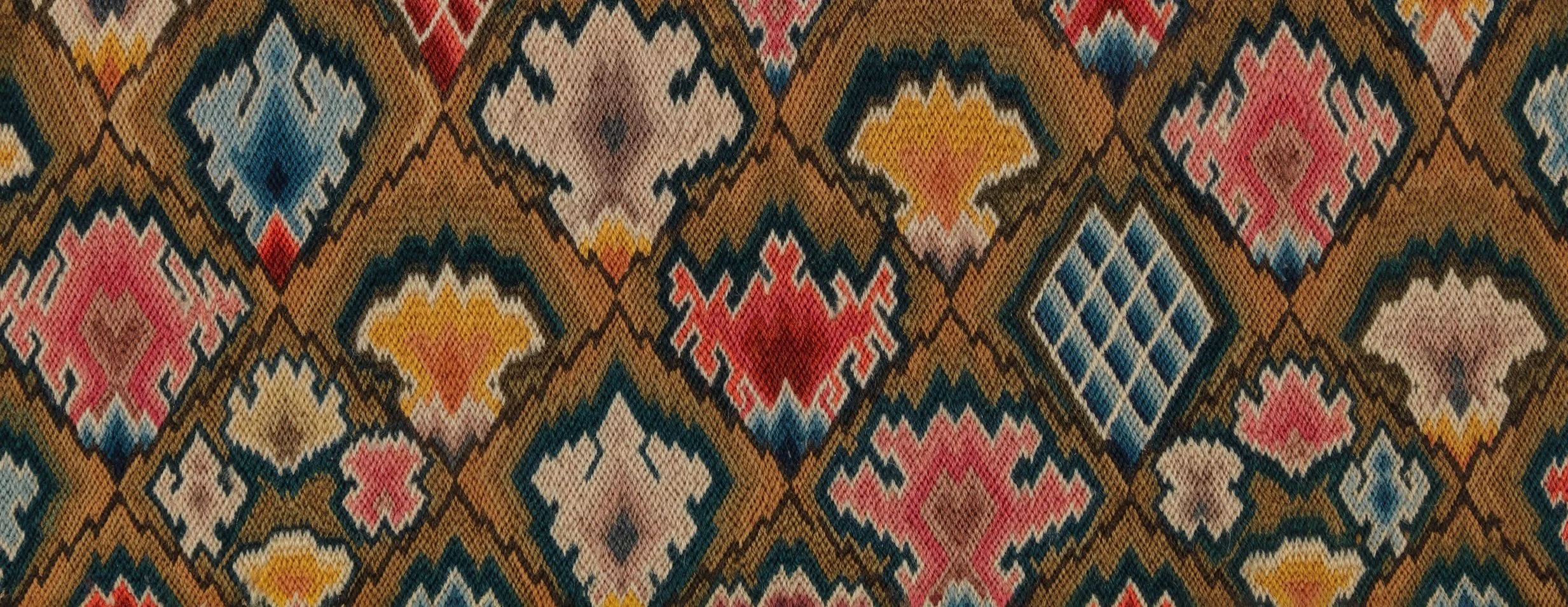
18th Century Iriſh Stitch
This style of embroidery presently goes by several names, including bargello, flame stitch, Florentine stitch, Hungarian stitch, and Irish stitch — which appears to be a common name in English for the style.
Elizabeth Sandwith Drinker’s journal describes several embroideries made in Irish stitch, including her 1759 bible. Additional examples:
“Abraham Price, makes, and ſells the true ſorts of Figur’d Paper Hangings Wholeſale and Retale, in Pieces of Twelve Yards long, In Imitation of Iriſh Stitch …” — from a trade card c. 1720 with an illustration of wallpaper imitating this sort of pattern
“And I give to my Daughter J.D. my Iriſh-ſtitch Chair and Stool that I worked, and my two fine long Cuſhions work'd and caſed, and my square one of Iriſh-stitch …” — Excellent Precedent of a Will in Sir Orl. Bridgman's Conveyances, 1725
“And as his Wife has lately opened School, this gives Notice to thoſe who may be willing to favour her with the Education of their Children, that they may be aſſured ſhe will uſe her beſt Endeavours to inſtruct them; ſhe alſo teaches Iriſh-ſtitch and Lace-work …” — The South-Carolina Gazette, July 13, 1747
“TAKEN out of the houſe of John Franks, tobacconiſt, in Second-ſtreet, Philadelphia, on Saturday the 18th of December, an Iriſh ſtitch pocket-book …” — The Pennsylvania Gazette, December 30, 1756
“Ruth Jones Hereby informs the Publish, that She intends to open a SCHOOL the 20th of March inſuing, in Pitt Street, where ſhe will endeavor to Teach young MISSES all the various Arts and Branches of NEEDLEWORK, namely, Needle Lace Work, Needle Work on Lawn, Flowering with Cruel, working Pocket Book with Iriſh Stitch, drawing and working of Twilights, making of Letters, and plain Sewing, &c.” — New-Hampshire Gazette, March 9, 1770
Embroideries worked in this style exist from the 16th and 17th centuries, and the style underwent a renaissance in the 1970s (and, thanks to embroiderers like Paul Bailie, may be undergoing a new revival).
This page focuses on 18th century flamestitch embroideries, and is organized by the type of embroidered item. Irish stitch patterns vary considerably — such as zig-zags, ogees, and carnations — and sometimes combinations of multiple styles on the same piece. In general, the stitches are all in one direction, and often (though not always) have a sort of ombré effect that suggests blending and depth.
I find that this style of embroidery results in a fairly dense, thick textile with a weight resembling an upholstery fabric. It’s excellent for applications requiring a hard-wearing textile, but not so good for applications requiring a lightweight or translucent decoration.
Additional Resources
Streets of Salem: Flame-Stitch
Embroiderers’ Guild of America: Bargello
Reproduction patterns available from The Scarlet Letter and Penny River
Book covers
Winterthur 1963.0067, Cumberland, New Jersey, c. 1710-1750
Elizabeth Sandwith’s Bible, 1759 (also here & here)
Concord Museum B801A, Pennsylvania (?), 1796
Handscreens
V&A T.93-1934 and T.94-1934, England, 1718
Colonial Williamsburg 1954-4, possibly America, c. 1750-1790
MFA 41.778, New England, second half of the 18th century
Winterthur 1958.1526, America, c. 1750-1800
Old Sturbridge Village 26.11.2, Boston
Concord Museum T816, probably after 1779
Housewifes
Chester County History Center 1994.1753, 1785
Pin-case and pocketbook made by Hannah Darlington, 1785
Old Sturbridge Village 26.85.19, possibly the outside of a needle case, Sunderland, Massachusetts, late 18th century
Pincushions
Chester County History Center 1988.7.44, c. 1760-1800
Huldah Robinson’s pincushion, Massachusetts, possibly c. 1764-1812
Colonial Williamsburg 1952-326, Great Britain, c. 1770-1780
Winterthur 1976.0178, Pennsylvania, c. 1780-1790
Winterthur 2005.0024.001 A, Pennsylvania, c. 1785-1810
Monmouth County Historical Association 1998.561, c. 1780-1810
Pockets
Philadelphia Museum of Art 1930-30-36, pocket with Irish stitch in wool and silk, America, mid-18th century
Chester County History Center 1993.766, a pair of women’s flamestitch pockets, c. 1760-1780, in Fitting & Proper; “fronts worked in multicolor flamestitch in a geometric pattern on off-white linen with an off-white linen linning and backing, bound in green wool tape”
Ivo Collection 1037, English flamestitched pockets with the initials ‘BL’ and dated 1766
Huntington L2015.41.64, a pair of pockets probably made in America c. 1760-1790
Pocketbooks
There’s a large group of flamestitched pocketbooks elsewhere on this website.
Samplers with flamestitched sections
V&A 145-1907 (Martha Wheeler 1710), England
Smith College 1968.30.220 (Marie Hamond 1713)
Winterthur 1975.0040 A (Jane Simons 1727)
Colonial Williamsburg 1987-716,1 (Mary Johnson 1742), Virginia
Winterthur 1958.1759 (1772), America; the bottom may be a marking sampler
V&A T.24-1940 (Jane Rollstone Alleyne 1777), England
Colonial Williamsburg 2014-7 (Henrietta Stevens 1788), Maryland
Mary Davis, late 18th century
Shoes
Met 2009.300.1483a, b, Europe, early 18th century
Met 2009.300.1411a, b, Britain, c. 1700-1729
V&A T.100&A-1929, Britain, 1730s-1740s
V&A T.64&A-1935, Britain, 1730s-1740s
Met 2009.300.1407a, b, Britain, c. 1750-1769
Met C.I.50.8.24a, b, France, 1780s
Wall Pockets
Bonhams Skinner Aug 11, 2019, probably Dutchess County, New York, c. 1756
Winterthur 1958.1525, America, 1766
Bonhams Skinner Aug 14-15, 2016, Lot 12, America, 1774
Upholstery & household decor
Boxes & chests
Historic Deerfield 2021.1, a box, England, c. 1700-1730
Firescreens & polescreens
Eron Johnson Antiques D3530, mid-18th century
Winterthur 1958.1506, Massachusetts, c. 1760-1780
Colonial Williamsburg 1961-43, America, c. 1770
Skinner 14 November 2023, Lot 11, late 18th century
Winterthur 1963.1013 A, B, Salem, Massachusetts, c. 1775-1810
Brunk Auctions Sep 16, 2023, Lot 1063, Salem, Massachusetts
Seating: Armchairs
Christies 14 Jul 2023, Lot 21927, an open armchair, late 17th or early 18th century
National Trust 170953, a wingback armchair, c. 1702-1714
New Hampshire History Network 1957.065.03.24, an easy chair, Portsmouth, New Hampshire, c. 1725-1740
Winterthur 1958.1505, an easy chair, Boston, c. 1750-1775
MFAH B.60.89, an easy chair, Massachusetts, c. 1750-1800
Met 50.228.3, the front of an easy chair, Rhode Island, 1758
National Trust 557587, a wing-back armchair, England, c. 1760
National Trust 557586, a Gainsborough armchair, England, c. 1770
Seating: Footstools
Bonhams 24 February 2016, Lot 260, France, c. 1700-1740
National Trust 830683, c. 1730-1770
Winterthur 1986.0513, after 1740
Seating: Side chairs (including seat cushion covers, slip seats, &c.)
Art Institute of Chicago 1971.740, a cushion cover, England c. 1701-1725
V&A T.178-1925, a chair seat, England, c. 1700-1750
Old Sturbridge Village 5.45.6 & 5.45.7, side chairs, Boston, c. 1730-1790
Winterthur 1969.5499, slip seat, after 1732
Old Sturbridge Village 5.45.2, a side chair, Boston, c. 1740
Winterthur 2008.0001.001 B, a slip seat, Connecticut, 1740
Chester County History Center FCHR1 / FCHR2 / FCHR3 / FCHR4 / FCHR5 / FCHR6 / FCHR7, chairs with flamestitched slip seats, c. 1740-1760
Chester County History Center FCHR68 / FCHR69, side chairs with flamestitched slip seats, c. 1740-1760
Winterthur 1984.0658.004, slip seat for a side chair, America, c. 1740-1790
Winterthur 1969.1065.001 & 1969.1065.002, chair seat covers, America, c. 1740-1800
Winterthur 1984.0663.001, slip seat for a side chair, Philadelphia, c. 1750-1760
Old Sturbridge Village 5.46.4a, a set of six side chairs, Woodstock, Connecticut, c. 1750-1775
Winterthur 1969.2189, a camp chair, Massachusetts, c. 1760-1780
Met 2015.92, a chair seat cover, New Hampshire, c. 1770
New Hampshire History Network 1972.051, a side chair, Exeter, New Hampshire, c. 1770-1790
Old Sturbridge Village 5.46.12, a side chair, Worcester, Massachusetts, c. 1780-1800
Winterthur 2008.0001.002 B, a slip seat, Connecticut, c. 1790-1800
Seating: Sofas, settles, & settees
Bonhams 31 January 2019, Lot 97, c. 1695
Leland Little Jan 2, 2021, Lot 0487
National Trust 446444, c. 1760
Table covers
Meg Andrews 9304, England, early 18th century
Winterthur 1966.0074 A, New York, 1759
Antiques Road Show: 1761 Flame-stitched Tablecloth
Wall hangings
Christies 10 May 2006, Lot 7306, late 17th or early 18th century
National Trust 557836, Belgium, c. 1670-1725
Meg Andrews 9296, England, early 18th century