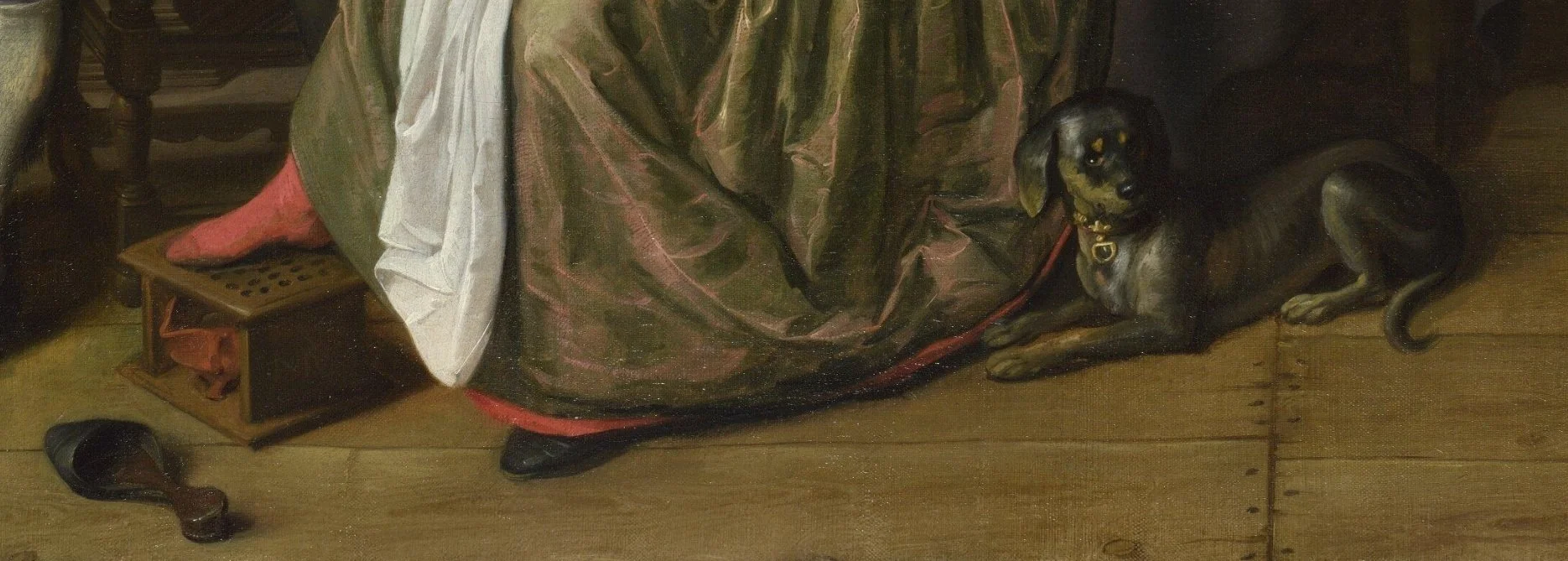
Detail from A young man and woman making music by Jan Miense Molenaer, c. 1630-1632. Shared under an Attribution-NonCommercial-NoDerivatives 4.0 International license
18th Century Foot Warmers & Foot Stoves
In A Catalogue and Description of the Etchings of Rembrandt Van-Rhyn (1752), the authors describe the use of foot warmers by Dutch women, both in Rembrandt’s time and in 18th century, in their commentary on a picture of an old woman:
She ſits on a carved Seat, and her right Foot is on a Foot-Stove, to which the Dutch Women are ſo accuſtomed, that even in Summer they uſe them without Fire, merely becauſe having been uſed to have their Feet raiſed ſo much higher than the Ground, they find themſelves uneaſy without them; and when a female Viſitant is receiv’d, it is as much the Cuſtom to ſet a Stove for her as a Chair; even at Church, during the Winter, Perſons let out theſe Stoves for the Uſe of the Ladies.
While foot warmers appear in many Dutch interior scenes, they were also manufactured and used elsewhere in Europe and in the American colonies. The extant examples linked below include many that were manufactured and/or used in America.
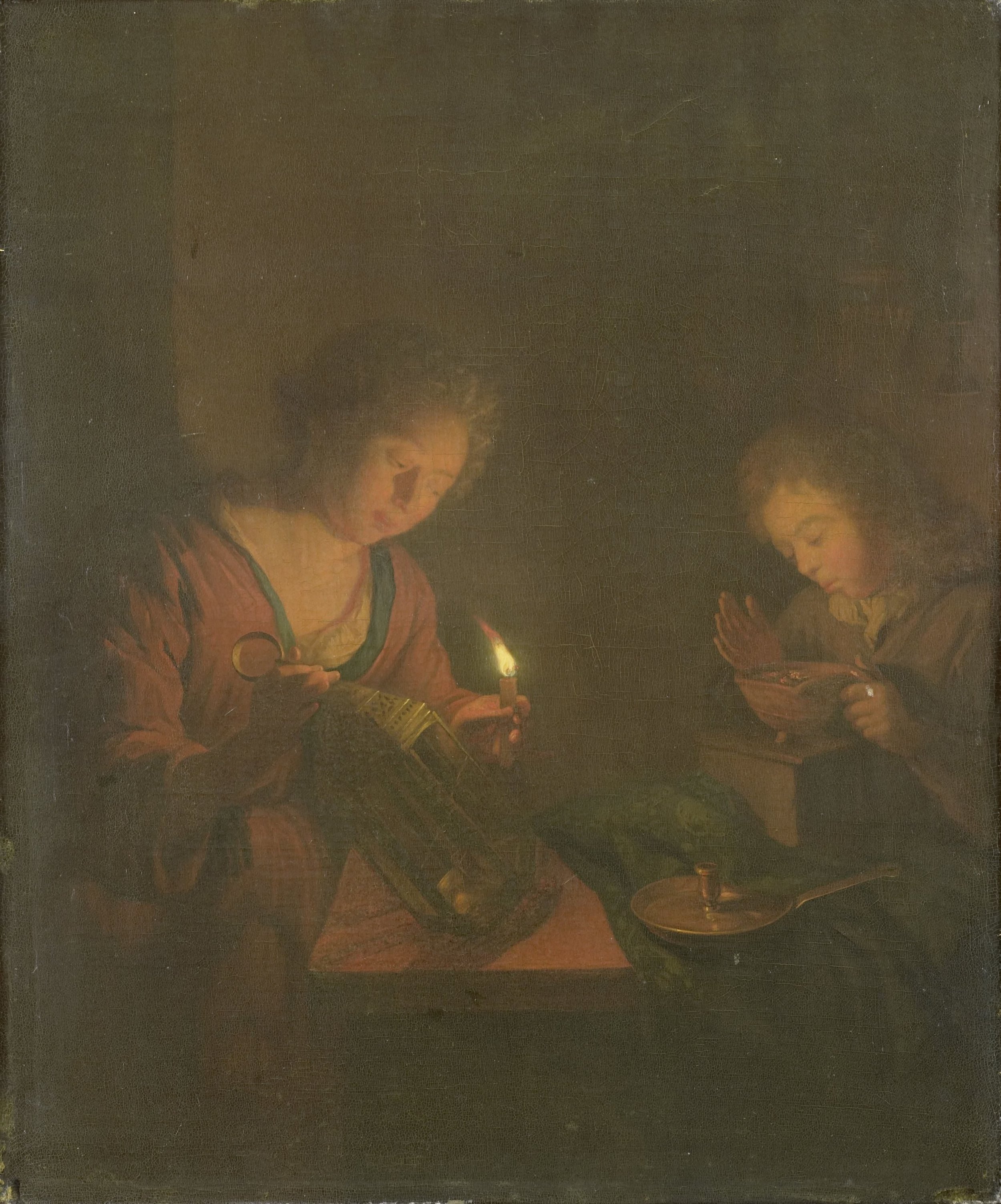
Detail from Godfried Schalcken’s c. 1690-1706 painting of a boy and a girl. The girl lights a lantern, while the boy blows on coals in a redware pan that will keep foot stove warm.
In his Essay on the causes, early signs and prevention of pulmonary consumption (1799), Dr. Thomas Beddoes notes:
It would be dangerous ſuddenly to lower the temperature to which the feeble or delicate have been long habituated. But ſixty degrees of Fahrenheit’s thermometer ſhould perhaps never, even at preſent, be exceeded. By gradual reduction we ſhould, I ſuppoſe, without unpleasant ſenſations, be well able to bear a temperature of fifty degrees. In effecting this change, attention muſt be paid to two circumſtances. A faſhion of warmer cloathing muſt be introduced, and the contrivances for keeping the feet warm muſt be adopted. An apparatus of great elegance might be invented, upon the Dutch principle: or the feet, when cold, may be placed upon a cloſe tin veſſel, containing warm water. In various kinds of indiſpoſition, attended with cold extremities, I have for ſome years recommended, with manifeſt advantage, a tin foot-warmer; and I underſtand they are now manufactured of a convenient form, by Lloyd, near Norfolk-Street, Strand, London.
Foot stoves were known to cause fires. The Leicester Journal (February 3, 1776) reported from Paris: “FIRE broke out in the Palais laſt night, occaſioned by a woman who went to ſleep with a foot ſtove under her, which catching her cloaths, ſhe was ſuffocated with the ſmoke.” The Carlisle Gazette published a short poem (January 24, 1787) “On a late FIRE, occaſioned by a Lady’s FOOT-STOVE, in St. PETER’s Church, PHILADELPHIA.”
A report of a robbery in Basseterre, Guadaloupe, published in several newspapers in February 1798: “At this inſtant Mrs. Temple (with an amiable courage peculiar to herſelf, and almoſt amounting to romantic heroiſm) opened the door, and preſented herſelf to the man who appeared to be the captain of the gang, enquired his buſineſs with her, informed him ſhe was the lady of the houſe, and requſted to be treated with delicacy. This the man promiſed, and religiouſly adhered to: he put coals into her foot ſtove, inſiſted on her taking a cordial which he prepared for her, to prevent her ſpirits from being too much depreſſed, aſſured her ſhe was ſafe under his protection, and behaved with all the sang froid imaginable.”
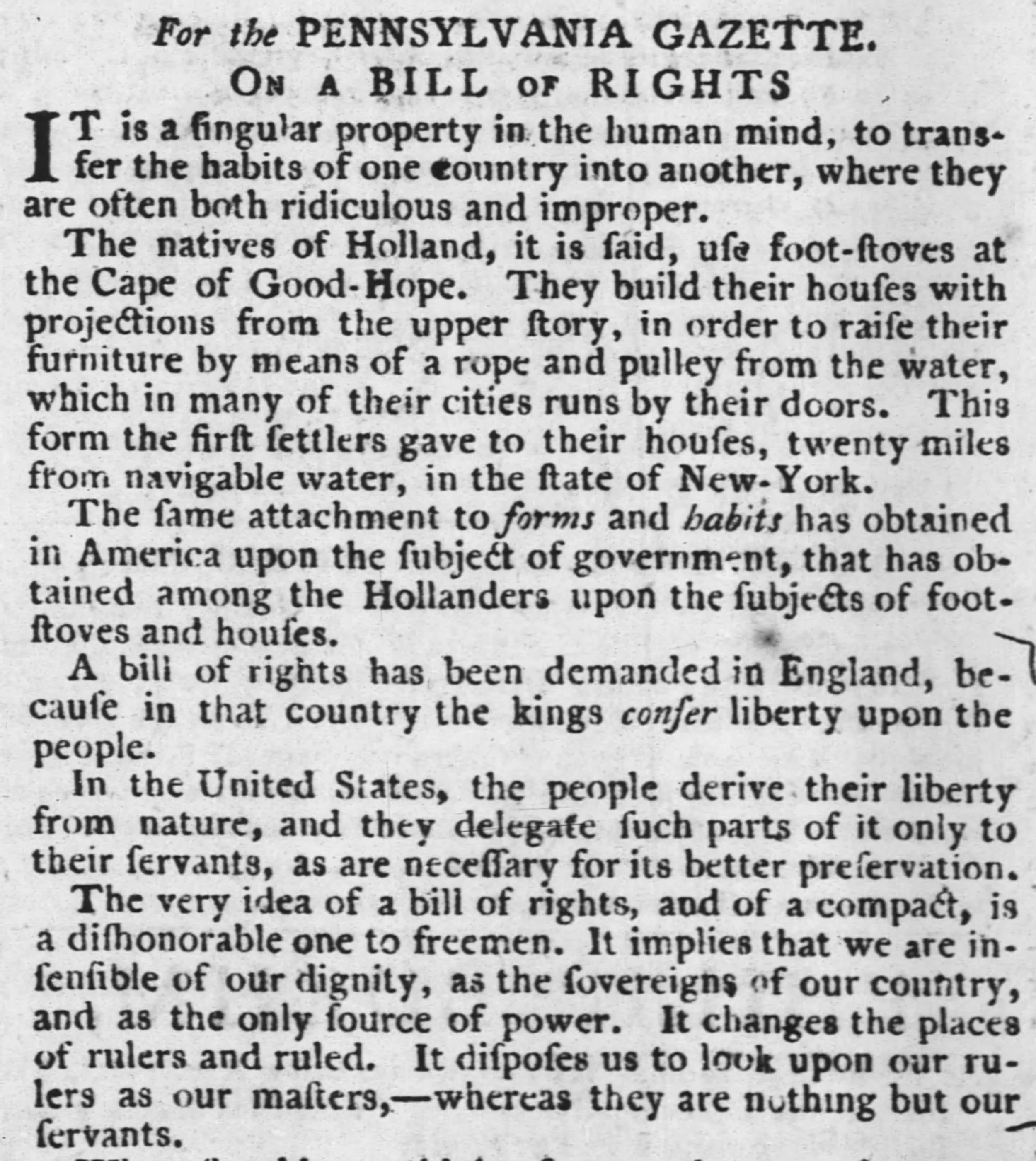
A letter published in the Pennsylvania Gazette (January 9, 1788) cited foot-warmers as an example of a foreign custom that the writer considered to be foolish when adopted in America:
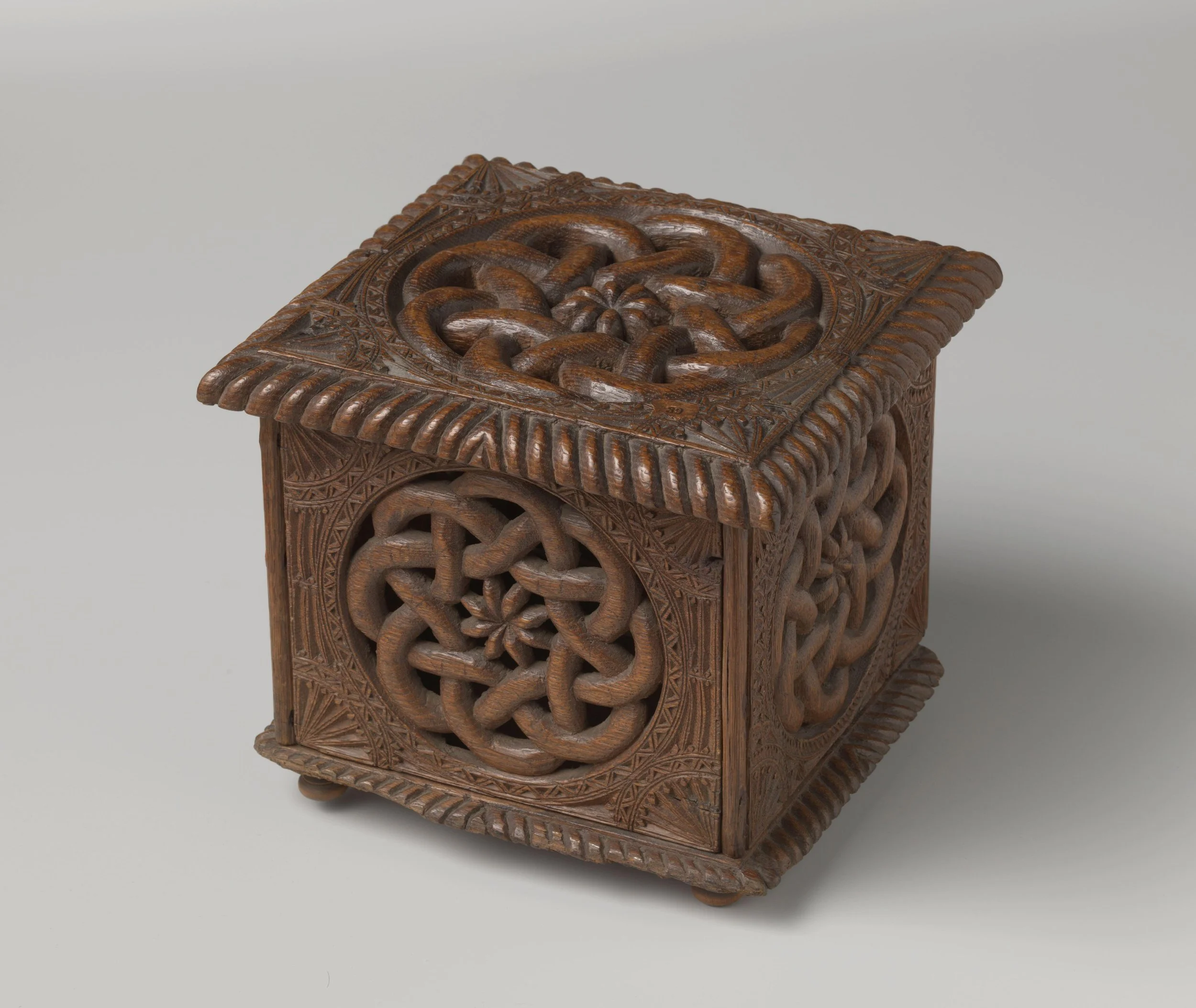
Extant 18th century foot warmers
The Rijksmuseum also has several miniature silver foot stoves from the 18th century, including BK-NM-3380 (c. 1649-1689), BK-NM-11177-164 (c. 1700), BK-NM-11177-168 (c. 1700), BK-NM-11177-163-A/BK-NM-11177-163-B (c. 1727-1742), BK-NM-11177-177 (c. 1755), BK-NM-11177-180 (c. 1755), BK-NM-11177-175 (c. 1755), BK-14913-V-A/BK-14913-V-B (1756), and BK-NM-11177-165 (1771).
You can also find antique foot warmers and foot stoves on eBay.
Philadelphia Museum of Art 1930-10-5, an oak foot warmer, Netherlands, 17th century
V&A 592-1906, a carved oak foot warmer, Netherlands, c. 1650
Albany Institute of History & Art u1975.8, a foot warmer made of sycamore, Netherlands, c. 1675; “Margarita [Douw] brought the stove with her to Albany [in New York] from the Netherlands.”
Monmouth County Historical Association 1990.523, a carved walnut foot warmer, early 18th century
Winterthur 1954.0071.006, tinned sheet iron, made in 18th century New England
Met 09.151.7, an 18th century Dutch wooden foot stove
Winterthur 1957.0100.004, tin and wood foot warmer, made in East Hampton, New York, c. 1725-1775
V&A 161-1891, octagonal brass foot warmer with repoussé decoration, Netherlands, 1733
Pocumtuck Valley Memorial Association 1923.07.02, a foot stove made of tin and wood
Sotheby’s L09769, Lot 8, a silver foot warmer, made in 18th century Venice
Rijksmuseum BK-NM-9367 and BK-NM-9368, Netherlands, c. 1750
Winterthur 1958.1714 A-C, made in Pennsylvania c. 1750-1800
Winterthur 1958.1554, c. 1750-1825
Winterthur 1975.0232, c. 1760-1830
Yale University Art Gallery 1931.302, a pewter foot warmer made in New York c. 1761-1793
V&A 1509-1903, northern Germany, 1769
Rijksmuseum BK-KOG-1430, dated 1770
18th Century Foot Warmer at the Old Stone Fort Museum
Winterthur 1958.1010 A, B, America, 1775
Pocumtuck Valley Memorial Association K.603, a foot warmer, c. 1780
Foot Warmer or Foot Stove, New England, circa 1780
National Museum of American History 24399, made in New York, late 18th century
Philadelphia Museum of Art 1930-10-3, a carved oak foot warmer, Netherlands, c. 1790
Concord Museum H0415, possibly c. 1794-1796
Concord Museum H2103, foot warmer with pan, late 18th or early 19th century
Concord Museum H2027, foot warmer, late 18th or early 19th century
Fraunces Tavern Museum 1908.05.001A, c. 1800
Depictions of foot warmers from the 17th and 18th centuries
The doctor’s visit by Quiringh van Brekelenkam
Two boys and a girl making music by Jan Miense Molenaer, 1629
A young man and woman making music by Jan Miense Molenaer, c. 1630-1632
Susanna van Collen with her daughter Anna by Rembrandt, c. 1632
Woman with a dog by Hendrik Gerritsz. Pot, c. 1635
Woman playing the virginal by Jan Miense Molenaer, c. 1637
Interior of a tailor’s shop by Quiringh van Brekelenkam, c. 1648
A woman asleep by a fire by Quiringh van Brekelenkam, c. 1648
The Milkmaid by Johannes Vermeer, c. 1660
The Idlers by Jan Steen, c. 1660
An interior with a man offering an oyster to a woman by Jan Steen, c. 1660-1665
The anemic lady by Samuel van Hoogstraten, c. 1660-1678
Saying Grace by Cornelis Pietersz. Bega, 1663
The sick woman by Jan Havicksz. Steen, c. 1663-1666
Interior with a lady choosing fish by Quiringh van Brekelenkam, 1664
The music lesson by Caspar Netscher, c. 1664-1684
An officer paying court to a young woman in an interior by Gabriel Metsu, before 1667
The Bean Feast by Jan Steen, 1668
Michiel Comans and his third wife Elisabeth van der Meersch, 1669
The chess players by Cornelis de Man, c. 1670
A girl lights a candle while a boy blows on coals by Godfried Schalcken, c. 1690-1706
Winter, tapestry designed by Lodewijk van Schoor, c. 1690-1720
Woman in an interior, c. 1700
Interior with a woman and a boy by Frans van Mieris the Younger
The Pancake Woman by Willem van Mieris, c. 1710-1719
Monkeys in an interior by Willem van Mieris, 1719
The Spinner by Willem van Mieris
Group portrait of the regentesses and headmistress of the Spin- & Nieuwe Werkhuis in Amsterdam, 1720
A woman with two children by Willem van Mieris, 1723
Interior with a mother and children by Willem van Mieris, 1728
Portrait of a woman attributed to Hendrik Pothoven
A woman shows a slice of salmon to a lady doing handwork by Elisabeth Geertruida Wassenbergh, c. 1750-1759
The doctor’s visit by Elisabeth Geertruida Wassenbergh, c. 1750-1760
The family of Jolle Jolles and Maria Elisabeth Meulenbroek by Januarius Zick, c. 1750-1774
The family of Anna Maria Vlotman by Johann Heinrich Strumph, c. 1750-1774
Jan van Dijk by Jan ten Compe, 1754
Dutch woman having breakfast by Jean-Etienne Liotard, c. 1756
Cat sitting on a foot stove by Louis Bernard Coclers
Child sitting on a foot stove by Louis Bernard Coclers
The four ages of man with the attributes of the seasons, personified by four women by Hieronymus van der Mij
Sewing workshop in Arles, 1760 by Antoine Raspal
Family portrait of Simon van der Stel, his wife Catharina Keyser, and their children Willem, Maria Jacoba, and Catharina Anthonia by Jan Maurits Quinkhard, 1765
Interior with a couple admiring prints by Jean Jacques de Boissieu, 1767
Triptych: Allegory of Art Training by Willem Joseph Laquy, c. 1770
Seated Woman with a Maid, Reading a Letter by Willem Joseph Laquy
Church interior by Cornelis van Hardenberg
Susanna Cornelia Mogge and her daughter Johanna Ferdinanda van Collen by Hermanus Numan, 1776
A woman with a baby sewing in an interior by Johannes Christiaan Janson
A woman and a child preparing food in a kitchen interior by Johannes Christiaan Janson
A Kitchen Maid by Hugues Taraval, 1783
Four figures in a room by Izaak Schmidt, 1786
The Cartographer by Johan Bernard Scheffer
Portrait of a woman and her son by Rienk Jelgerhuis, 1790
Portrait of an unknown family by Jean Humbert, last quarter of the 18th century
The family of Hendrik Gijsbert Knoops by Rienk Jelgerhuis, 1798
Jan Troost, Aleyda van der Sluys, and six children by Rienk Jelgerhuis, 1798
The family of Arend van Roggen and Johanna Hendrika Graadt by Rienk Jelgerhuis, 1798
Portrait of two women, fourth quarter of the 18th century
Gothofreda Geertruy van Coeverden and her daughter Albertina Godefrida Royaards by Rienk Jelgerhuis, 1800
Jean Henri de Chatelain, Jeanne Cornelie van Homrigh, and children by Jan Lodewijk Jonxis, 1807
Pieter Walland, Carolina Johanna Cornelia Falck, and their children by Adriaan de Lelie, 1808
The family of Barend van den Bosch by Jan Gerrit Erkelens, c. 1816
An interior with a woman peeling apples by Abraham van Strij
An interior with a child seated in a high chair teasing a dog, a servant washing by the window behind her by Abraham van Strij
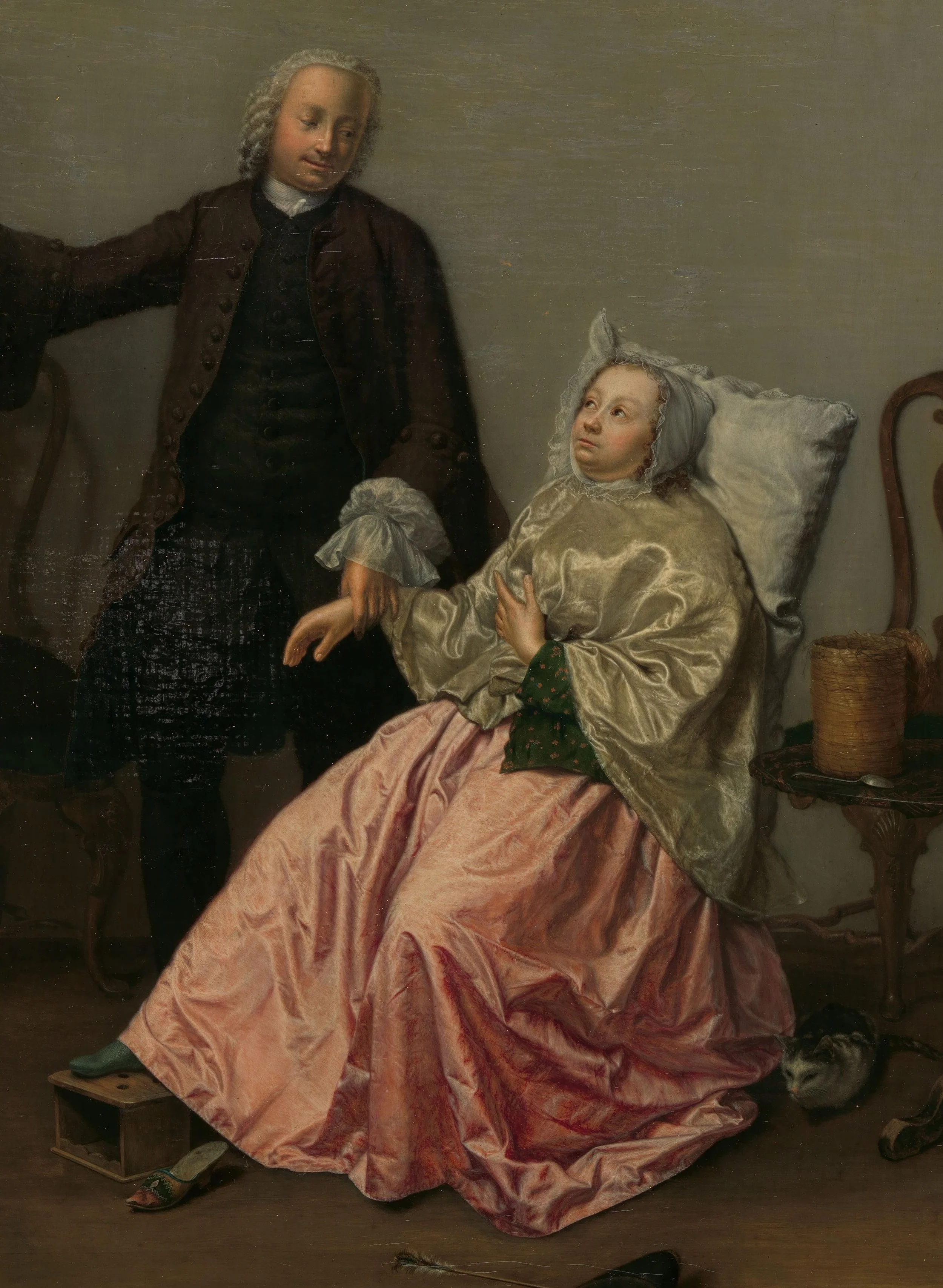
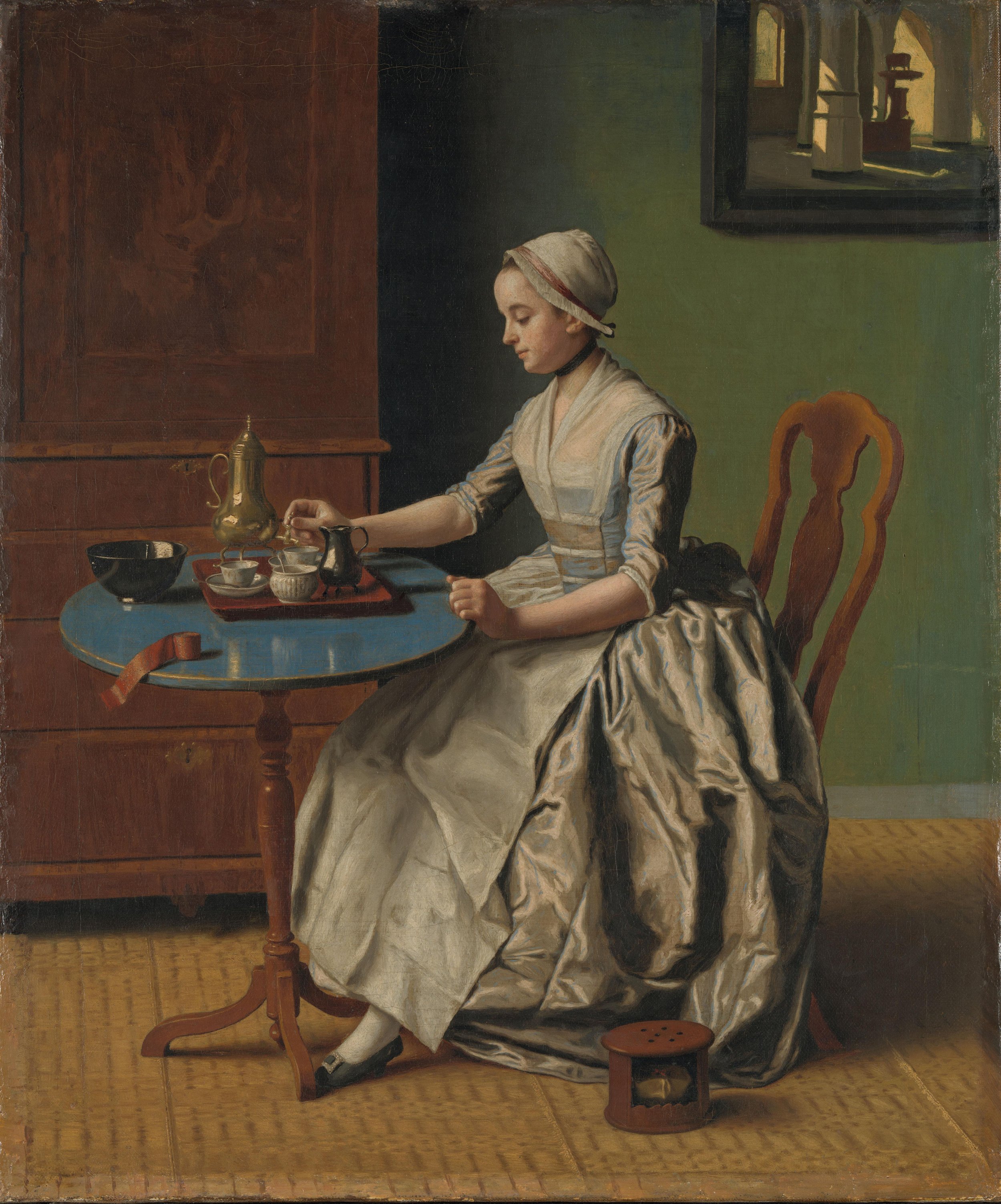
Most of the artwork linked from this section here shows Dutch women using foot warmers, as in these details from paintings by Elisabeth Geertruida Wassenbergh and Jean-Etienne Liotard.