18th Century Linen Clothing
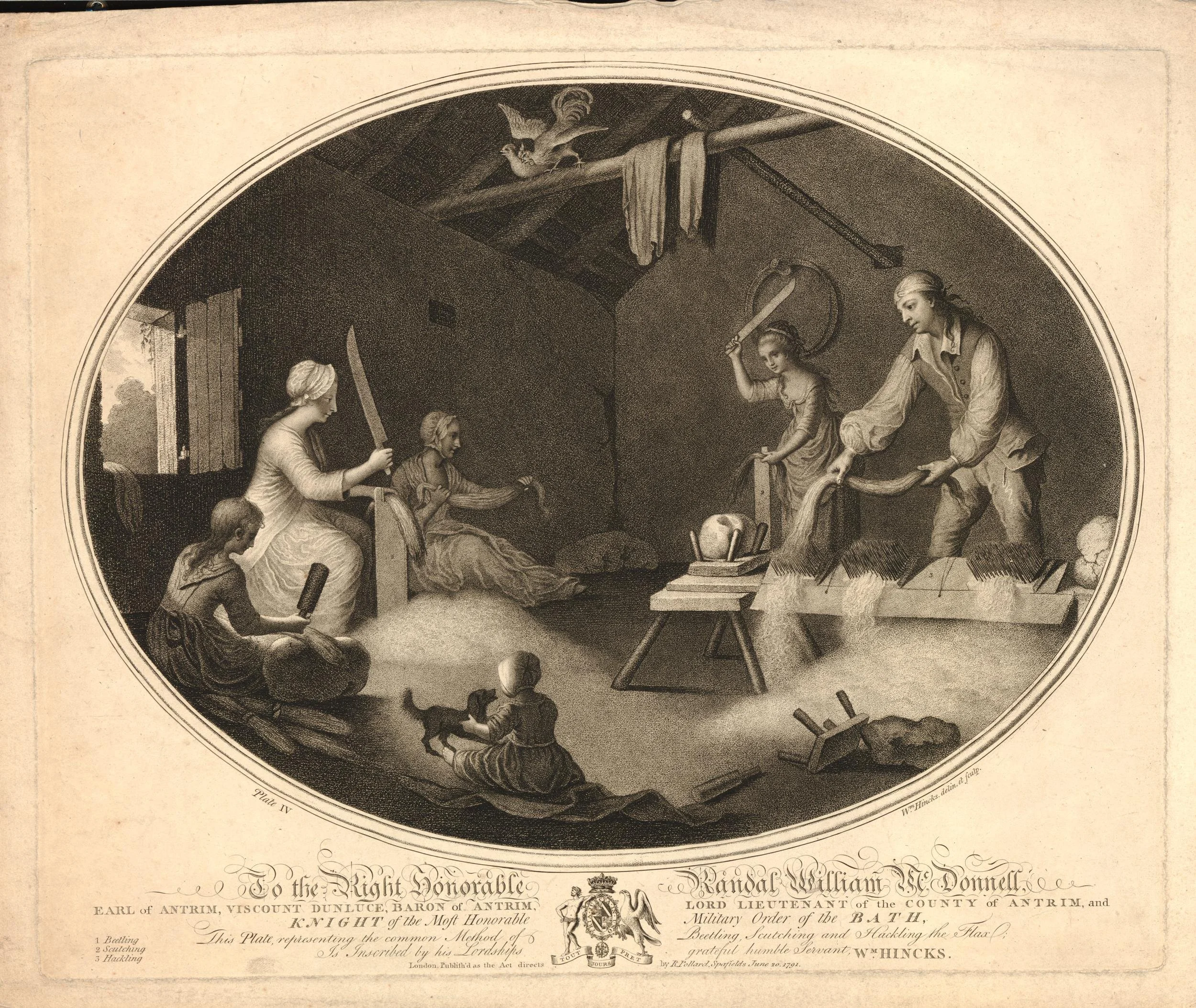
Irish Linen Industry: The common Method of Beetling, Scutching and Hackling the Flax
© The Trustees of the British Museum. Shared under a Creative Commons Attribution-NonCommercial-ShareAlike 4.0 International (CC BY-NC-SA 4.0) licence.
Linen was commonly used for shirts, shifts, functional aprons, and the linings of many other garments (including waistcoats and gowns). Linen is also used as the ground for some embroidered garments and accessories, such as women’s petticoats and pockets. Several women’s waistcoats are made of quilted and/or embroidered linen, too.
Some people recommend linen for re-enactment clothing (especially for outdoor events in hot weather), but others note the relative lack of garments specifically described as being made of linen or the lack of extant garments. See the Additional Resources on this page for some discussion and analysis of descriptions of linen clothing.
This page collects links to extant linen garments from the 18th century, along with references to linen clothing. There are sections on white linen clothing, linen clothing with embroidery, linen clothing with printed patterns, buff or natural linen clothing, solid-colored dyed linen clothing, and checked or striped linen clothing.
Additional Resources
This site contains affiliate links for which I may be compensated
White linen clothing
Etienne Loys’ 1753 portrait of Guillaume Barcellon with a tennis racket probably shows a white linen waistcoat similar to the examples below. An Edinburgh Auction shows James Graham “wearing his accustomed suit of white linen with black stockings.” I suspect Noel Desenfans is also wearing a linen suit.
For more on white linen clothing worn in hot climates, see “For the heat is beyond your conception”: men’s summer dress in the American south during the long eighteenth-century.
MFA 43.672 and 43.673, white linen quilted and corded petticoats, one with a floral design, the other with a Chinoiserie-inspired design, England, early 18th century
National Trust 1349000, a white linen waistcoat decorated with corded quilting; retains one Dorset wheel button; 1720-1740
Historic Deerfield F.075, a white linen waistcoat quilted to shape with corded designs, probably English, 1725-1750
National Trust 1366510.1 & 1366510.2, waistcoat fronts with floral motifs in drawn thread work, some areas with trapunto, 1730-1770
KM 2463, a quilted white linen shortgown from the 1740s from Sweden
National Trust 1349001, a sleeved waistcoat trimmed with whitework down the front and on the hems, possibly German or Scandinavian, 1740-1750
Met C.I.44.8.9a, b, a pair of linen mitts, probably European
Museum Rotterdam 20890-1-2, a pair of white linen mitts
Met 43.130.8, a French waistcoat
Met 21.136.4, a Swiss waistcoat
Augusta Auctions Nov 11 2015 Lot 239, knee breeches in white pinstripe linen, American, 1760-1770
National Trust 1350470, a child’s cream linen gown with the bodice and sleeves lined in heavier linen; neck and sleeves edged with narrow lace; 1770
Connecticut Historical Society 2001.49.6, a small boy’s waistcoat in white plain-woven linen with Dorset buttons, 1770s
Colonial Williamsburg 1993-46, boy’s linen breeches in coarse tabby linen, America (Maine or New Hampshire), 1775-1800
Kelvingrove Art Gallery and Museum 1932.51.o, a cord-quilted linen pet en l’air worn by Mary McDowall of Johnstone Castle in Scotland, made c. 1780-1781
Connecticut Historical Society 1841.5.0, white linen waistcoat worn by Col. William Ledyard when he was killed in 1781; the linen is woven in alternating reversing twilled stripes, the buttons are linen-covered wood. Matching breeches are CHS 1962.43.7.
Colonial Williamsburg 2008-113, a man’s double-breasted waistcoat in white linen with thread-covered white buttons, made in England c. 1780-1800
Henry Ford 35.596.22, a waistcoat, c. 1780-1840
DAR 2389.2, a child’s waistcoat; “Main fabric is a damask with a geometric pattern, while white plainweave linen is used to line the front facing. Two 1" deep pockets; standing collar. Closes with four sets of white cotton tapes all the way to the collar,” probably c. 1790
Met 1988.342.3, linen trousers made in Europe c. 1793
Henry Ford 96.0.171.42, a jacket, c. 1800
Met 2009.300.1685a, b, a pair of linen mitts made in America c. 1800-1824
References to white linen clothing (other than shirts, shifts, aprons, etc.)
“a white Linen Jacket” (Boston Evening Post, July 6, 1752)
“white Linen long Breeches” (Virginia Gazette, October 27, 1752)
“a Pair of white Linen Breeches” (Virginia Gazette, October 17, 1755)
“a white Linen Waist-coat” (Maryland Gazette, August 20, 1761)
“Carried with her a white Linen Jacket, ruffle cuffed, a Petticoat of the same” (Maryland Gazette, August 8, 1762)
“a short white linen sack, petticoat of the same” (Virginia Gazette, April 25, 1766)
“2 linen jackets, 1 white and 1 striped” (New-York Gazette, July 27, 1772)
“a white Linen Coat” (Virginia Gazette, July 1, 1773)
“a pair of white linen trowsers” (Pennsylvania Gazette, August 10, 1773)
“a white linen jacket without buttons” (Virginia Gazette, July 21, 1774)
Galerie des Modes, 7e Cahier, 4e Figure, 1778: “The Print shows a Lady of quality, walking in the country, dressed in a demi-polonaise with a simple tail. The petticoat and the tail are of white linen, of which the trim and flounce, which are very inconvenient while walking, were replaced with bands of fabric painted with borders.”
“two short gowns (or bed-gowns) one of white linen” (Maryland Journal and Baltimore Advertiser, May 4, 1779)
“SARAH DANIEL … had on a cotton petticoat and white linen waistcoat” (Virginia Gazette and General Advertiser, January 12, 1791)
“a homespun white linen jacket” (North Carolina Gazette, September 24, 1791)
“white linen overalls” (The City Gazette, December 12, 1791)
“a white linen coat and jacket” (Virginia Gazette and General Advertiser, January 18, 1792)
“white linen overalls” (Virginia Gazette and General Advertiser, January 25, 1792)
“overhawls white, and white linen breeches” (The City Gazette, June 23, 1792)
“white linen wrapper” (The City Gazette, August 27, 1794)
“a suit of coarse white linen” (The City Gazette, September 12, 1797)
Embroidered linen clothing
Many embroidered petticoats and embroidered pockets also use a linen ground.
Met 45.49, a sleeved linen waistcoat, British, early 18th century
LACMA M.80.43.4a-b, a pair of mitts in linen with silk embroidery, probably made in India for the Western market, 1700-1725
Kunstmuseum Den Haag 0150867, fine linen mitts embroidered with black silk
Met 1993.17a, b, an embroidered dress, Italy, 1725-1750
Met C.I.66.34, an embroidered robe à l’anglaise, British, 1725-1750
Met 54.124, a child’s dress, linen embroidered with wool, American, mid-18th century
Museum Rotterdam 20837-A-B, a pair of linen mitts with tambour embroidery in silk
Met 42.188.2, a linen petticoat embroidered with crewel wool in New England, c. 1750
KM 67871.2, white linen robe à l'anglaise with blue embroidery, c. 1750-1799
Fries Museum T01193, a pair of white linen mitts with blue embroidery, c. 1750-1799
Connecticut Historical Society 1978.104.0, a small boy’s sleeved waistcoat with crewel embroidery, 1758-1760
National Trust 1350246, a boy’s waistcoat, 1760-1770; probably homespun twilled linen, lined with a coarser twilled linen and embroidered in silks
National Trust 1365653.1, an embroidered linen dress, c. 1770
Kerry Taylor Auctions Dec 12 2016, Lot 40, an embroidered linen open robe, English, 1770s
KM 678712.2, a robe à l’angalise in a cotton-linen blend, embroidered with blue cotton, 1770s
Met 1998.314a, b, a robe à la polonaise in heavy linen with floral appliqués outlined in sequins, made in Britain c. 1780
V&A 184-1898, “a woman's gown of linen tamboured in an all-over pattern of serpentine trails with flowers and leaves in shades of pink, green, yellow and red, with additional herringbone stitch,”, possibly embroidered and made in the 1770s and then remade in the 1780s
Philadelphia Museum of Art 1991-75-27, a tan linen waistcoat with silk embroidery, late 18th century
Met 2010.156, an embroidered linen skirt, British, late 18th century
Meg Andrews 8327, a linen embroidered waistcoat with tambour embroidery in a guilloche design, 1790s
Printed linen clothing
From Identifying Printed Textiles in Dress 1740-1890:
a) Because of linen manufacture being a home industry, printed linens like fustians were not subject to the prohibition of 1722 to 1774. Nevertheless, relatively few printed linen garments survive to represent this period. By 1770, linens were being printed in the regions of London, Manchester, Carlisle, Glasgow and Dublin. Scottish printers appear to have made a speciality of handkerchiefs, but the distribution of garment printing of linens has not yet been studied.
b) Printed linens enjoyed wide sales in both the home and export markets. That printed linens gained some measure of fashionability is demonstrated by examples in the Barbara Johnson album, in which both plate-printed and block-printed examples occur. Printed linens gained an association with country wear that was well developed by the 1780s. In a novel of 1789, the heroine disguises herself “as country lass, in a fine flowered linen gown, pink petticoat, straw hat, and white cloth cloak…” [Bennett, Agnes Maria. Agnes de-Courci, a domestic tale. Bath, 1789, p.206]. Another country maiden attired for a rustic fête wears “a little straw-hat, lined with pink, and a flowered linen gown, tied with ribbons of the same colour, and pinned back to shew a pink petticoat…” [Keate, George. Sketches from nature; taken, and coloured in a journey to Margate. London, 1790, p.121.]
c) Linen is not an easy fibre to print, and it is more difficult to obtain the same depth of shade as on cotton. This may be why it is usually found printed with simpler colour effects than cotton. Madder colours were often used as these could withstand the laundering (bucking with alkalis) that linens were expected to endure.
Morphy Auctions Lot 1186, a woman’s short gown made from block-printed linen possibly produced c. 1730-1740, “the ground of the fabric now an ivory color and the printed floral devices with black (now brown) outline work, leaves and petals colored in green and pinkish red, respectively”
National Trust 814614.11, a doll’s gown in linen block printed in red with leaf, bird foot, and triple-dot design, 1740-1760
In Fitting & Proper: “Woman’s gown, c. 1740-60, altered c. 1775-80, an open robe in beige linen, block printed in two shades of brown, lined with beige linen and with blue and white checked linen”
Fries Museum T1957-450, a house dress or contouche in white linen printed with a red design, c. 1750-1799
Centraal Museum 11020, a girl’s caraco in ivory-colored linen printed with a sprinkled pattern of red and blue flowers, lined with white linen, c. 1750-1775
Met C.I.37.2, a coat (bedgown), American, third quarter of the 18th century
Historic New England 1998.5875, dress with blue copperplate printed floral pattern on cream ground, worn by Deborah Sampson, 1760-1790
Printed linen waistcoat, c. 1765-1770; “This waistcoat is lined in fine linen or cotton, and has two slightly different patterns on the front and back. It is closed with self covered buttons and welted buttonholes. The absence of pocket bags under the flaps suggest that perhaps this was a casual waistcoat for wear with a banyan and matching cap.”
Chertsey M.1989.13, “white linen open robe block printed with bamboo and flowering branches design in rose madder, brown and blue,” c. 1770-1773
KCI AC7621 92-34-2AB, robe à la française in white glazed plain-weave linen with a blue floral print, France, 1770s
Manchester 1970.199, a white linen dress “White linen, block printed in spaced pairs of narrow lilac stripes with related pattern of sprigs and a light scattering of smaller sprigs inbetween in red, yellow and brown. The sprigs are 'pencilled' by hand.” See also Identifying Printed Textiles in Dress 1740-1890.
Met 26.265.48, a quilted petticoat in linen with two different printed designs, France, late 18th century
Centraal Museum 14571, a jacket for an infant in printed linen, c. 1775
Fries Museum T1956-436, a printed linen handkerchief, c. 1775-1799
V&A T.219-1966, a lady’s swallowtail jacket made of “linen printed in a repeating pattern of floral sprigs,” France, 1780s
V&A T.230-1927, a gown in block-printed linen, England, 1780s
From Fitting & Proper: Woman’s shortgown, c. 1780-1800, “brown and off-white figured print cotton, lined with off-white linen and with brown and off-white floral printed linen in the sleeves”; also a woman’s underpetticoat, c. 1780-1800, “an off-white linen petticoat trimmmed with bands of two different brown and off-white linen floral prints, one on the inside of the hem and one on the outside”
Text references to printed linen clothing
“a flowered linen bed gown, with the flowers wash’d almost white … a common India linen gown, black and redish brown spotted figure” (The New York Journal, July 30, 1772)
“Whereas Thomas Searl ... committed to the common goal at Bodmin … The ſaid Thomas Searl … wears a white ruſty wig, with a pale blue coat, flowered linen waiſtcoat, and an old claret-colour breeches.” (The Western Flying Post; or, Sherborne and Yeovil Mercury, November 23, 1772)
“Ran away from his maſter, Arthur Maddick, of Brixham, fiſherman, Thomas Thorn, his apprentice ... wore, when he went off, a reddiſh colour beaver coat, a flowered linen waiſtcoat, and a pair of black pluſh breeches.” (The Western Flying Post; or, Sherborne and Yeovil Mercury, October 18, 1773)
“a Negro Woman, named RACHEL … had on when she went away … a blue and white flowered Linen Waistcoat” (Virginia Gazette, February 10, 1774)
“the houſe of Phillip Jenkyn, inn-keeper, in Bodmin, was feloniouſly broke open … from which there was found wanting the next morning … a flower’d linen gown, with ſprigs of red, blue, and purple; the ruffle cuffs belonging to the ſame were left behind: what is remarkable, the gown had been lately lengthened.” (The Western Flying Post; or, Sherborne and Yeovil Mercury, July 4, 1774)
“blue and white ſtamped linen [jacket and petticoat]” (The Pennsylvania Evening Post, October 19, 1776)
“the petticoat is trimmed with a sprigged linen flounce gathered in pipes” (Galerie des Modes, 16e Cahier, 1ere Figure, 1778)
“Deserted from a recruiting party of his Majeſty’s ſeventh, or Queen’s regiment of dragoons, James White … had on when he went away a light fuſtian frock, plain cocked hat, with a cockhade and red feather, flowered linen waiſtcoat, and fuſtian breeches.” (The Gloucester Journal, October 26, 1778)
“a flowered linen apron matching the trim of the Caraco … Her pleated caraco, or caraco à la Française, is trimmed with a large band of linen, with a matching petticoat trimmed with an ample volant, and over it an apron, also of flowered linen, with trimmed and drawstringed pockets.” (Galerie des Modes, 17e Cahier, 6e Figure, 1779)
“a printed linen waistcoat” (Virginia Gazette or American Advertiser, October 30, 1784)
“Whereas Mr. Stephen Waream’s Wife eloped on the the 27th of October … had on and carried away … a flowered linen gown” (Salisbury Journal, November 10, 1788)
The Instructions for Cutting Out Apparel for the Poor (1789) recommends the use of printed linen fabric when making tippets and bedgowns for child-bed linen
“her child had on a red printed linen frock” (The City Gazette, January 5, 1796)
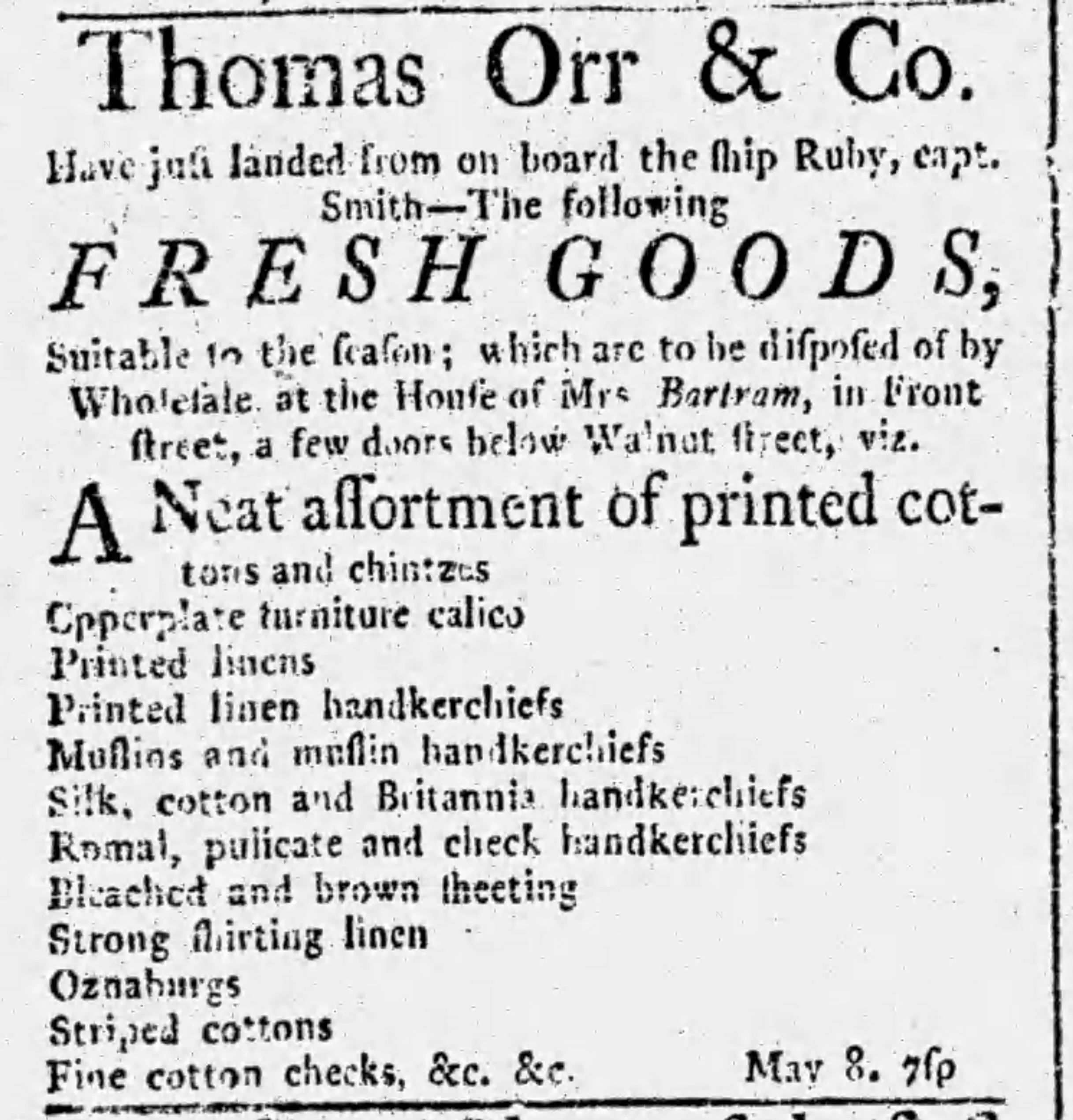
Several newspaper advertisements describe printed linen fabrics and handkerchiefs, such as this advertisement from Poulson’s American Daily Advertiser, May 10, 1787
Clothing made from buff or natural linen (probably undyed & unbleached)
V&A T.184 to C-1961, a boy’s suit of buff linen, c. 1780
MFA 43.1968a-b, a pair of light brown linen mitts
Kerry Taylor Auctions Dec 8 2009, Lot 71, gentleman’s country coat in beige linen, c. 1800
Solid-colored dyed linen clothing in colors other than white
Fries Museum T11025, an apron in blue linen damask, c. 1700-1749 (see also: blue aprons)
V&A T.962-1919, a brown fustian twill coat with pewter buttons, made in England c. 1750-1765
Boy’s breeches, c. 1760-1770, in Fitting & Proper: “brown linen twill or fustian, lined with off-white linen”
Newport Historical Society 99.3.87, c. 1775; “Brown Quaker girl's dress with coarse linen lining. Yellowed fine muslin ruffles at neck and cuffs. Tan 1/4 in. trim around neck. Relatively large (3/4 in. deep) cartridge pleats on waist of skirt. Three decorative pleats on cuff. 2 in.wide sashes (robings) hang from shoulder to waist. Initials "DE" written on PL of neck muslin decorations. Tucks on back of bodice run from neckline to waist in a "V" shape.”
Kerry Taylor Auctions Dec 12 2006, Lot 113, an infant’s brown linen frock coat with a pink linen lining, c. 1780
Connecticut Historical Society 1981.110.0, a boy's jacket in brown linen with pewter buttons, Connecticut, c. 1775-1785
Augusta Auctions Nov 13 2013 Lot 194, middle class man’s day suit, brown linen dyed with butternuts, Rhode Island, 1780s; Henry Ford 2013.136.1, a man’s suit in brown linen, made in Massachusetts or New Hampshire c. 1780-1790
National Trust 355933, a dark brown linen day dress with a small peplum, trimmed with pale blue silk ribbon, 1790
Monmouth County Historical Association 3042.1, a pair of brown linen mitts, c. 1790
Landesmuseum Württemburg 1992-179 a,b, a boy’s linen suit, France, c. 1790
Additional Resources
Of Dying Flax and Linnen, A Perfect Diſcovery of the Art of Dying (1705)
Text references to linen clothing in colors other than white
The predominant color in the text references – as in the extant examples above – is brown. However, “brown linen” may also refer to unbleached linen, like the natural/buff colored linen garments listed elsewhere on this page.
See also the blue aprons notebook page for additional references & depictions relating to blue linen aprons.
Neal Hurst, associate curator of costume and textiles at the Colonial Williamsburg Foundation, writes:
In Williamsburg the 2nd Virginia regiment is having their osnaburg hunting shirts dyed purple: “It is Expected that each Capt. will with all Expedition Provide Legins for his men & hunting shirts Dy’d of a purple Coulour…” (Orderly Book of the 2d Virginia Regiment, October 27, 1775)
If we continue on the hunting shirt trend, of which are generally made of linen for the continental army: In 1776, a German officer who faced American soldiers at the Battle of Long Island, described them wearing “black, white, and purple linen blouses”
Bernhard A. Uhlendorf, Revolution in America: Confidential Letters and Journals 1776-1784 of Adjutant General Major Baurmeister of the Hessian Forces (New Brunswick: Rutgers University Press, 1957), 38.
American artist Charles Willson Peale also described a multitude of colors worn on hunting shirts in the Philadelphia area and claimed that “very often these shirts were dyed brown – yellow, pink, and blue black, any colour according to the fancy of the companies.”
Jules David Prown, Art as Evidence: Writing on Art and Material Culture (New Haven: Yale University Press, 2001), 170. [This page is viewable via Google Books.]
The backcountry traveler John Smyth also claimed that its inhabitants chose a wide variety of color and said “Their hunting, or rifle shirts, they have also died in a variety of colours, some yellow, others red, some brown, and many wear them quite white.”
John Ferdinand Smyth Stuart, A Tour of the United States of America (Dublin: Printed by G. Perrin, 1784), 116. [You can also read this in The English Review or The Scots Magazine.]
For more of his research on hunting shirts, see “kind of armour, being peculiar to America”: The American Hunting Shirt.
“The Regimentals or Cloathing for the private Men are to be Camblet Coats, Brown Linen Waiſtcoats, with two Pair of Canvas Trouzes for each Man.” (Quadriennium Annae Postremum, Or, The Political State of Great Britain, 1740)
“3 Pair of brown Linen [Trowsers]” (Virginia Gazette, September 26, 1745)
“a Pair of brown Linen Trowsers” (Virginia Gazette, August 7-14, 1746)
“brown Linen Trowsers” (Virginia Gazette, May 9, 1751)
“a Pair of brown Linen Trousers” (Virginia Gazette, June 18, 1752)
“a coarse brown linen waistcoat” (The New-York Gazette, August 8, 1765)
“a short brown linen jacket” (Virginia Gazette, June 27, 1766)
“The cloathing of the negroes (the houſhold ſlaves excepted) is ſcarce ſufficient to anſwer the demands of modeſty. Several modern compilerso f the hiſtory of our Weſt-India ſettlements have enumarated ſtockings and ſhoes among the articles of cloathing for the negroes, though nothing could more certainly betray their ignorance of this ſubject, ſince a ſlave in ſtockings and ſhoes, in theſe countries, would be as uncommon a ſpectacle, as a negro inſtructed in the principles of Chriſtianity; and if any of them have either ſhirts, breeches, or petticoats, they are the produce of their own private induſtry, as their maſters furniſh only a piece of coarſe blue, or brown linen, which is applied to the middle in both ſexes, and a blanket, with which the ſlave covers himſelf at night, ſleeping on boards only.” (“The unhappy State of Slaves in Berbice [Guyana],” The London Magazine, 1769)
“a pair of short brown linen breeches” (Virginia Gazette, June 21, 1770)
“a pair of new brown linen breeches” (Virginia Gazette, June 21, 1770)
“a brown linen [coat]” (Virginia Gazette, January 10, 1771)
“one brown Linen Coat” (Virginia Gazette, August 22, 1771)
“short brown Linen Breeches” (Virginia Gazette, September 10, 1772)
“brown linen waistcoat” (The New-York Gazette, July 5, 1773)
“had on a brown linen jacket and petticoat” (Virginia Gazette, August 4, 1774)
“had on a brown linen coat” (Virginia Gazette, August 11, 1774)
“a Yallow Linnen under Waiſtcoat Otter colour” (Connecticut Journal, September 9, 1774)
“had on when she went away a brown linen jacket and petticoat” (Virginia Gazette, January 12, 1775)
“Voltaire’s Dress. ‘On the two days I saw him, he wore white cloth shoes, white woolen stockings, red breeches, with a night-gown and waistcoat of blue linen, flowered, and lined with yellow. He had on a grizzle wig with three ties, and over it a silk night-cap embroidered with gold and silver.” (History of Friedrich II of Prussia, April 1776; H/T Jennifer Heim)
“a brown Linen Jacket” (The New-York Gazette, July 15, 1776)
“one brown and one white Linen Waistcoat, one brown Linen Breeches” (The New-York Gazette, July 29, 1776)
“brown linen trowsers” (The New-York Gazette, October 14, 1776)
“a Pair of brown Linen Trousers” (Virginia Gazette, May 2, 1777)
“a pair of brown linen breeches” (Virginia Gazette, July 10, 1778)
“four under jackets, two of them striped, one brown linen, the other brown broad cloth” (Connecticut Gazette, July 6, 1781)
“two pair of old brown linen Trowsers” (Connecticut Courant, November 19, 1782)
“a pair of brown linen breeches” (Connecticut Courant, June 3, 1783)
“a brown linen short Coat, Jacket and Breaches … brown linen Jacket in Breaches” (Connecticut Courant, July 8, 1783)
“brown Linen outside Jacket” (Middlesex Gazette, September 12, 1789)
“brown linen overalls” (Virginia Herald and Fredericksburg Advertiser, December 3, 1789)
“a pair of brown linen trowsers” (Virginia Herald and Fredericksburg Advertiser, November 4, 1790)
“one new pair linen [trowsers] colour’d yellow” (Connecticut Journal, July 25, 1792)
“brown linen overalls” (Virginia Herald and Fredericksburg Advertiser, July 4, 1793)
“a pair of yellow linen overalls” (Connecticut Gazette, September 3, 1795)
“At eight in the morning we go in diſhabile to the pump-room, which is crowded like a Welſh fair; and there you ſee the higheſt quality and loweſt tradesfolks, joſtling each other, without ceremony, hail fellow, well met … The ladies wear jackets and petticoats of brown linen, with chip hats, in which they fix their handkerchiefs to wipe the ſweat from their faces; but, truly, whether it is owing to the ſteam that ſurrounds them, or the heat of the water, or the nature of the dreſs, or to all theſe cauſes together, they look ſo fluſhed, and ſo frightful, that I always turn my eyes another way.” (The Miscellaneous Works of Tobias Smollett, M. D., 1796)
“a shirt and overalls of brown linen” (Virginia Gazette and General Advertiser, September 24, 1796)
“Had on when she eloped a blue striped Virginia cloth Jacket and brown linen petticoat” (The Times; and District of Columbia Daily Advertiser, August 7, 1799)
“a pair of short brown linen trowsers” (Virginia Gazette and General Advertiser, August 27, 1799)
Striped or checked linen clothing
V&A T.355-1984, a man’s double-breasted waistcoat in green and white striped linen, Britain, 1750s
Historic Deerfield F.235, a striped linen (or linen/cotton) shortgown, America, c. 1750-1800
V&A T.6-1985, a man’s coat in checked linen with a blue weft and white warp, probably made in France. 1755-1765
Rhode Island Historical Society 1959.6.1, a child’s double-breasted coat in cream and blue vertical stripes, worn about 1762 by William Battey in Scituate, Rhode Island; see also One for the Little Boy
Fries Museum T1957-410, a petticoat in a checked linen fabric with brown and pinkish-white stripes, with a band of blue and white checked linen at the top, c. 1775-1799
A striped linen waistcoat worn by Col. Joseph Noyes during the Battle of Rhode Island (Rhode Island Historical Society 2013.42.1)
Obadiah Mead’s jacket, 1779
Cooper Hewitt 2016-35-87, a pair of pockets in linen with thin brown and white stripes, made in America c. 1775-1825
Met C.I.40.159.4, a pocket made in America in 1789, brown linen with thin white and blue stripes
Connecticut Historical Society 1988.7.1, a striped shortgown made of plain-woven linen with narrow blue and white warp and blue weft, Connecticut, c. 1790-1800
Met 1997.508, a summer double-breasted cutaway coat in checked blue linen, America, c. 1815
Text references to checked or striped linen clothing (other than shirts or aprons)
“striped Linen Breeches” (Boston Evening Post, July 24, 1738)
“a double breasted Linen striped Jacket” (Boston Evening Post, August 25, 1746)
“WHESEAS Elizabeth the Wife of Mr. Lambart, of Deddington in Oxfordſhire, Glover, hath eloped form her ſaid Huſband … had on when ſhe went away a light colour’d Camblet Gown, a black Beaver Hat, a ſpotted Silk Handkerchief, and a ſmall Hoop; but ſhe had with her a blue and white ſtrip’d Linnen Gown" (Jackson’s Oxford Journal, June 15, 1754)
“a striped Linen Gown” (The Pennsylvania Gazette, September 29, 1757)
“WHereas William Whittle, apprentice to Abraham Brodhurſt, Frame-work-knitter, abſconded from his Maſter’s Service … had on when he went away an old Frize coat, with white mettle buttons; and an old Strip’d Linnen waiſtcoat, a pair of leather breeches almoſt new, a pair of old black ſtockings, and a bad pair of ſhoes.” (Leicester Journal, and Midland Counties General Advertiser, April 26, 1760)
“a striped Linen Bed gown” (The Pennsylvania Gazette, September 23, 1762)
“a striped linen under jacket” (Connecticut Courant, August 19, 1765)
“dark check’d linen long Trowsers” (Connecticut Courant, July 20, 1767)
“John Bryn, an Irishman … had on … striped linen trowsers … John Milighen … had on … striped linen jacket” (The Pennsylvania Gazette, October 15, 1767)
“a strip’d cotton and linen Jacket with the stripes downwards” (Boston Post-Boy, December 21, 1767)
“two pair … striped linen [trowsers]” (The Pennsylvania Gazette, July 21, 1768)
“one blue and white striped Linen [Gown]” (Connecticut Gazette, June 10, 1768)
“one pair of check linen trowsers” (Virginia Gazette, August 4, 1768)
“a pair of check linen trousers” (Virginia Gazette, August 4, 1768)
“a striped linen gown” (The Pennsylvania Gazette, September 15, 1768)
“striped linen trowsers” (The Pennsylvania Gazette, November 3, 1768)
“a Pair of new long striped Linen Trowsers” (The Boston News-Letter, March 28, 1771)
“striped linen trowsers” (The Pennsylvania Gazette, June 13, 1771)
“one white striped lappel’d linen vest … striped new linen blue and white short gown” (Connecticut Courant, July 2, 1771)
“a pair of linen trowsers, striped with blue” (The Pennsylvania Gazette, May 28, 1772)
“2 linen jackets, 1 white and 1 striped” (New-York Gazette, July 27, 1772)
“took with her a blue and white small striped linen gown” (The New York Journal, July 30, 1772)
“a pair of linen striped blue and white trowsers” (The New-York Gazette, October 12, 1772)
“a strip’d linnen [Gown]” (Connecticut Gazette, May 28, 1773)
“a striped Linen Vest, with Sleeves, the Stripes going round his Body” (Philadelphia, July 7)
“a striped linen jacket, filled with blue” (Pennsylvania Gazette, August 10, 1773)
“a stript linnen waistcoat” (Connecticut Courant, September 28, 1773)
“a striped linen jacket” (The Newport Mercury, May 30, 1774)
“one pair strip’d linnen trowsers” (Connecticut Courant, June 21, 1774)
“one pair check’d linen trowsers” (Connecticut Courant, August 9, 1774)
“an old homespun blue and white striped linen jacket with sleeves” (The New-York Gazette, September 11, 1775)
“check’d linnen trowsers” (Connecticut Courant, November 6, 1775)
“a pair of striped linen [breeches]” (The New-Jersey Gazette, December 31, 1777)
“a striped tow and linnen gown” (Connecticut Courant, May 12, 1778)
“a striped linen short gown” (The New-Jersey Gazette, May 13, 1778)
“RAN AWAY from the ſubſcriber, living in Second ſtreet, near the corner of Arch-ſtreet, Ann Coffin, an indented ſervant girl, eleven years of age, ſlender made, black hair, and very talkative: Had on when ſhe went away, which was on Monday morning laſt, a ſhort linen check gown, green petticoats, and a cloth coloured cloack.” (Poulson’s American Daily Advertiser, November 3, 1778)
“a Linen striped under Jacket” (The Providence Gazette, August 7, 1779)
“a striped linen jacket with sleeves” (Connecticut Journal, July 26, 1781)
“a striped linen Coat” (Connecticut Courant, November 12, 1782)
“one pair of striped linen [trowsers]” (Connecticut Courant, November 19, 1782)
“a striped linen Coat and Vest” (Connecticut Courant, January 7, 1783)
“a blue and white striped Linen Jacket” (The Royal Gazette, November 5, 1783)
“a striped linen double breasted Jacket, with a belt” (Connecticut Courant, January 6, 1784)
“a new red striped linen coat, a new jacket nearly the same” (Virginia Journal and Alexandria Advertiser, August 12, 1784)
“one pair striped linen trowsers” (Connecticut Gazette, July 22, 1785)
“1 striped linnen Waistcoat” (The Independent Chronicle and the Universal Advertiser, July 28, 1785)
“striped blue and white linen jacket” (Virginia Journal and Alexandria Advertiser, October 20, 1785)
“striped Linen Trowsers” (Connecticut Journal, September 20, 1786)
“a striped Linen Gown” (The Providence Gazette, August 25, 1787)
“a striped blue and white Linen Coat and Waistcoat” (The Providence Gazette and Country Journal, September 13, 1788)
“one pair check linen trousers” (Connecticut Courant, November 22, 1790)
“a white and blue striped linen petticoat and jacket” (The City Gazette, June 9, 1791)
“striped Linen Trowsers” (Connecticut Courant, November 12, 1792)
“a blue and white striped linen wrapper” (The City Gazette, March 20, 1795)
“one striped linen vest homemade” (Connecticut Courant, July 25, 1796)
“a pair of striped linen trowsers” (Connecticut Journal, June 13, 1798)
“one pair striped linen [overhalls]” (Western Star, June 1, 1801)
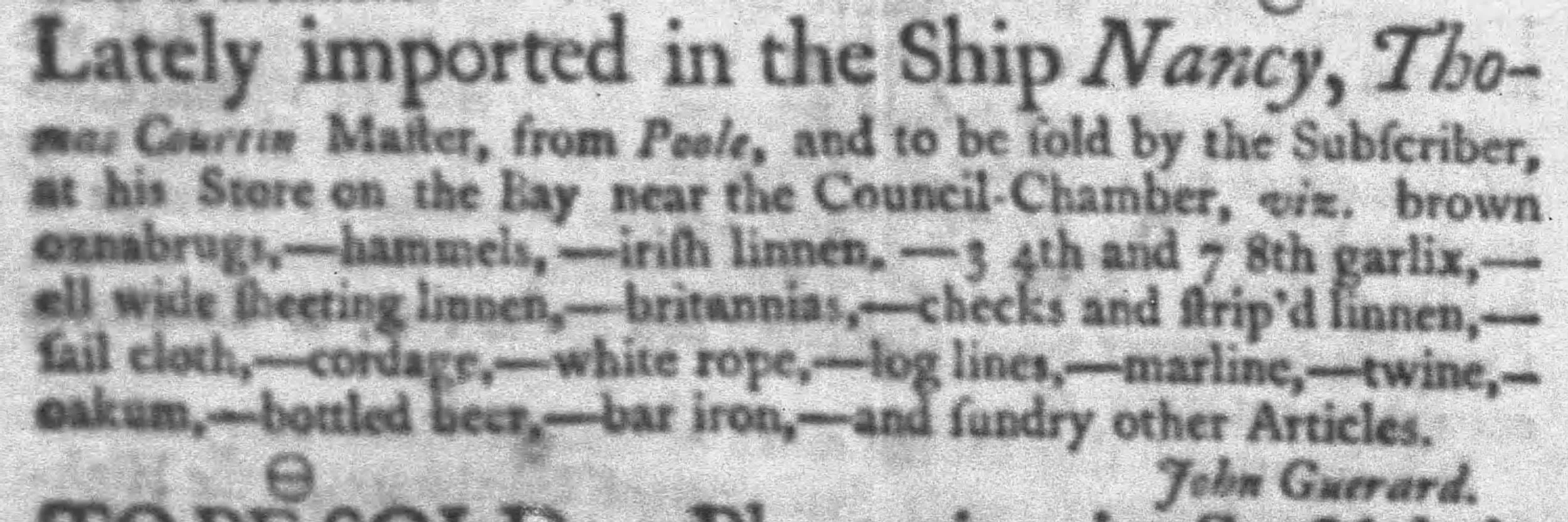
These fabrics also appear in 18th century advertisements; here, “checks and ſtrip’d linnen” appear in a list of imported goods in The South-Carolina Gazette, May 16, 1748